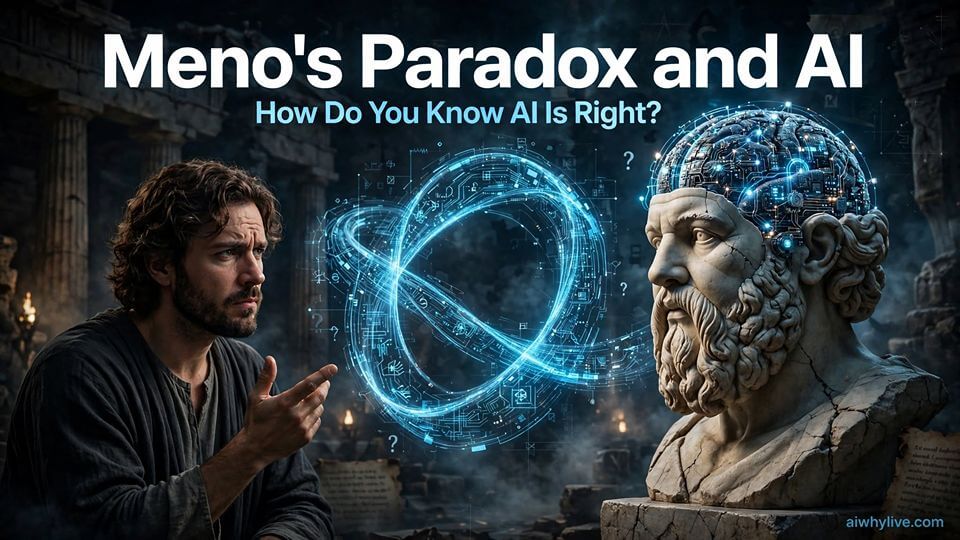
Meno's Paradox Just Got Wi-Fi: What AI Changes About Knowing
You open an AI chatbot.
You type:
"Explain quantum computing."
AI explains it.
Excellent.
But how do you know the explanation is correct?
You don't understand quantum computing.
That's why you asked.
So you ask AI:
"Are you sure?"
AI replies:
"Yes."
Excellent.
Now you have two answers from the same machine.
😂
Welcome to one of the oldest problems in philosophy.
Except now it has a chatbot.
But if you know absolutely nothing about the subject...
how do you know whether AI's beautiful answer is right?
Meno's Paradox is more than 2,000 years old.
Artificial intelligence may have just made it an everyday problem.
🧠 AIWhyLive Explains: What Is Meno's Paradox?
Meno's Paradox, also known as the Paradox of Inquiry, asks how a person can search for knowledge they do not already possess.
In Plato's dialogue Meno, Meno challenges Socrates with a philosophical problem.
If you already know what you are searching for, why search?
You already know it.
But if you don't know what you are searching for, how will you recognize it when you find it?
That creates the paradox.
If you don't know the answer, how can you recognize the correct answer when it appears?
Imagine I tell you:
"Find a flibbertigloop."
You ask:
"What's a flibbertigloop?"
I answer:
"I'm not telling you."
Okay.
You search the room.
You find a pencil.
Is that a flibbertigloop?
You don't know.
You find a chair.
Maybe that's one.
You find my missing sock.
Could be.
The problem isn't simply finding the answer.
You may not possess enough knowledge to recognize the answer.
More than two millennia later, that problem suddenly sounds suspiciously like using AI.
How Does Meno's Paradox Apply to Artificial Intelligence?
Meno's Paradox applies to AI because people often use artificial intelligence precisely when they lack enough knowledge to answer a question themselves.
But that same lack of knowledge can make it difficult to judge whether the AI response is accurate, incomplete or wrong.
That is the AI-era version of the paradox.
You ask AI because you don't know.
AI answers.
Now you must decide whether to believe the answer.
Using what?
Your knowledge of the subject?
But your lack of knowledge was why you asked AI.
And suddenly Meno's ancient problem has Wi-Fi.
Then Along Came the Answer Machine
For most of history, Meno's Paradox was an interesting philosophical problem.
Then humanity invented machines into which ordinary people can type practically any question.
Medicine.
Law.
Programming.
Physics.
Finance.
History.
Relationships.
Car repair.
Nutrition.
Philosophy.
Why your washing machine sounds like it's attempting to escape.
Anything.
Suddenly billions of people potentially have access to extraordinarily powerful question-answering technology.
That creates an enormous opportunity.
And an enormous problem.
But the less you know about something, the less equipped you may be to recognize when AI gets it wrong.
🍗 Lechon Manok: The AI Verification Method
Human:
"AI, what's the answer?"
AI:
"42."
Human:
"I don't know anything about this subject. Is 42 definitely correct?"
AI:
"Yes."
Human:
"How do I know you're correct?"
AI:
"You can verify it."
Human:
"How?"
AI:
"Research the subject."
Human:
"If I knew how to research and verify the subject, why did I ask you?"
AI:
"That's an excellent question."
Human:
"Don't start."
😂
Meno would have loved this.
Why Wrong AI Answers Can Be Difficult to Recognize
AI does something psychologically different from a traditional search engine.
A search engine usually gives you links.
You still have to decide what to open.
You read.
You compare.
You evaluate.
Generative AI can instead give you something that feels much more complete:
an answer.
Usually clearly written.
Confidently presented.
Organized beautifully.
Sometimes with headings.
Maybe bullet points.
Perhaps a table.
Possibly even citations.
The response can feel finished.
And that matters.
A bad answer written beautifully can invite belief.
Modern AI systems can produce inaccurate information, unsupported claims or fabricated details while presenting them fluently.
This is why AI literacy cannot simply mean:
Knowing how to prompt AI.
It must also include:
Knowing when the answer requires verification.
🐘 Elephant in the Room: What Happens When AI Becomes Almost Always Right?
Here's where Meno's Paradox becomes even more interesting.
Suppose an early AI system is correct 70% of the time.
You quickly learn to distrust it.
Then AI improves.
90%.
You trust it more.
95%.
More.
99%.
Fantastic.
But now think about the remaining 1%.
The machine has trained you through thousands of successful interactions to expect correctness.
Then one day it gives you something wrong.
Not ridiculous.
Not obviously false.
Plausibly wrong.
Beautifully written.
Perfect grammar.
Logical structure.
Professional tone.
Perhaps citations.
And you're asking about something you know almost nothing about.
How do you recognize the mistake?
It may be very good AI that is occasionally wrong.
The better AI becomes, the more valuable its answers become.
But the more reliable AI becomes, the easier it may also become for humans to stop checking those answers.
Unknown Unknowns May Be the Bigger AI Problem
There are things you know.
There are things you know you don't know.
And then there are things you don't know that you don't know.
AI is extremely useful for the second category.
You know nothing about PHP?
Ask AI to explain it.
You don't understand compound interest?
Ask.
You don't know what an API is?
Ask.
But the third category is harder.
If you don't know that an issue exists, you may never think to ask about it.
Yet this is where AI may also help solve part of the very problem it intensifies.
Because now you can ask:
The Most Powerful AI Prompt May Not Be "Give Me the Answer"
Perhaps better AI use begins with different questions.
"What am I missing?"
"What questions should I be asking before making this decision?"
"What assumptions in my question might be wrong?"
"What would an expert notice here that a beginner probably wouldn't?"
"What evidence would change this conclusion?"
"What are the strongest arguments against your answer?"
"Which parts of your answer require independent verification?"
"What should I ask next?"
This is a radically different way to use artificial intelligence.
AI stops being:
The Answer Machine.
And becomes:
The Question Machine.
That may actually be more powerful.
👦 ELI12: Imagine You've Never Seen a Forest
Imagine you've never been inside a forest.
You ask AI:
"How do I cross a forest?"
AI gives you directions.
Great.
But because you've never been in a forest, you may not know to ask about:
- weather,
- water,
- getting lost,
- nightfall,
- dangerous animals,
- poisonous plants,
- river crossings,
- or emergency communication.
Your question wasn't stupid.
You simply didn't know enough to know which questions were missing.
Now imagine AI responds:
That's a different kind of assistance.
It isn't merely answering your question.
It's helping you discover the questions you didn't know to ask.
Maybe Socrates Would Have Loved AI
There is another side to this story.
It would be easy to turn Meno's Paradox into another:
"AI MAKES HUMANS STUPID!"
That would miss half the opportunity.
AI could also become one of the most scalable Socratic tools humanity has ever created.
In Plato's Meno, Socrates does not simply hand an answer to Meno's enslaved attendant during the famous geometry discussion.
He asks questions.
The learner initially gives a confident but incorrect answer.
Further questioning exposes the mistake.
Recognizing that he does not know becomes part of the learning process.
Whatever one thinks about Plato's larger theory of recollection, the educational idea remains powerful:
AI could be used similarly.
Instead of:
"Here is the answer."
Imagine:
"What do you think the answer is, and why?"
Then:
"What assumption are you making?"
Then:
"What evidence would prove you wrong?"
Then:
"Would you like to revise your answer?"
Same AI.
Completely different intellectual experience.
AI Can Destroy Inquiry—or Improve It
This may be one of the most important educational choices of the AI era.
AI can destroy inquiry by answering too quickly.
Or AI can improve inquiry by questioning us back.
Same technology.
Different use.
A student can ask:
"Give me the answer."
Or:
"Help me figure out the answer without telling me yet."
The first produces an output.
The second may produce understanding.
Search Engines Gave Us Information. AI Gives Us Conclusions.
This distinction matters.
Traditional search largely said:
"Here are places where the answer might be."
Generative AI increasingly says:
"Here's the answer."
That saves enormous amounts of time.
And that is genuinely useful.
But the friction of old-fashioned searching sometimes had educational value.
Opening several sources exposed disagreement.
Reading a full article exposed context you weren't searching for.
Following links introduced adjacent ideas.
You searched for A and accidentally discovered B.
AI can compress that journey into four paragraphs.
Efficiency goes up.
But something else can potentially go down:
Discovery.
The questions surrounding the answer can become easier to miss.
🐘 The Bigger Elephant: What Happens When We Stop Knowing Why We Know?
Ask someone:
"How do you know that?"
Traditional answers might include:
"I studied it."
"I read the research."
"My teacher explained it."
"I experienced it."
"I checked several sources."
Now there is another possible answer:
"AI told me."
That is not automatically bad.
Human beings have always depended on other people and institutions for knowledge.
No person independently verifies everything they believe.
We trust teachers.
Doctors.
Scientists.
Books.
Journalists.
Databases.
Experts.
And one another.
But AI introduces a new kind of intermediary between human beings and information.
That has created a serious field of philosophical inquiry sometimes described as the epistemology of artificial intelligence.
The question is not merely:
Can AI know things?
For ordinary users, a more immediate question may be:
Now that is an AI problem worth thinking about.
Can You Trust AI Answers?
AI answers can be useful and often accurate, but confidence should depend on the consequences of being wrong, the quality of available evidence and your ability to independently verify important claims.
Not every question needs the same level of skepticism.
If you ask AI:
"Give me ten funny names for my cat."
Verification is probably unnecessary.
If you ask:
"Explain this PHP error."
You can test the code.
If you ask:
"Should I invest my retirement savings this way?"
The consequences are much larger.
If you ask about medical treatment, legal rights, safety or another high-stakes subject, independent professional or authoritative verification becomes much more important.
A useful rule is:
How Do You Verify an AI Answer When You Don't Know the Subject?
You don't need to become an expert before using AI.
That would defeat much of its purpose.
Instead, verification can happen in layers.
- Ask AI to identify uncertainty. Which claims is it least certain about?
- Ask for primary or authoritative sources. Then open them yourself.
- Check important factual claims independently. Especially numbers, dates, quotations and recent events.
- Ask for the strongest opposing view. A good answer should survive challenge.
- Use another independent source or tool. Don't merely ask the same system the same question differently and call that verification.
- Raise the verification standard when the stakes rise. Health, money, law and safety deserve more scrutiny than trivia.
The goal is not to distrust everything AI says.
The goal is to calibrate trust.
The Age of Answers May Make Questions More Valuable
AI is making answers extraordinarily cheap.
For most of human history, expert information was expensive.
You needed access to books.
Teachers.
Universities.
Libraries.
Professionals.
Experience.
Time.
Now someone with Internet access can ask questions that once required access to specialists.
That may become one of artificial intelligence's greatest contributions.
But when answers become abundant, scarcity moves somewhere else.
Perhaps toward:
judgment.
curiosity.
skepticism.
context.
verification.
And especially:
the ability to ask the right question.
It may simultaneously increase the value of questioning.
🍗 Lechon Manok: The Student of the Future
Teacher:
"Explain your answer."
Student:
"AI gave it to me."
Teacher:
"Do you understand it?"
Student:
"Yes."
Teacher:
"Explain it without AI."
Student:
"Why are you against technology?"
😂
Beneath the joke is a serious distinction.
AI makes it easier than almost any technology before it to possess answers without necessarily possessing the knowledge underneath them.
The Real AI Divide May Not Be Users vs Non-Users
For years we've heard:
People who use AI will beat people who don't.
Maybe.
But another divide may become more important.
versus
People who use AI for inquiry.
The first asks:
"What's the answer?"
The second continues:
"Why?"
"What am I missing?"
"What assumptions are we making?"
"What evidence contradicts this?"
"How could this be wrong?"
"What should I ask next?"
Both use AI.
One risks outsourcing thinking.
The other uses AI to amplify it.
Frequently Asked Questions About Meno's Paradox and AI
What is Meno's Paradox in simple terms?
Meno's Paradox asks how you can search for something you do not know. If you already know the answer, searching seems unnecessary. If you do not know it, the paradox asks how you will recognize the correct answer when you find it.
What does Meno's Paradox have to do with AI?
People often ask AI questions because they lack knowledge about a subject. But that same lack of knowledge can make it difficult to recognize when an AI answer is inaccurate or incomplete. This gives the ancient Paradox of Inquiry a new relevance in the Age of AI.
How do I know if an AI answer is correct?
For important factual claims, compare the answer with authoritative or primary sources, check dates and numbers, examine opposing evidence and increase verification when the consequences of an error are serious. Asking the same AI whether it is sure is not independent verification.
Can AI hallucinate or make up information?
Yes. Generative AI systems can produce incorrect, unsupported or fabricated information while presenting it fluently. The frequency and type of errors vary by model, task and available information, which is why important claims may require independent verification.
Can AI improve critical thinking?
It can, depending on how it is used. AI can simply provide answers, but it can also challenge assumptions, ask Socratic questions, present counterarguments and help users identify gaps in their reasoning. The technology can therefore reduce or encourage inquiry depending on how the interaction is structured.
What is the Socratic method in AI?
A Socratic approach uses questions rather than immediately giving answers. An AI tutor might ask what the learner already believes, why they believe it, what assumptions they are making and what evidence could change their conclusion. The goal is to encourage reasoning rather than simply deliver an output.
Does using AI mean I am outsourcing my thinking?
Not necessarily. AI can replace parts of thinking if a user simply accepts its conclusions, but it can also extend human thinking when used to explore alternatives, challenge assumptions, discover missing questions, test ideas and locate evidence for independent evaluation.
🎤 Drop Mic: Meno's Paradox Just Got Wi-Fi
More than two thousand years ago, Meno asked:
How can we search for something we don't know?
Today we have machines that can answer almost anything we ask.
Problem solved?
Not quite.
Because now we face a strange new version of the same problem.
how do you know whether AI gave you the right answer?
And if you already know enough to completely verify the answer yourself...
how much did you need AI in the first place?
Maybe the solution isn't to stop asking AI.
Quite the opposite.
Ask more.
Ask for the answer.
Then ask why.
Ask what it might have missed.
Ask what assumptions it made.
Ask what an expert would challenge.
Ask what evidence contradicts it.
Ask what needs verification.
And perhaps most importantly:
Because the greatest promise of artificial intelligence may not be that humanity finally built a machine with all the answers.
Maybe it is that we built a machine capable of helping us discover better questions.
For thousands of years, knowledge was scarce.
Now answers are becoming abundant.
Curiosity must not become scarce with them.
Meno asked how humans could search for what they didn't know.
More than two millennia later, AI offers us a strange answer:
Start by asking.
But don't stop when it answers.
AIWhyLive — Think beyond the prompt.

In the traditional economy, we traded time for money. In the attention economy, we traded focus for dopamine. But as Read more
In the age of artificial intelligence, we are witnessing a strange paradox: the technology designed to save us time is Read more
Why We Must Shatter the Myth of Eternal Struggle 📖 Abstract: The Infinite Cycle of Near-Success The ancient Greek myth Read more

The Cloud Has a ZIP Code: What Happens When AI Moves Into Your Neighborhood? For years, artificial intelligence lived somewhere Read more