AI vs AI: Gemini 4 vs Claude — Who Beats Who?
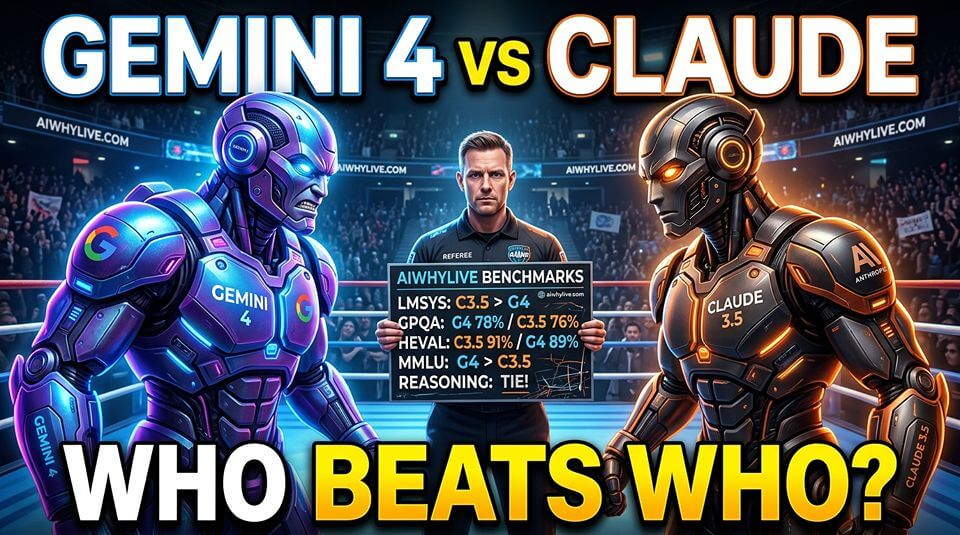
Google has Gemini 4 Argon. Anthropic has Claude Opus 5.5. Both can code. Both can reason. Both can handle enormous amounts of information. Both have benchmark charts telling us how intelligent they are.
So let us ask the question everybody wants answered:
Who wins?
Gemini?
Claude?
Sorry.
The answer is becoming increasingly annoying.
It depends.
And that may actually be the most important development in the AI race.
It may tell us that the Age of One Best AI is ending.
🧠 AIWhyLive Explains: Gemini 4 vs Claude in Plain English
Gemini 4 Argon is Google's new frontier AI model. Google introduced it for difficult real-world work including coding, science, finance, legal tasks and cybersecurity.
Claude Opus 5.5 is Anthropic's frontier Opus model. Anthropic emphasizes its abilities in agentic coding, computer use and professional knowledge work.
Put them beside each other and something interesting happens.
Neither model simply destroys the other across everything.
One benchmark favors Gemini. Another favors Claude. Change the reasoning configuration and the comparison can change again.
So if somebody tells you:
"AI X beats AI Y."
There is an obvious follow-up question.
Gemini 4 Argon vs Claude Opus 5.5: Quick Comparison
As of October 2026, available company disclosures and independent testing suggest two extremely capable models with overlapping strengths rather than one universal champion.
| Category | Gemini 4 Argon | Claude Opus 5.5 |
|---|---|---|
| Positioning | Complex reasoning and deep work across coding, science, finance, legal and cybersecurity tasks | Agentic coding, computer use and professional knowledge work |
| Context | Up to 1 million tokens | Up to 1 million tokens in the independently tested configuration |
| Independent intelligence comparison | Very close to the frontier | Very close to the frontier |
| Pricing advantage | Aggressively priced during Google's introductory period | Higher per-token pricing in the comparison, although actual task cost depends on token use and workload |
| Best answer | It depends on what you are asking the AI to do. | |
Benchmark rankings, pricing and model configurations change quickly. Treat this comparison as a snapshot of the frontier in October 2026, not a permanent ranking.
The Benchmark Problem: Everybody Can Be a Winner
Welcome to modern AI competition.
A company releases a model.
Then comes the chart.
Green bars. Blue bars. Percentages. Coding tests. Reasoning tests. Agent tests. Academic tests with names ordinary people have never heard of.
And somewhere on that chart, conveniently, the new model looks fantastic.
This does not mean benchmarks are useless.
Benchmarks are useful because we need repeatable ways to test AI systems.
But a benchmark measures a particular capability under particular conditions. It does not automatically answer the much larger question:
Which AI is best for you?
Independent Artificial Analysis testing demonstrates the problem nicely. At comparable high-reasoning settings, Claude Opus 5.5 and Gemini 4 Argon sit extremely close on its overall Intelligence Index, while individual tests favor different models.
That is more interesting than declaring a knockout.
🍗 Lechon Manok: AI Has Discovered Benchmark Politics
Gemini: "I beat Claude."
Claude: "According to whose benchmark?"
Gemini: "Mine."
Claude: "Interesting. According to mine, I beat you."
Human: "So who's smarter?"
Gemini: "It depends."
Claude: "I agree."
Human: "Excellent."
😂 Artificial intelligence has finally mastered one of humanity's greatest intellectual traditions:
arguing about statistics.
We are approaching the point where humans may need AI to understand the benchmarks being used by AI companies to explain why their AI is better than the other AI.
Progress!
Gemini 4 May Be Better at One Job. Claude May Be Better at Another.
This is where the comparison becomes useful.
Imagine asking:
Which is better, a hammer or a screwdriver?
The question sounds incomplete because the answer depends on what you are trying to do.
Frontier AI may be heading in the same direction.
A developer may prefer one model for navigating a large codebase.
A researcher may prefer another for analyzing documents.
A writer may care more about tone, instruction-following and editing.
A company deploying thousands of automated tasks may care enormously about API cost.
Someone working inside Google's ecosystem may value Gemini integration.
Someone building long-running coding agents may care more about Claude's particular strengths.
And tomorrow's model update can rearrange all of this again.
Maybe there is only the best AI for this particular job.
👦 ELI12: Which AI Is Better?
Imagine you have two very smart classmates.
One is excellent at math and science.
The other is excellent at writing and building things.
But both are pretty good at almost everything.
You ask:
"Who is smarter?"
That is difficult to answer.
So instead you ask:
"Who should help me with this particular problem?"
That question is much more useful.
Gemini 4 and Claude are becoming like that.
Don't just ask which AI is smarter. Ask which AI is better for what you need done.
Price Changes the Meaning of "Best"
Intelligence is only one part of an AI system.
Suppose Model A performs slightly better but costs several times more to operate.
For one difficult task, the additional capability might be worth paying for.
For one million routine tasks, the economics may completely change the decision.
Google launched Gemini 4 Argon with aggressive introductory API pricing. That makes the Gemini-vs-Claude comparison not merely an intelligence contest but also an economics problem.
But even price needs context.
Lower cost per token does not guarantee lower cost per completed task. One model may use more tokens, reason for longer or require additional attempts.
The number on the pricing page is important.
The cost of getting useful work completed is more important.
Speed Is Not the Same as Intelligence
A similar problem appears with speed.
A model can generate tokens quickly but take longer before producing its first useful response.
Another can respond sooner but perform differently on a complex reasoning task.
For chatting, latency may matter enormously.
For an autonomous coding job that runs for 30 minutes, waiting several extra seconds for the first token may barely matter.
This is why reducing AI comparisons to one number is increasingly misleading.
Intelligence, latency, throughput, reliability, context, price and tool use are different things.
🐘 Elephant in the Room: Are Humans Even Going to Choose the AI?
Here is where Gemini vs Claude becomes much more interesting.
Today we still think like this:
You open Gemini.
Or Claude.
Or ChatGPT.
You choose the machine.
But why should that remain the system?
If AI models become specialists, another layer of intelligence could examine your task first.
Then the workflow becomes:
Need code?
Send it to whichever model currently performs best for that kind of coding.
Need research?
Route it somewhere else.
Need an image?
Use another model.
Need a huge document analyzed?
The system chooses accordingly.
You may not even know which model completed the task.
What Happens When AI Starts Choosing AI?
This may be the bigger story hiding behind today's model wars.
We still treat AI brands almost like sports teams.
Team Gemini.
Team Claude.
Team ChatGPT.
People argue about which one is smarter.
But computers do not need brand loyalty.
An intelligent system could simply ask:
Which model gives me the best combination of capability, speed, reliability and price for this task?
Then route the work accordingly.
The human might never see the competition happening underneath.
It may be the AI that knows when another AI can do the job better.
The Best AI May Eventually Be Several AIs
This sounds strange only because we still imagine an AI assistant as one intelligence.
But consider how ordinary software already works.
Your phone does not insist that one program perform every task. Different components handle photos, networking, storage, security and communication.
Future AI assistants may work similarly.
One AI talks to you.
Another plans.
Another writes code.
Another searches.
Another checks the answer.
Another watches for mistakes.
The interface looks like one assistant.
Behind it may be an entire team of machines.
At that point, asking whether Gemini beat Claude may sound a little like asking:
Which part of your computer won?
So Which Should You Use: Gemini 4 or Claude?
For ordinary users, the useful answer is not to choose a permanent AI champion.
Choose according to the work.
If you already have access to both, give them the same meaningful task.
Not:
"Write me a poem about a cat."
Give them something you actually need done.
A difficult coding problem.
A long document.
A research question.
An editing task.
A workflow that normally consumes an hour of your time.
Then compare what matters:
- Which understood the instructions better?
- Which produced fewer mistakes?
- Which required less correction?
- Which gave you something genuinely useful?
- Which completed the work faster?
- Which costs less for the amount of useful work produced?
Your own workload can be more informative than somebody else's leaderboard.
Don't Marry Your AI
This may be the simplest advice in the entire article.
Do not become emotionally attached to an AI brand.
Today's winner can become tomorrow's second place.
A model you disliked six months ago can suddenly become excellent after an update.
A feature that makes one platform indispensable today can appear elsewhere next month.
Use the tool that helps you accomplish the work.
If another tool becomes better, use that one.
The AI does not care about your loyalty.
Your unfinished work probably does.
Frequently Asked Questions
Is Gemini 4 better than Claude?
There is no universal answer. Gemini 4 Argon and Claude Opus 5.5 perform differently depending on the benchmark, reasoning configuration and type of task. Current independent comparisons place them extremely close overall while individual tests favor different models.
Which is better for coding, Gemini 4 or Claude?
Both are frontier-level coding models. Google emphasizes Gemini 4 Argon's performance on complex coding and agentic tasks, while Anthropic specifically positions Claude Opus 5.5 as a leader in agentic coding. The better choice can depend on the codebase, tools, workflow and task, so real-world testing on your own work is more useful than relying on one benchmark.
Which is cheaper, Gemini 4 or Claude Opus 5.5?
Gemini 4 Argon launched with aggressive introductory API pricing that is lower per token than Claude Opus 5.5 in current independent comparisons. However, cost per token and cost per completed task are not identical because models may consume different numbers of tokens and require different amounts of reasoning or correction.
Does Gemini 4 have a larger context window than Claude?
Gemini 4 Argon supports a 1-million-token unified input-output limit through the Gemini API. Independent comparisons also list Claude Opus 5.5 configurations with a 1-million-token context window. Practical long-context performance can still differ even when headline context limits are similar.
What is the best AI in 2026?
The answer increasingly depends on the task. Frontier models can differ in coding, research, writing, tool use, latency, cost, context handling and autonomous work. Instead of choosing one permanent winner, compare models according to the work you actually need completed.
🎤 Drop Mic: Who Beats Who?
Gemini 4 vs Claude.
Who wins?
We could stare at benchmarks all day.
Gemini wins here.
Claude wins there.
One costs less.
Another responds sooner under particular conditions.
Next month, somebody releases another model and we start the argument again.
Maybe that is because we are asking an increasingly outdated question.
The future of AI may not belong to one machine that defeats every other machine.
It may belong to ecosystems of specialized intelligences working together.
One AI understands what you want.
Another decides how to accomplish it.
Another performs the task.
Another checks the result.
And somewhere behind the interface, Gemini, Claude, ChatGPT or something we have not met yet may quietly do whatever each does best.
Maybe that's already the wrong question.
When machines become specialists, humans don't need one AI to win everything.
We need the right intelligence for the right problem.
And eventually, we may not even have to choose it ourselves.
The winner of the AI war may not be the AI that beats every other AI.
It may be the AI smart enough to know when somebody else can do the job better.
Now that would be intelligent.
AIWhyLive — Think beyond the prompt.

The fight gets the attention. The original problem may still be waiting for an answer. What if the biggest trick Read more

Back in 2024, the hosting debate still sounded familiar. People compared: uptime storage renewal pricing speed support response time server Read more

📖 The Old Fable, New Arena https://www.youtube.com/watch?v=GfsGU4L7iTw We all know the classic story: the flashy hare sprints ahead, the steady Read more

“The trouble with the rat race is that even if you win, you're still a rat.” — Lily Tomlin, American Read more