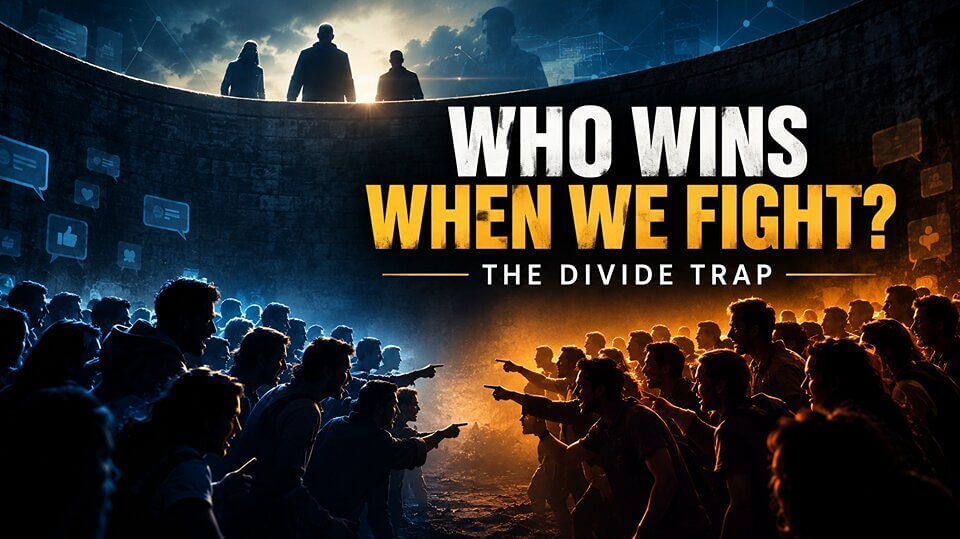
The fight gets the attention. The original problem may still be waiting for an answer.
What if the biggest trick isn't making people choose sides—but making them forget to ask who benefits when they fight?
Imagine a farmer who traps several rats in a well. At first, they search for food. They look for grain. They try to survive together in a place they cannot escape.
But after nearly two weeks, the story takes a darker turn. One rat reportedly begins hunting the others instead of searching for grain.
That is the story told in a video called The Divide Trap: How Powerful People Make You Fight Each Other. The rats are trapped together, yet their attention shifts from the conditions holding them there to the creatures trapped beside them.
The story works as a metaphor for something familiar in human society: when pressure grows, people can become so consumed by fighting one another that they stop examining the problem affecting them all.
The rat story is an analogy, not proof that every conflict is deliberately engineered. But the question it raises is worth asking—especially in an age when AI can help turn a disagreement into an endless supply of content.
🧠 AIWhyLive Explains: What Is the Divide Trap?
The Divide Trap describes a situation in which people become divided into opposing sides and spend their energy attacking one another instead of examining the underlying issue.
It resembles the familiar idea of divide and conquer: division can weaken cooperation and make collective action harder. The important distinction is that not every disagreement is planned, and not every person involved in a conflict is being manipulated.
Sometimes people have legitimate differences. Sometimes there is wrongdoing that deserves attention. Sometimes opposing sides genuinely disagree about the facts or the solution.
The trap appears when the fight becomes so absorbing that the original problem disappears from view.
🐀 From Searching for Grain to Fighting Other Rats
Return to the farmer's well.
The rats initially have a shared problem: they are trapped and need food. But in the video's telling, survival changes the way one rat behaves. Instead of searching for grain, it begins attacking the others.
The metaphor asks us to consider what happens when fear, scarcity, anger or prolonged pressure changes the target of our attention.
In everyday life, the shared problem might be a workplace that is failing, a community facing an unresolved issue, a family struggling under pressure or citizens demanding explanations about public decisions.
Instead of investigating the cause, people may begin fighting over personalities, loyalties, old grudges or which side deserves to win.
Sometimes the disagreement is necessary. Sometimes confrontation is the only way to demand accountability. But when the argument consumes all available attention, it can become harder to distinguish between fighting for a solution and simply fighting.
Who Benefits When Everyone Is Fighting?
This is the uncomfortable question at the center of the Divide Trap.
When a crowd becomes absorbed in a public confrontation, attention naturally shifts toward the people involved. Who started it? Who looked stronger? Who delivered the best comeback? Who embarrassed whom?
Those questions can be entertaining. They can also be less important than the questions that started the dispute.
Consider a public disagreement about a government decision. Citizens may have legitimate questions about the process, the evidence, the spending or the outcome. Then the disagreement becomes personal. Supporters choose sides. Social media fills with reactions. The confrontation becomes the headline.
Meanwhile, the original questions may remain unanswered.
What was the decision? What evidence is available? Where did the money go, if public funds were involved? What has been explained, and what remains unanswered?
These questions do not become less important just because the people arguing about them have become more interesting.
A public argument can attract attention without producing public understanding.
That does not prove anyone planned a distraction. A heated exchange can arise from a genuine disagreement, competing priorities or personal tensions. But regardless of how the conflict began, the public can still lose sight of the issue that deserves scrutiny.
And when the audience debates who won the confrontation, the public may still be waiting for answers.
How AI Can Make the Divide Trap Bigger
Division existed long before artificial intelligence. People have always argued, competed for influence, formed groups and spread rumors.
What AI changes is the speed, scale and flexibility with which content can be produced.
1. One argument can become hundreds of posts
A single disagreement can be turned into short videos, memes, reaction posts, commentary, headlines and persuasive arguments for opposing sides. AI tools can help create these variations quickly and at relatively low cost.
More content does not necessarily mean more understanding. Sometimes it simply means the same argument gets repeated in more formats.
2. Anger can become an engagement strategy
Content that provokes a strong reaction can attract comments, shares and repeat visits. Social platforms may reward engagement, and creators may learn that outrage generates attention.
This creates an incentive to frame disagreements in the most emotionally compelling way. A complicated issue becomes a simple battle. A person becomes a villain. A group becomes the enemy.
That does not mean every platform, creator or argument is intentionally designed to divide people. It means the incentives surrounding online attention can sometimes amplify divisive content, regardless of whether division was the original goal.
3. AI can make both sides sound convincing
AI can help someone write a polished defense of one position. Another person can use the same technology to construct an equally polished argument for the opposite position.
Both may sound confident. Both may use emotional language. Both may include selective facts. And either may leave out information that complicates its preferred conclusion.
Fluent writing is not proof of accuracy. A persuasive argument is not automatically a complete argument.
4. The audience can become part of the machine
Every angry comment, reaction and share can help a post travel farther. People who believe they are fighting misinformation or defending the truth may unintentionally spread the very content they dislike.
Before sharing an outrageous claim to condemn it, ask whether you have verified it—and whether your post will correct the misunderstanding or simply give it a larger audience.
Sometimes the most effective response is to investigate. Sometimes it is to correct the record. Sometimes it is to refuse to amplify an unverified claim.
👦 ELI12: Imagine Two Neighbors Arguing
Two neighbors are upset because something in their community is not working.
Instead of checking what happened, they begin blaming each other. Their friends join in. Their families take sides. Soon, everybody is arguing.
But the original problem is still there.
Now imagine someone posts a video of their argument. Thousands of people watch it. Some laugh. Some get angry. Others make more videos about it.
The argument becomes famous. The problem remains unsolved.
The lesson: Before joining a fight, find out what the fight is actually about—and whether your participation will help solve anything.
🍗 Lechon Manok: Congratulations, You Won the Argument
You defeated a stranger in the comments section.
Your reply received 2,000 likes. Your followers called you a genius. Someone made a reaction video. Three people blocked you. Your opponent posted another response.
Congratulations! You have achieved internet victory.
One small question, though: Did the original problem get solved?
Did anyone check the facts? Did anyone understand the other side better? Did anything improve outside the comment section?
Or did you spend three hours defending your side while the people who needed to answer the original question quietly moved on with their day?
😂 Welcome to the modern battlefield. The ammunition is unlimited, the audience is enormous, and the victory may exist only on your screen.
Does This Mean We Should Avoid Conflict?
No.
Some conflicts are necessary. People should challenge dishonesty, question authority, defend their rights and demand accountability. Silence is not always wisdom, and compromise is not always the right answer.
The goal is not to avoid every battle. It is to recognize which battles matter, what evidence supports our position and what outcome we are trying to achieve.
Ask yourself:
- Am I defending a principle, or merely protecting my pride?
- Have I checked the facts, or am I reacting to a headline or edited clip?
- Am I criticizing a specific action, or treating an entire group as the enemy?
- Will my response help clarify the issue or simply intensify the argument?
- What evidence or result would convince me that my current position needs to change?
These questions do not require you to abandon your beliefs. They help ensure that your beliefs are not being used as an excuse to stop thinking.
How to Escape the Divide Trap in the Age of AI
Return to the original question
When a controversy becomes personal, return to the issue that started it. What happened? What can be verified? What information is missing? What would a meaningful resolution look like?
Separate evidence from interpretation
A video may show a real confrontation without explaining everything that led to it. A quotation may be authentic but incomplete. A confident social media post may contain a mixture of facts, assumptions and opinion.
Check primary sources where possible. Compare reliable reporting. Distinguish what is established from what someone believes it means.
Do not let AI do your thinking for you
Use AI to summarize competing arguments, identify unanswered questions, compare claims and help you find relevant sources. Then check important claims against those sources.
AI can help you examine a position. It can also help you defend a mistaken one with impressive language. The difference depends partly on the questions you ask and how carefully you evaluate the answers.
Recognize when disengaging is useful
You do not have to respond to every provocation. If a conversation has become a cycle of insults and repetition, stepping away may preserve your time and attention for something more productive.
But do not confuse avoiding an unproductive online argument with ignoring a real-world problem. Sometimes the best next step is not another comment. It is reading the documents, asking a specific question, contacting the responsible office or supporting a constructive solution.
Ask who benefits—but do not invent a villain
It is reasonable to ask who gains attention, money, influence or an advantage from a conflict. It is not reasonable to assume that the existence of a beneficiary proves that person or organization deliberately created the conflict.
Follow the evidence. Examine incentives. Look for documented actions. Leave room for explanations that the available facts do not rule out.
Critical thinking means questioning a compelling story—even when that story agrees with you.
🐘 The Bigger Question: Who Is Still Looking at the Problem?
The Divide Trap is powerful as a metaphor because it reminds us that attention is limited.
When we spend it all on personal attacks, online rivalries and endless arguments, we have less of it available for research, cooperation, accountability and practical action.
That cost matters whether the disagreement concerns politics, work, family, business or social media.
Sometimes the person across from you really is wrong. Sometimes you are. Sometimes both sides have part of the truth. And sometimes the issue is more complicated than the version that fits neatly into a viral post.
The answer is not to assume that a hidden hand controls every argument. It is to remain alert to the possibility that conflict can benefit some people while making it harder for everyone else to address a shared problem.
Frequently Asked Questions
What is the Divide Trap?
The Divide Trap is a way of describing how people can become so focused on fighting one another that they neglect the underlying problem. It is related to the broader idea of divide and conquer, but it does not prove that every disagreement is deliberately engineered.
How does AI contribute to social division?
AI can help people create persuasive posts, videos, images and arguments quickly. When this content is used to provoke anger or reinforce hostility, it can contribute to division. AI can also help people understand opposing views and check claims when used carefully.
Does every political controversy distract people from the truth?
No. Some controversies expose important facts, wrongdoing or legitimate disagreements. The useful question is whether public attention remains focused on evidence, accountability and the original issue—or becomes consumed by personalities and spectacle.
How can I avoid being manipulated by divisive content?
Verify claims before sharing them, look for original sources, distinguish facts from opinions, consider missing context and ask whether your reaction will help clarify the issue. Be especially careful with content designed to make you angry before you have checked what happened.
Who benefits when people fight each other?
The answer depends on the situation. Some creators may gain engagement, some organizations may gain attention or influence, and some people may benefit when scrutiny shifts elsewhere. A benefit alone does not prove that someone deliberately caused the conflict; evidence is needed to establish intent.
🎤 Drop Mic: Don't Become Another Rat in the Well
The internet gives us more ways than ever to speak, publish, argue and respond. AI makes many of those actions faster and easier.
But having more ways to fight does not mean we are getting better at solving problems.
We can spend our days proving the other side is stupid. We can let a viral confrontation decide what deserves our attention. We can use AI to produce a sharper insult, a more convincing accusation or a more polished defense of a position we have never seriously questioned.
Or we can pause.
We can ask what happened, what the evidence says, what remains unresolved and what would actually make things better.
We can disagree without surrendering our ability to think. We can demand accountability without assuming every opponent is an enemy. We can use AI to investigate a problem instead of merely generating more ammunition for an argument.
Before you attack the other person, ask whether you are solving the problem.
Before you share the next outrage, ask whether you know the whole story.
The rats in the story are trapped together. The metaphor asks whether they can recognize the trap before turning against one another.
We have something the rats in that story do not: the ability to stop, question the situation, cooperate and choose our response.
AI can help us create more arguments. It can help us understand them, too. The technology does not decide which purpose we choose.
The real victory is not always defeating the other side. Sometimes it is refusing to let the fight replace the problem that needs to be solved.
So the next time a controversy fills your screen, ask one question before joining the battle:
AIWhyLive — Think beyond the prompt.

Welcome to (WordPress) aiwhylive.com. This is your first post. Edit or delete it, then start writing! Like most journey, it Read more

"AI Showdown: ChatGPT vs. Bard - Unveiling the Ultimate AI Champion!" Let AI answer which is of them is better!
Please note that clickbait titles are often designed to grab attention but may not always accurately reflect the content or Read more
Prepare for the impact of El Niño in the Philippines with valuable insights and life-saving strategies. Learn how to identify Read more