
Evolution of Epal in the Philippines from tarpaulin and social media to AI-driven epal
Before artificial intelligence, before social media, before selfies, before algorithms and before tarpaulins large enough to survive a typhoon, the Philippines had already developed one of its most enduring homegrown products:
The Epal.
Proudly Philippine-made.
No batteries required.
Powered almost entirely by attention.
For international readers encountering this magnificent specimen for the first time, epal in the Philippines is associated with the Filipino idea of mapapel or pumapapel—someone who unnecessarily inserts themselves into the picture, grabs attention, seeks recognition or desperately wants to be noticed.
In Philippine politics, epal became especially associated with people attaching names, faces, slogans and personal branding to public projects, programs, assistance and government services.
But before we continue, AIWhyLive would like to correct a terrible historical injustice.
Not every Epal is a politician.
And not every political Epal necessarily holds elected office.
There are assistants.
Staff.
Followers.
Operators.
Friends.
Relatives.
Would-be successors.
Professional photo bombers.
And ambitious creatures quietly epal-ing their way toward recognition, influence and favor.
The master may enjoy being seen.
The servant may discover that being seen beside the master is also very useful.
So as master, so as slave.
Welcome to the evolution of Epal in the Philippines.
From ape...
to analog Epal...
to digital Epal...
to social-media Epal...
and finally:
AI-driven Epal.
Evolution is amazing.
What Does Epal Mean in the Philippines?
Epal is Filipino slang for an attention-grabber—someone who unnecessarily inserts themselves into a situation, seeks recognition, grabs credit or makes themselves unusually visible where the attention may not belong to them.
The term is associated with the Filipino mapapel or pumapapel, referring to someone who tries to play a conspicuous or unnecessary role, particularly when seeking attention or recognition.
In Philippine political culture, epal became strongly associated with public personalities placing their names, images, slogans or branding on government-funded projects, programs, assistance and public materials.
The principle behind criticism of political Epal behavior is remarkably simple:
Public money paid for the project.
Therefore, thank the public.
Apparently, this is advanced mathematics.
The issue became serious enough that anti-epal policies have repeatedly tried to separate public service from personal advertising.
In 2026, national authorities again ordered strict enforcement against the use of officials' names, photographs, logos, initials, slogans, color motifs and similar identifying symbols on government-funded projects.
Which tells us something fascinating.
After years of evolution...
Epal remains extremely difficult to eradicate.
🧠 AIWhyLive Explains: Epal Is Not a Job Title
There is a common misconception that epal simply means politician.
No.
Politician is an occupation.
Epal is a lifestyle.
One does not necessarily need to hold public office to achieve advanced Epal status.
An individual merely needs the ancient desire to be included in a picture that did not originally require them.
This is why the political ecosystem matters.
Around every sufficiently powerful source of attention, smaller organisms may develop.
The assistant appears in the photograph.
The associate stands near the ribbon.
The loyal follower shares everything.
The aspiring somebody makes sure everybody knows that somebody important knows them.
The future candidate begins appearing long before anyone remembers asking.
Recognition becomes currency.
Proximity becomes branding.
Visibility becomes investment.
And eventually the apprentice discovers the master's great secret:
You don't always have to accomplish something to appear associated with the accomplishment.
Evolution continues.
Stage 1: Homo Epalus — The Analog Epal
The early Epal lived in difficult conditions.
There was no Facebook.
No TikTok.
No algorithm.
No instant livestream.
No AI image generator.
Our ancestors had to epal manually.
Imagine the hardship.
They needed actual photographers.
Actual printing.
Actual tarpaulins.
Actual walls.
Actual ceremonies.
Actual crowds.
To achieve maximum visibility, the Analog Epal had to physically appear somewhere.
Groundbreaking?
Present.
Ribbon cutting?
Present.
Basketball tournament?
Present.
Graduation?
Present.
Birthday?
Present.
Wedding?
Why not?
Funeral?
Apparently, death should not interfere with branding opportunities.
The Analog Epal understood one fundamental principle:
If an event happens and your face isn't visible, did the event really happen?
Primitive.
But effective.
Stage 2: The Tarpaulin Epal
Then came one of the greatest technologies in Philippine Epal evolution.
The tarpaulin.
Suddenly, the Epal no longer needed to be physically present.
The face could be present instead.
Happy birthday!
Face.
Congratulations, graduates!
Face.
Happy fiesta!
Face.
Merry Christmas!
Face.
Happy New Year!
Face.
Drive safely!
Face.
Stay hydrated!
Face.
Condolences.
Face.
At some point you begin wondering whether the message is the occasion...
or the occasion is merely an excuse for the face.
The genius of the tarpaulin was scalability.
One human could now smile simultaneously from multiple locations.
Before cloud computing, the Philippines had already invented distributed Epal computing.
Stage 3: Epal 2.0 — Social Media Arrives
Then evolution accelerated.
Social media arrived.
The Epal looked at the Like button.
The Like button looked back.
It was love at first sight.
For centuries, Epal craved attention without a reliable measurement system.
Then social media gave humanity:
Likes.
Shares.
Comments.
Followers.
Views.
Reactions.
Engagement.
Finally!
Epal had analytics.
The old Epal merely suspected that people were looking.
The Digital Epal could open a dashboard and confirm it.
This changed everything.
A birthday greeting was no longer simply a greeting.
It was content.
A wedding was content.
A funeral was content.
A donation was content.
A handshake was content.
A meeting was content.
Walking into the meeting was content.
Leaving the meeting was content.
Posting about how exhausting the meeting was?
Premium content.
The Epal had evolved from seeking attention...
to measuring it.
🍗 Lechon Manok: If Nobody Posted It, Did You Actually Help?
Once upon a time, somebody helped another person.
Nobody photographed it.
Nobody uploaded it.
Nobody added a logo.
Nobody posted:
SERVING THE PEOPLE ❤️🙏
Historians remain unsure whether the good deed actually happened.
Modern Epal science requires documentation.
Step 1: Find person who needs help.
Step 2: Help.
Step 3: Stop.
No.
Sorry.
That's the obsolete version.
Updated procedure:
Step 1: Find person who needs help.
Step 2: Find camera.
Step 3: Find better camera angle.
Step 4: Help.
Step 5: Upload.
Step 6: Add inspirational caption.
Step 7: Add name.
Step 8: Add slogan.
Step 9: Monitor engagement.
Step 10: Thank everybody for appreciating your humility.
😂
Stage 4: The Validation Epal
Social media created a new evolutionary pressure.
It was no longer enough to be visible.
You had to be validated.
Likes became tiny digital applause.
Shares became proof of relevance.
Comments became oxygen.
Followers became status.
The Epal adapted beautifully.
Soon, public service itself risked becoming indistinguishable from personal content marketing.
The question quietly changed from:
Did this help people?
to:
Did people see me helping people?
Those are not the same question.
One measures impact.
The other measures attention.
But attention is addictive because attention can eventually become something even more valuable.
Recognition.
And recognition can become political capital.
Stage 5: The Everywhere Epal
The mature Epal develops a remarkable biological adaptation:
the ability to appear everywhere.
Birthday?
There.
Wedding?
There.
Graduation?
There.
Sports event?
There.
Medical mission?
There.
Relief operation?
There.
Fiesta?
There.
Funeral?
There.
At this stage, even mortality struggles to escape personal branding.
Imagine reaching the gates of eternity and discovering:
IN LOVING MEMORY
Sponsored by somebody whose face is somehow larger than the deceased.
There are moments when humanity should probably allow the occasion to remain about somebody else.
But advanced Epal biology rejects this principle.
Because every human event contains one precious natural resource:
attention.
And attention must never go to waste.
🐘 The Elephant in the Room: Is It Still Public Service If the Camera Must Be There?
Cameras are not evil.
Public officials and organizations should communicate what they do.
Transparency matters.
People deserve to know how programs work.
Citizens should know where public money goes.
Documentation can be necessary.
The problem begins when documentation slowly transforms into self-worship.
There is a difference between:
"Here is what the government did."
and:
"Look what I did for you."
Especially when the taxpayer paid for it.
The road isn't a personal gift.
The medicine isn't a personal gift.
The scholarship isn't a personal gift.
The assistance isn't a personal gift.
The public project isn't a personal gift.
Public service should not behave like a Christmas present personally purchased by the smiling face printed beside it.
The taxpayer is not receiving a favor from the taxpayer's own money.
That sentence should not be revolutionary.
Stage 6: The Proxy Epal
Now we reach a more sophisticated species.
Suppose anti-epal rules become stricter.
Suppose putting one's own face everywhere becomes inconvenient.
Has evolution ended?
Of course not.
Nature finds a way.
Enter:
The Proxy Epal.
This is where our earlier clarification becomes important.
Epal behavior does not require elected office.
Attention can flow through ecosystems.
Associates.
Staff.
Supporters.
Allies.
Organizations.
Pages.
People who happen to be extraordinarily enthusiastic about ensuring everybody remembers who deserves credit.
Sometimes the central figure doesn't even need to say much.
Others can epal on their behalf.
And sometimes those people aren't merely promoting the master.
They're promoting themselves by demonstrating proximity to the master.
Political photosynthesis.
Stand close enough to power...
and perhaps some recognition will rub off.
So as master, so as slave.
Eventually, today's loyal supporting character may dream of becoming tomorrow's main character.
The circle of Epal is complete.
Stage 7: Algorithmic Epal
Social media gave Epal attention.
Algorithms gave Epal strategy.
Now visibility could be optimized.
Post at the right time.
Use the right format.
Trigger emotion.
Generate comments.
Produce short videos.
Respond quickly.
Repeat successful content.
Study analytics.
The Epal was no longer merely seeking attention.
The Epal was optimizing for attention.
This is an important evolutionary leap.
The old tarpaulin waited beside the road.
The Algorithmic Epal follows you home.
Into your phone.
Into your feed.
Into your notifications.
Into breakfast.
Into lunch.
Into the bathroom.
The tarpaulin could only hope you passed by.
The algorithm can chase you.
Progress.
Stage 8: AI-Driven Epal
And now...
Artificial intelligence.
The final form?
Probably not.
But impressive.
AI can help create:
- captions
- speeches
- posters
- videos
- images
- talking points
- campaign messages
- greetings
- responses
- slogans
- hashtags
- content calendars
- audience analysis
- sentiment analysis
- personalized messages
Suddenly, Epal doesn't even have to personally think of what to say.
The machine can epal at scale.
Want 30 inspirational captions?
Done.
Birthday greeting?
Done.
Condolence message?
Done.
Fiesta greeting?
Done.
"Make me sound humble."
Done.
"Make me sound like a servant leader."
Done.
"Make it emotional but not too political."
Done.
"Add three heart emojis."
Done.
"Make me relatable."
Done.
And humanity reaches a technological milestone:
We have automated attention-seeking.
🍗 Lechon Manok: Artificial Intelligence Meets Natural Epal
Human:
"AI, make me look humble."
AI:
"Certainly."
Human:
"More humble."
AI:
"Done."
Human:
"Add my face."
AI:
"Done."
Human:
"Make my face bigger."
AI:
"Done."
Human:
"Bigger."
AI:
"Done."
Human:
"Put the public project behind me."
AI:
"Done."
Human:
"Now write: 'No need to thank me.'"
AI:
"..."
Human:
"Why did you stop?"
AI:
"I have achieved artificial intelligence."
😂
From Ape to AI-Driven Epal
And so we arrive at the magnificent evolutionary chart:
APE
↓
HUMAN
↓
EPAL
↓
TARPAULIN EPAL
↓
SOCIAL MEDIA EPAL
↓
VALIDATION EPAL
↓
ALGORITHMIC EPAL
↓
AI-DRIVEN EPAL
Charles Darwin may wish to file an appeal.
Technology changes.
The underlying craving does not.
Attention.
Recognition.
Validation.
Credit.
Power.
The tools simply become better.
The cave wall became the poster.
The poster became the tarpaulin.
The tarpaulin became the social post.
The social post became the short video.
The short video became AI-generated content.
Evolution didn't eliminate Epal.
It gave Epal better software.
👦 ELI12: What Is Epal?
Imagine your whole class buys your teacher a birthday cake.
Everybody contributed money.
Then one student walks to the front, holds the cake and announces:
"You're welcome, Ma'am."
Then takes a picture.
Then puts their name on the cake.
Then posts the photo online.
Then writes:
"Always serving my classmates."
Then asks everyone to share it.
That's Epal.
Now imagine AI automatically creates the caption, edits the photo, generates the video and schedules the post.
That's:
Epal Pro Max AI Edition.
The Real Fuel of Epal Is Not Politics
Politics gives Epal an especially fertile environment.
But the deeper fuel is human.
Validation.
We want to be noticed.
We want recognition.
We want people to know we helped.
We want people to know we were there.
We want people to know important people know us.
Social media didn't invent this.
Politics didn't invent this.
AI certainly didn't invent it.
Technology simply made validation faster, measurable and scalable.
That's why anti-Epal rules can remove a face from a government sign...
without necessarily removing Epal from the human heart.
You can regulate a billboard.
Regulating ego is somewhat harder.
🧠 AIWhyLive Explains: Why Epal Survives Every Technology
Epal survives because the reward survives.
Recognition can produce familiarity.
Familiarity can produce popularity.
Popularity can produce influence.
Influence can produce power.
And power can produce more opportunities for recognition.
It's a beautiful self-sustaining ecosystem.
Which explains why the Epal face keeps appearing.
Not necessarily because the face is attractive.
Not necessarily because the public requested it.
But because repetition has value.
See the face enough times and it becomes familiar.
Remember the name enough times and it becomes easier to recall.
And when political decisions eventually arrive...
familiarity matters.
Which brings us to the least funny part of this satire.
From Likes to Votes: The Ultimate Epal Evolution
Likes are nice.
Shares are nicer.
Comments feel wonderful.
Recognition is useful.
But for political Epal behavior, there is an even more valuable form of engagement.
Votes.
This is where the entire evolutionary story comes together.
The birthday greeting.
The funeral appearance.
The tarpaulin.
The social post.
The relief photo.
The inspirational caption.
The handshake.
The algorithm.
The AI-generated message.
All of them can contribute to the same valuable commodity:
familiarity.
But familiarity still has to survive election day.
And if personality branding, endless visibility and star-spangled awesomeness are somehow not enough?
Political systems can still face another temptation:
transactional politics.
Money.
Favors.
Patronage.
Immediate benefits.
Anything capable of turning recognition into political loyalty.
Because the final ambition of political Epal behavior is not merely to be seen.
It is to remain seen.
Again.
And again.
And again.
For all eternity.
🐘 The Final Elephant: Can You Be Anti-Epal While Still Being Epal?
Of course.
This is the Philippines.
Evolution is advanced here.
One may publicly oppose self-promotion...
very visibly.
One may announce humility...
repeatedly.
One may explain that public service is not about recognition...
while making absolutely certain everybody recognizes who said it.
One may even launch a campaign against Epal behavior.
Preferably with excellent lighting.
Perhaps a photographer.
Maybe a hashtag.
And definitely a post explaining how little attention one desires.
The paradox is beautiful.
The highest form of Epal may eventually be being recognized for fighting Epal.
Evolution complete.
Almost.
Frequently Asked Questions About Epal in the Philippines
What does Epal mean in the Philippines?
Epal is Filipino slang for someone who unnecessarily inserts themselves into a situation, seeks attention or recognition, grabs credit or makes themselves conspicuously visible. In Philippine political culture, the word is often associated with excessive self-promotion connected to public projects, services and government activities.
Where does the word Epal come from?
The slang term epal is associated with the Filipino words mapapel and pumapapel, which can describe someone trying to play a conspicuous or unnecessary role, particularly when seeking attention or recognition.
Does Epal only refer to politicians?
No. Epal is not an official political title and can describe attention-seeking behavior outside politics. In political environments, it may also describe behavior by associates, supporters, staff or other people seeking recognition through their proximity to political power.
What is political Epal?
Political Epal generally refers to excessive political self-promotion, particularly when a person's name, image, slogan or personal branding is attached to public services, projects or activities in ways that make taxpayer-funded work appear like a personal favor or achievement.
What is anti-Epal in the Philippines?
Anti-Epal policies and campaigns seek to prevent public resources, government projects and official activities from being used for unnecessary personal promotion. In 2026, national authorities again ordered enforcement against names, photographs, logos, initials, slogans, color motifs and similar identifying symbols on government-funded projects.
Why do people criticize Epal politics?
Critics argue that taxpayer-funded projects and public services should be presented as government or public programs rather than personal gifts from individual political personalities. Excessive personal branding can blur the difference between public service and political advertising.
What is a social media Epal?
A social media Epal is AIWhyLive's satirical description of attention-seeking behavior adapted to digital platforms, where visibility can be measured through likes, comments, shares, views and followers.
What is an AI-driven Epal?
AI-driven Epal is AIWhyLive's satirical term for the next evolution of attention-seeking: using artificial intelligence to generate captions, images, videos, speeches, slogans, greetings, responses and other content that can increase personal visibility at scale.
Why does Epal survive despite anti-Epal rules?
Rules can regulate specific forms of political branding, but the desire for recognition is a broader human behavior. As technology changes, attention-seeking can move from physical signs and tarpaulins to social media, algorithms and potentially AI-generated content.
Is Epal unique to the Philippines?
Attention-seeking and political self-promotion are certainly not uniquely Filipino behaviors. What is distinctly Filipino is the slang term epal and the particular cultural and political meaning that developed around it.
🧠 AIWhyLive Explains: Epal Is Filipino. The Ego Is Universal.
This distinction matters.
The Philippines did not invent self-promotion.
Human beings have been attaching themselves to achievements since long before anybody invented a tarpaulin.
Political branding exists around the world.
Attention-seeking exists around the world.
Taking credit exists around the world.
What Filipinos contributed was something more efficient.
A wonderfully compact word for it.
Epal.
Four letters.
One diagnosis.
No laboratory test required.
🎤 Drop Mic: Epal Never Dies. It Upgrades.
The Epal began with a simple desire.
Look at me.
Technology answered.
The poster said:
Look at me.
The tarpaulin said:
Look at me.
Social media said:
Like me.
The algorithm said:
Engage with me.
AI said:
I can automate that.
And so the Epal evolved.
Smarter.
Faster.
More polished.
More measurable.
More scalable.
More humble-looking.
Potentially AI-powered.
The face may disappear from one government sign.
It may reappear somewhere else.
The logo may disappear.
Perhaps the color remains.
The name may disappear.
Perhaps somebody else says it.
The tarpaulin may eventually disappear.
The algorithm doesn't need one.
But underneath all the technology remains the ancient cry:
NOTICE ME.
And no matter how technologically advanced, algorithmically optimized, artificially intelligent and star-spangled awesome the Epal becomes...
there remains one brutally old-fashioned problem.
At some point...
people still have to vote.
And when attention, branding and artificial intelligence are not enough, the old temptations of transactional politics, money, favors and patronage do not magically disappear.
The tools evolve.
The ego evolves.
The campaign evolves.
The Epal evolves.
From ape to AI.
But the oldest political shortcuts can remain stubbornly analog.
So yes, AIWhyLive asked AI one final question:
Is there an Epal Heaven?
Or perhaps an...
Epal Help?
AI refused to comment.
That's for another day.
For now, remember:
Epal never dies.
It upgrades.
And unfortunately...
the voter gets the software update too.
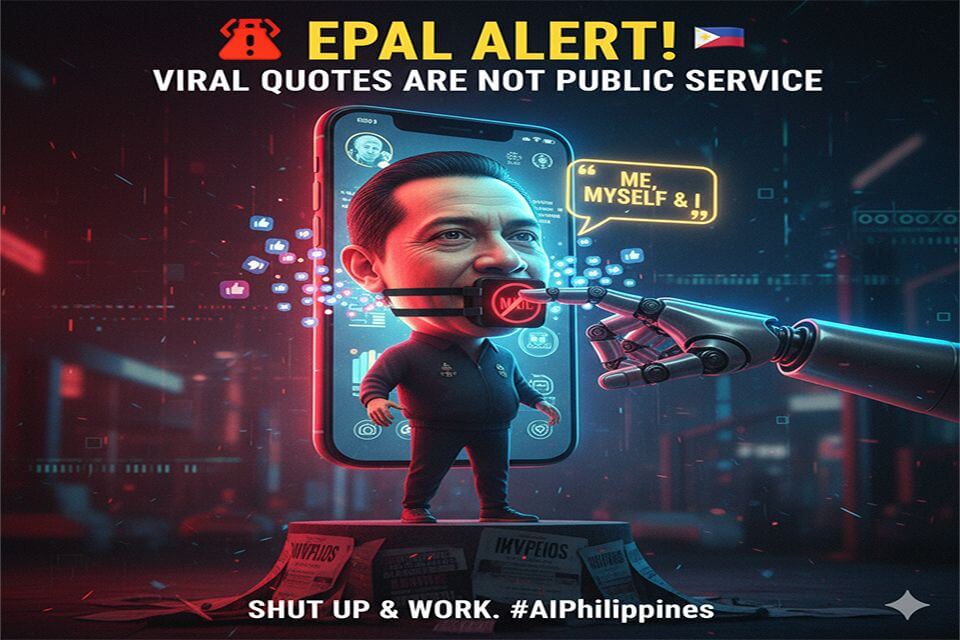
There’s a silent revolution happening in the world of work, powered by AI, which values one thing above all: Efficiency Read more
How to Look Good, Sound Smart, and Stay Irrelevant—A Satirical Masterclass 💅 STEP 1: BUY YOUR WAY TO “CREDIBILITY” Gone Read more

When Self-Praise Meets Self-Learning: A Satirical Guide to Algorithmic Self-Promotion It used to be enough for the local mayor to Read more

Congratulations. People are seeing you. That doesn't mean you're right. In fact, it might mean absolutely nothing. You could be Read more