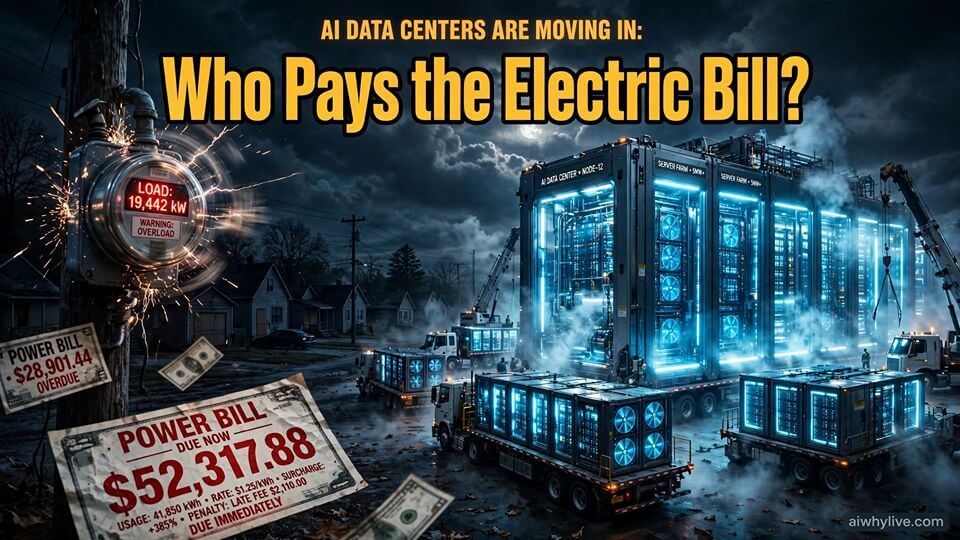
The Cloud Has a ZIP Code: What Happens When AI Moves Into Your Neighborhood?
For years, artificial intelligence lived somewhere called "the cloud."
Very convenient place, the cloud.
No address.
No electric meter.
No water bill.
No noisy construction.
No transmission lines.
No giant building beside your neighborhood.
You opened an AI chatbot.
Asked a question.
AI answered.
Magic.
Except the cloud was never really a cloud.
It was land.
Buildings.
Computer chips.
Cooling systems.
Transformers.
Power lines.
Water.
And a very large electric bill.
Now, as the AI boom demands more computing power, the physical side of artificial intelligence is becoming harder to ignore.
The cloud is coming down to Earth.
And in some communities, it is moving next door.
Will AI take my job?
A new question is appearing:
Who's paying to plug it in?
🧠 AIWhyLive Explains: Why Do AI Data Centers Need So Much Electricity?
AI data centers need large amounts of electricity because modern artificial intelligence runs on thousands of powerful computer chips performing enormous numbers of calculations.
Those chips generate heat.
The heat must be removed.
The servers need networking.
The facility needs backup systems.
Transformers deliver power at usable voltages.
Transmission and distribution infrastructure must bring electricity to the site.
And as more people and businesses use AI, more computing infrastructure is being built.
The International Energy Agency says global investment in data centers is surging as artificial intelligence becomes increasingly important to economic and technology policy.
The world's largest data-center operators are expected to spend more than $700 billion in capital expenditure in 2026, with most of that spending directed toward developing new data centers.
But AI has a physical body.
We call much of that body a data center.
The Cloud Has a ZIP Code
This may be one of the great marketing achievements of the Internet age.
We called it:
THE CLOUD.
Sounds beautiful.
Light.
Weightless.
Floating peacefully above us.
Maybe with angels.
😂
We probably wouldn't have loved:
THE GIANT BUILDING FULL OF COMPUTERS USING INDUSTRIAL AMOUNTS OF ELECTRICITY.
Wouldn't fit nicely on the button either.
But it is closer to physical reality.
Every time millions of people ask AI questions, generate video, write code, analyze documents or train increasingly capable models, computers somewhere are doing the work.
Those computers have an address.
They are connected to a real electricity grid.
They occupy real land.
And increasingly, communities living near that infrastructure are asking questions.
Then AI Knocked on the Neighborhood Door
Imagine the announcement.
A giant technology project is coming to your community.
Jobs!
Investment!
Tax revenue!
Economic development!
Your community may become part of the AI revolution.
Wonderful.
Then somebody in the back raises a hand.
How much electricity does it need?
Another hand.
Where is that electricity coming from?
Another.
Do we need new transmission lines?
Another.
What about water?
Another.
Who's paying for the grid upgrades?
And suddenly the AI revolution has become a town meeting.
This is no longer hypothetical.
Communities in several countries are questioning large data-center projects over electricity demand, water use, land, infrastructure, environmental effects, tax incentives and how much information residents receive before projects are approved.
The International Energy Agency says policymakers are becoming increasingly sensitive to concerns from local communities about the effects of data centers on electricity prices, emissions and water.
Infrastructure is local.
🍗 Lechon Manok: Everybody Loves AI Until It Moves Next Door
Human:
"I love AI."
Tech company:
"Excellent!"
Human:
"I use it every day."
Tech company:
"Wonderful!"
Human:
"I want faster AI."
Tech company:
"We can help."
Human:
"I want smarter AI."
Tech company:
"Absolutely."
Human:
"I want unlimited AI."
Tech company:
"Great news. We're building a massive data center near your neighborhood."
Human:
"...Near my neighborhood?"
😂
Welcome to the AI revolution.
Apparently, we all wanted the cloud.
We just forgot that eventually somebody has to live underneath it.
🐘 Elephant in the Room: Do AI Data Centers Raise Electricity Bills?
AI data centers can put upward pressure on electricity bills, but they do not automatically make electricity more expensive for everyone.
This distinction matters.
According to the International Energy Agency, the effect depends partly on how electricity infrastructure costs are allocated.
Suppose a large data center requires:
- new transmission lines,
- new substations,
- new transformers,
- additional generation,
- and other grid upgrades.
If those costs are recovered from all electricity users, existing consumers can end up paying part of the cost created by the new demand.
But there is another possibility.
If a data center makes better use of existing electricity infrastructure and pays an appropriate share of fixed costs, its additional consumption can spread those costs across more electricity sales and potentially ease pressure on other customers.
So the factual answer is not:
"Data centers make your electricity bill go up."
The better answer is:
That turns an AI debate into a public-policy debate.
Who Pays for the Bigger Grid?
Imagine a huge new AI data center needs major upgrades to the electricity system.
Who pays?
The technology company?
The utility?
The government?
Taxpayers?
Every household connected to the same electricity network?
There is no universal answer.
Different electricity markets have different regulations and tariff structures.
But regulators increasingly have tools designed to protect existing customers.
The IEA points to mechanisms including long-term contracts, minimum-payment commitments, exit fees, collateral and phased connections.
The principle is simple:
Because somebody eventually pays.
"Pay Your Way"
One idea is increasingly central to the data-center debate:
Large electricity users should pay their fair share.
Some jurisdictions are developing special tariff frameworks for large loads.
Others are exploring requirements that data centers contribute additional electricity supply.
The IEA describes one emerging strategy as "bring your own power".
Under some versions of this approach, a new data center may need to build or contract additional generation rather than simply arriving at the grid with a giant electrical appetite.
Technology companies themselves are also responding to public concern.
Some have announced community investments involving energy affordability, water conservation, education, training and other local priorities.
That is important because the debate is moving beyond:
"Can we build the data center?"
Toward:
"What does the community get if we build the data center?"
👦 ELI12: The New Neighbor With 100 Refrigerators
Imagine five families live on your street.
Everyone shares the same electricity infrastructure.
Then a very rich new neighbor arrives.
Wonderful.
The new neighbor builds a giant house.
Also fine.
Then 100 refrigerators arrive.
The electricity company says:
"We're going to need a much bigger transformer."
Okay.
Then comes the interesting question:
Who pays for the new transformer?
If the new neighbor pays because the new neighbor created the need, most people probably understand.
If the five existing families suddenly receive bigger bills because their rich new neighbor brought 100 refrigerators...
There may be a neighborhood meeting.
😂
Real electricity markets are much more complicated.
But the fairness question is surprisingly similar.
The Strange Economics of an AI Data Center
A traditional factory is easy to visualize.
Raw materials arrive.
People work.
Products leave.
A data center is different.
It can represent billions of dollars of investment.
It can occupy substantial land.
It can require enormous electricity infrastructure.
But after construction, its employment profile may look very different from a traditional labor-intensive factory.
Inside, thousands upon thousands of machines may be working.
But the machines aren't collecting salaries.
That creates a reasonable community question:
That is not anti-AI.
It is the same question communities can reasonably ask about any major infrastructure project.
AI Doesn't Only Need Electricity
Electricity gets most of the attention.
But depending on location, design and cooling technology, data centers can also raise questions about:
- water,
- land,
- transmission infrastructure,
- backup generation,
- construction,
- noise,
- tax incentives,
- and environmental impacts.
None of this automatically means:
DATA CENTER = BAD.
Data centers can bring investment, construction activity, tax revenue, digital infrastructure and wider economic benefits.
Artificial intelligence itself may generate significant productivity and economic gains.
The question is whether benefits, costs and risks are distributed fairly.
The AI Boom Is Meeting Something AI Cannot Generate
AI can generate an image in seconds.
It can generate software in minutes.
It can generate a business plan before lunch.
But ask AI to generate a high-voltage transmission line...
You may have to wait a little longer.
The IEA says electricity networks around the world face long connection queues and slow permitting timelines, while the AI investment boom is stretching supply chains for important electrical equipment.
Some data-center connection queues have cumulative capacity larger than the current peak electricity demand of the jurisdiction waiting to connect them.
That creates a fundamental collision:
Infrastructure moves at infrastructure speed.
An AI model can improve dramatically in months.
A major transmission project can take years.
A new generation of computer chips can arrive while the electricity infrastructure intended to power the previous generation is still waiting for permits.
The most advanced intelligence humanity has created may discover that one of its biggest bottlenecks is something extremely old-fashioned:
A cable.
Yes, Even Power Lines Can Stop the AI Boom
On October 21, 2026, shares in Australian data-center operator NextDC fell about 42% after the company sharply reduced its earnings forecast.
One of the problems involved delays to electricity infrastructure serving its Melbourne data center.
According to Reuters, community opposition had led the electricity network operator to suspend some work required to increase the site's power supply.
Residents had objected to large concrete poles needed for 66,000-volt electricity lines.
Think about the chain of events.
A company can have:
The money.
The computers.
The customers.
The AI boom.
And still have a problem because somebody has to install the power lines.
Sometimes civilization is wonderfully physical.
The Biggest AI Bottleneck May Not Be Intelligence
The AI race started with questions like:
Who has the smartest model?
Then:
Who has the best chips?
Then:
Who has the most computing power?
Increasingly, another question matters:
Who has electricity?
Who has grid connections?
Who has transformers?
Who has transmission capacity?
Who has generation?
Who has land?
And perhaps most importantly:
Who has a community willing to host all of it?
AI Needs a Social License Too
This may be the part of the AI boom that technology companies underestimated.
Building artificial intelligence is not only an engineering challenge.
It is increasingly an electricity challenge.
An environmental challenge.
A regulatory challenge.
A political challenge.
And a community-relations challenge.
The people living near AI infrastructure are not background characters in the AI revolution.
They vote.
They attend hearings.
They organize.
They challenge projects.
They ask questions.
And increasingly, they want receipts.
In October 2026, Amazon Web Services announced that it would invest more than $1 billion over five years in communities hosting its U.S. data centers, including initiatives involving energy affordability, water and energy preservation, education and job training.
Why?
Because community acceptance is becoming part of the infrastructure equation.
You can have the money.
You can have the computers.
You can have the electricity.
But if the community says no, you still have a problem.
But Let's Be Fair: AI Isn't the Only Reason Electricity Demand Is Rising
This is where sensational AI commentary can go wrong.
Global electricity demand is rising for many reasons.
Industry.
Air conditioning.
Electric vehicles.
Heat pumps.
Appliances.
Economic development.
And data centers.
So if your electricity bill increases, it would be misleading to point at the nearest data center and automatically declare:
"AI DID IT!"
Electricity prices are affected by generation costs, fuel prices, grid investment, regulation, weather, taxes, market design and many other factors.
AI data centers are an important new source of demand.
They are not a universal explanation for every electricity-price increase.
But AI introduces an unusual challenge:
Globally manageable can still become locally enormous.
Why the Philippines Should Pay Attention
This does not mean a giant AI data center is about to appear beside your subdivision tomorrow.
But the underlying issue matters to countries such as the Philippines.
Southeast Asia has rapidly growing electricity demand.
We need power for homes.
Hospitals.
Businesses.
Factories.
Air conditioning.
Transportation.
Economic development.
And increasingly, digital infrastructure.
If countries want to attract AI investment—and there are good reasons to want it—the conversation should not stop at:
How do we attract the data center?
It should continue:
- Where will the electricity come from?
- What additional generation is required?
- What grid infrastructure must be built?
- Who pays for that infrastructure?
- How will water and environmental impacts be managed?
- What does the host community receive?
- How are existing electricity customers protected?
Those questions are not anti-AI.
🍗 Lechon Manok: Please Build It Somewhere Else
Country:
"We want to become an AI superpower!"
Investor:
"Excellent. We'll build data centers."
Country:
"Fantastic!"
Investor:
"We need land."
Country:
"Sure."
Investor:
"Electricity."
Country:
"Okay."
Investor:
"Lots of electricity."
Country:
"...How much?"
Investor:
"Also transmission."
Country:
"Okay..."
Investor:
"Substations."
Country:
"Anything else?"
Investor:
"Possibly water."
Country:
"Where exactly are you planning to build this?"
Investor:
"Near you."
Country:
"Have you considered the neighboring country?"
😂
Everybody wants the AI economy.
The interesting question is how many people want the infrastructure that makes it possible.
The Cloud Was Never Free
Digital technology trained us to believe computation was almost weightless.
Send an email.
Upload a photo.
Stream a movie.
Ask AI a question.
Something happens somewhere.
We rarely see it.
AI is making that illusion harder to maintain.
As computation becomes more intensive, its physical footprint becomes more visible.
The Age of AI needs:
chips.
land.
electricity.
water.
cables.
transformers.
power plants.
transmission lines.
money.
And increasingly:
permission.
We just couldn't see the building.
Frequently Asked Questions About AI Data Centers and Electricity
Do AI data centers use a lot of electricity?
Yes. AI-focused data centers can require very large amounts of electricity because they contain large numbers of high-performance computing systems as well as cooling, networking and supporting infrastructure. The scale varies considerably between facilities.
Do AI data centers increase residential electricity bills?
Not automatically. According to the International Energy Agency, the effect depends partly on whether new generation and grid infrastructure are required and how those costs are allocated. If large new costs are spread across all customers, bills can face upward pressure. If data centers pay their share and make better use of existing capacity, they can potentially help spread fixed costs.
Who pays for electricity infrastructure for a new data center?
The answer depends on local regulations, utility tariffs and agreements with the data-center operator. Regulators can use tools such as long-term contracts, minimum payments, connection charges, collateral and exit fees to reduce the risk that existing electricity customers pay for infrastructure built primarily for a large new load.
Why do communities oppose AI data centers?
Concerns vary by location but can include electricity costs, grid infrastructure, water use, land, noise, environmental impacts, tax incentives and whether the economic benefits justify the local costs. Other communities welcome data centers because of investment, tax revenue, construction activity and other benefits.
Do data centers use water?
Many data centers use water directly or indirectly as part of cooling and electricity generation, although consumption varies greatly according to cooling technology, climate, electricity source and facility design. Some cooling approaches reduce water use but may require more electricity, creating a trade-off between water and energy efficiency.
What does "bring your own power" mean for data centers?
Bring-your-own-power refers to policies or business strategies in which large new electricity users contribute additional power supply rather than relying entirely on existing grid capacity. The exact requirements differ by jurisdiction and can include building or contracting new generation.
Are AI data centers bad for communities?
Not inherently. Data centers can bring investment, tax revenue, infrastructure and economic benefits, but they can also create substantial electricity, water and land demands. The outcome depends on the location, project design, local resources, regulation and how costs and benefits are shared.
🎤 Drop Mic: AI Is Moving Into the Neighborhood
For years, the AI debate was strangely abstract.
Will AI become conscious?
Will AI become smarter than us?
Will AI take our jobs?
Will AI destroy humanity?
Meanwhile, something much less science-fiction was happening.
Someone had to build the data center.
Someone had to supply the electricity.
Someone had to upgrade the grid.
Someone had to manufacture the transformer.
Someone had to install the cable.
Someone had to provide the water.
Someone had to approve the land.
And eventually...
somebody received the bill.
AI may live in the cloud.
But the cloud has a ZIP code.
It lives somewhere.
Beside somebody.
Connected to somebody's electricity system.
Using infrastructure somebody has to pay for.
And perhaps that is where the next stage of the AI debate begins.
Not:
Should we stop AI?
Not:
Are data centers evil?
But something far more practical:
AI companies want communities to welcome the future.
Fair enough.
But communities are entitled to ask what the future is bringing with it.
Jobs?
Investment?
Cheaper energy?
Better infrastructure?
Or merely a very large building with an even larger appetite for electricity?
The Age of AI is moving from our screens into the physical world.
And when it arrives in the neighborhood, perhaps the first thing we should ask isn't:
How intelligent is it?
Maybe it's:
AIWhyLive — Think beyond the prompt.

AI can read it, summarize it, analyze it, and sometimes get it wrong. But who gets to use your personal Read more

🌑 The Illusion of Control in the Age of Noise We live in an era where every scroll, every click, Read more

In the age of AI, decisions are no longer made by gut feeling alone. Data is everywhere — from the Read more

In today’s AI-driven world, we often hear that “data is the new oil.” This metaphor captures how machine learning models Read more