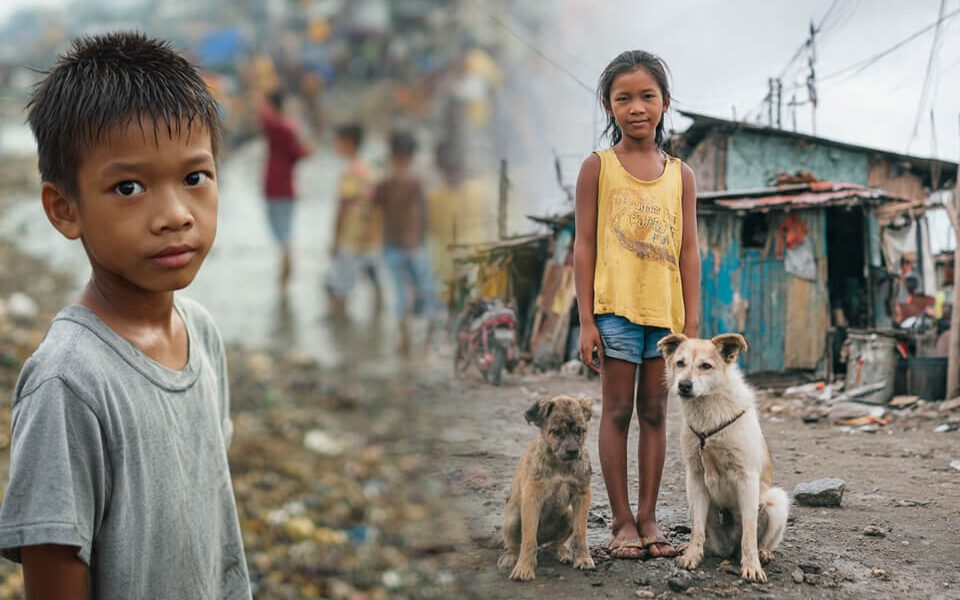
We call ourselves a “rising economy,” yet millions still live hand-to-mouth. This is the Poverty Paradox — rich country on paper, poor people in real life. The truth? AI’s real purpose isn’t just to make art or write content — it’s to break the system that keeps Filipinos poor.
15.5 million Filipino families consider themselves poor (SWS, April 2025). Read more at: https://www.aiwhylive.com/politics-of-poverty-philippines-ai/
Part I: Politics’ Most Profitable Business — “Helping the Poor”
Let’s be real: the most successful business in the Philippines isn’t BPO, real estate, or even OFW remittances.
It’s poverty — or more accurately, the business of “helping” the poor.
Every election season, the same show repeats: politicians riding brand-new SUVs, flashing smiles, handing out ayuda for the cameras. Poverty isn’t treated as a crisis; it’s a campaign prop.
Here’s how the game works:
- The Photo Op: Distribution Drives Become Content. Instead of reform, we get selfies with sacks of rice.
- The Pity Fund: Charity becomes a tool to secure loyalty, not to create independence.
- The Perpetual Threat: Keeping people poor means keeping voters dependent — ensuring dynasties stay in power.
We have the money, brains, and talent to move forward. But our system thrives on inefficiency and manual data. It’s not broken — it’s designed that way.
Part II: The 4Ps Failure — Ghosts in the Machine
The 4Ps (Pantawid Pamilyang Pilipino Program) was meant to be a lifeline — a fair, data-based system to help struggling families.
But in reality, it became a symbol of how bad data equals bad governance.
Outdated surveys, manual lists, and political “recommendations” make it easy to manipulate. Local officials can add or remove names depending on loyalty, not need. That’s what we call Patronage Leakage — money meant for the poor, quietly redirected to the loyal.
Here’s the painful truth:
The 4Ps doesn’t fail because Filipinos are lazy. It fails because its data is lazy.
Imagine if we used AI-driven systems that can update in real-time — identifying who’s really poor through satellite images, transaction records, and census data.
That’s what “The Real 4Ps Change in the AI Era” means: moving from political guessing to algorithmic precision.
Part III: The AI Sledgehammer — When Data Becomes the New Weapon
AI isn’t just about chatbots or writing tools. Its real power is in destroying corruption at the data level.
Because, unlike humans, AI can’t be bribed.
It doesn’t care who your mayor is. It only follows truth.
Here’s how it fights the system:
| The Problem | AI’s Solution |
|---|---|
| Ghost Projects – Roads and schools that exist only on paper. | Predictive Procurement Audits – AI scans bids and budgets, flags overpriced materials or collusion before money is released. |
| Fake Poverty Lists – Politicians deciding who’s “poor.” | Granular Poverty Mapping – AI reads satellite data and census info to find real poverty hotspots instantly. |
| Red Tape & Fixers – Land titles and business permits are taking years. | Blockchain + AI Verification – A tamper-proof digital record that cuts out middlemen and bribes. |
This isn’t just efficiency — it’s data integrity.
AI doesn’t replace government; it forces government to act honestly.
Part IV: Ending the Photo-Op Economy
The Poverty Paradox is not about lack of talent or resources. It’s about design — a system that profits from keeping people poor.
AI can change that. It can separate “helping for headlines” from “helping for real.”
But if leaders refuse to integrate technology that can audit, track, and expose inefficiency, their refusal should be seen for what it is — self-preservation.
Let’s be honest: the real fear isn’t that AI will replace jobs.
The real fear is that AI will replace excuses.
The tech is ready. The question now is —
Do our leaders have the diskarte to give up their favorite business model?
Sources:
- The Real 4Ps Change in the AI Era: Why Data Is the Ultimate Anti-Poverty Weapon
- The Politics of Poverty in the Philippines: How AI Exposes the Business Model
AI and Philippine Politics: Part 3 > “Blessed are ye poor: for yours is the kingdom of God.” > — Read more

Drawing on our Politics of Poverty in the Philippines & AI analysis, we see a familiar pattern: we “teach them Read more

In the Philippines, poverty has long been a political prop—a backdrop for photo ops, a campaign slogan, and a business Read more
If stupidity can go viral, why not kindness—especially when it’s lit, scripted, and monetized? We’ve monetized stupidity. We’ve turned pranks Read more