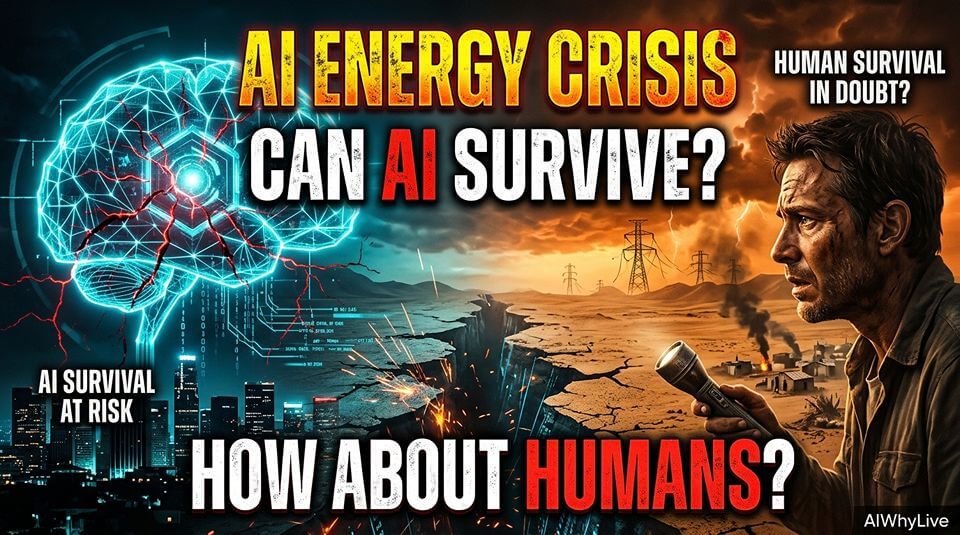
Can AI and Humans Survive the Global Energy Crisis?
For years, we worried about whether computers would become powerful enough to run artificial intelligence.
That problem appears to be getting solved.
Now another problem is showing up.
Can we find enough electricity to plug everything in?
AI data centers need electricity.
Factories need electricity.
Hospitals need electricity.
Homes need electricity.
Electric vehicles need electricity.
Air conditioners need electricity—sometimes during the exact heat waves when electricity systems are under the greatest pressure.
And billions of people would understandably like more access to reliable, affordable energy as their economies develop.
Welcome to another strange problem of the Age of AI.
Humanity needs more electricity.
And both are asking an electricity system that cannot always expand as quickly as demand.
🧠 AIWhyLive Explains: Is AI Causing the Global Energy Crisis?
No. That would be an exaggeration.
Artificial intelligence did not create the world's energy problems, and data centers are not consuming most of the world's electricity.
Global electricity demand is increasing for many reasons: industrial growth, more appliances, electric vehicles, heat pumps, air conditioning and data centers are all contributing.
The International Energy Agency forecasts global electricity demand to increase 3.6% in 2026 and another 3.8% in 2027.
So this is not a simple story about evil computers stealing electricity from humans.
It is more interesting than that.
It became a very large new customer while the rest of us were still trying to solve it.
The AI Revolution Has a Power Cord
Artificial intelligence often feels almost magical.
You type a question.
Words appear.
You ask for code.
Code appears.
You generate an image.
A picture appears.
But nothing magical happened.
Somewhere, physical machines performed enormous numbers of calculations.
Those machines sit inside physical buildings.
They require chips, cooling equipment, networking, water in some facilities and—most importantly for this discussion—electricity.
The cloud is not floating in the sky.
It has a power bill.
How Much Electricity Are Data Centers Using?
Data-center electricity consumption is growing quickly as cloud computing and artificial intelligence expand.
The International Energy Agency has repeatedly warned that the important issue is not simply global electricity consumption, but also where new data centers are concentrated.
A large electricity load can be manageable globally while creating serious problems locally.
Why?
Because electricity is not magically transported from every power plant on Earth to whichever data center needs it.
Power generation, transmission lines, substations and distribution networks must exist in the right places.
It is also:
"Do we have enough electricity in the right place, at the right time, with the grid infrastructure needed to deliver it?"
Then AI Hit a Wall—An Electrical One
In October 2026, a remarkable example appeared in the United Kingdom.
Microsoft withdrew from an agreement connected to a planned AI data center after major delays involving its electricity connection were reported.
The planned facility was intended to begin with about 50 megawatts of AI computing capacity.
But the expected electricity connection had reportedly slipped into the 2030s.
Think about what that means.
The problem was not that humanity could not manufacture computers powerful enough for the project.
The problem was getting enough electricity to the computers.
Now we are discovering another limit:
Can we find enough power to plug them in?
👦 ELI12: Imagine Your House Has Ten Outlets
Imagine your house has ten electrical outlets.
The refrigerator needs one.
The television needs one.
Your parents need some.
You need one.
The air conditioner definitely wants one.
Then an extremely intelligent robot moves into your house.
The robot says:
"Good news! I can help your family use electricity more efficiently."
Excellent.
Then the robot adds:
"I also need three outlets."
😂
Now your family has an interesting problem.
The robot may genuinely help.
But first you have to power the robot.
That is a simplified version of the AI energy paradox.
🐘 Elephant in the Room: Who Gets the Electricity?
This is where the conversation becomes uncomfortable.
Imagine an electricity system struggling to expand quickly enough.
Homes need power.
Hospitals need power.
Factories need power.
Schools need power.
Water systems need power.
Businesses need power.
Air conditioning needs power during dangerous heat.
And then a new AI data center arrives asking for hundreds of megawatts.
There is not literally a giant switch marked:
or
AI
Electricity systems do not normally work that way.
But large new loads create real questions.
Who pays for new generation?
Who pays for transmission?
Who pays for substations?
Should existing electricity customers carry some of those costs?
Should large data centers bring some of their own power?
Should they reduce consumption when the grid is under stress?
And how quickly should they be allowed to connect when other customers also need capacity?
These are no longer theoretical questions.
Someone Has to Pay for the Bigger Grid
In the United States, regulators are already wrestling with this issue.
In September 2026, the Federal Energy Regulatory Commission directed grid operator PJM to revise a proposal designed to address a power-supply shortfall of more than 6,800 megawatts.
Rapidly expanding data-center demand was an important part of that challenge.
One of the key issues was cost.
Regulators argued that existing customers should not simply be left paying costs attributable to large new electricity demand.
That is an important distinction.
The question is not:
"Should AI exist?"
The more practical question is:
"If AI requires enormous new electricity infrastructure, who should pay for it?"
🍗 Lechon Manok: AI, Please Solve the Energy Crisis
Human: "AI, we have an energy crisis."
AI: "Certainly. We should improve transmission, expand generation, deploy storage, increase efficiency and modernize the grid."
Human: "Brilliant!"
AI: "Thank you."
Human: "Please calculate the best solution."
AI: "Certainly."
Human: "Anything else?"
AI: "Yes."
Human: "What?"
AI: "Electricity."
Human: "How much?"
AI: "About that..."
😂
We may eventually ask artificial intelligence to help solve an electricity problem while simultaneously building more electricity infrastructure to power the artificial intelligence helping us solve the electricity problem.
Welcome to progress.
But AI Could Also Help Solve the Energy Problem
This is where an anti-AI article would become too simple.
AI is not only an electricity consumer.
Artificial intelligence can also potentially help electricity systems operate more intelligently.
AI can assist with forecasting electricity demand, predicting renewable generation, detecting equipment problems, optimizing operations and helping grid operators understand increasingly complicated electricity systems.
Better forecasting matters when more solar and wind power enter the grid.
Better maintenance can matter when aging infrastructure fails.
Better optimization can potentially help operators use existing assets more efficiently.
So we arrive at a wonderfully ridiculous but potentially useful paradox:
Electricity systems need to become smarter.
AI may help make electricity systems smarter.
But making AI smarter requires more electricity.
AI Companies Are Starting to Think Like Energy Companies
The scale of the challenge is changing corporate behavior.
According to the International Energy Agency, data-center operators continue to sign large renewable power-purchase agreements.
Companies and developers are also exploring technologies including advanced geothermal energy, nuclear power, long-duration storage, batteries and on-site generation.
Some policy makers are even exploring versions of a simple idea:
If you are bringing an enormous new electricity demand to the grid, perhaps you should also help bring new electricity supply.
This is sometimes described as "bring your own power."
That may become one of the defining infrastructure questions of the AI boom.
The Data Center Could Become Part of the Grid
There is another possibility.
Instead of treating every data center as a giant machine that demands full electricity whenever it wants, some future AI workloads could become more flexible.
Imagine moving non-urgent AI calculations to times when renewable electricity is abundant.
Imagine shifting some computing between regions.
Imagine data centers with batteries or their own generation helping support the grid during stressful periods.
The IEA says these kinds of arrangements are being explored, although flexible computing remains difficult and relatively uncommon.
There is a simple reason.
AI computing capacity is extremely valuable.
Turning expensive computers off just because electricity is scarce can also be extremely expensive.
So again, the engineering answer meets the economic answer.
The Global Number Can Hide the Local Problem
This point is important because scary global numbers are easy to misuse.
Data centers are not expected to consume most of the world's electricity.
Even rapid AI growth does not mean every household is about to lose power because somebody generated an AI cat video.
The more immediate challenge is concentration.
A large cluster of data centers can create enormous new demand in one region.
That region may have limited transmission capacity.
New power plants take time.
New transmission lines can take years.
Substations and transformers cannot always be ordered today and installed tomorrow.
That is why an AI boom that looks manageable on a global spreadsheet can become a serious infrastructure problem in a particular community.
And Humans Are Using More Electricity Too
There is another reason not to blame everything on AI.
Humanity itself is electrifying.
More people are buying air conditioners.
Vehicles are moving toward electricity.
Heating is increasingly electrified in some countries.
Industry needs power.
Digital services need power.
Developing economies want higher living standards.
And extreme heat can sharply increase cooling demand.
The IEA's 2026 outlook even warns that a stronger-than-expected El Niño could push electricity demand higher while affecting some hydropower and wind generation.
So the real competition is not simply:
Humans vs AI.
It is:
The Energy Crisis Does Not Hurt Everyone Equally
A wealthy technology company facing an electricity shortage has options.
It can invest billions.
It can choose another location.
It can sign long-term electricity contracts.
It can build generation.
It can negotiate with governments and utilities.
Ordinary people have fewer options.
A household cannot relocate to another country because electricity prices increased.
A small business cannot casually build a power plant.
A family struggling with cooling costs during extreme heat cannot negotiate a gigawatt-scale electricity contract.
This is why the human side of the AI energy story matters.
The IEA reports that high energy prices and supply disruptions have already forced conservation measures in some price-sensitive economies.
An energy shock that appears as an infrastructure problem to a technology company can appear as a household-budget problem to a human being.
🐘 Another Elephant: What Is AI Electricity Actually Worth?
Here is an uncomfortable question.
Not all AI computation has equal value.
AI helping discover a medicine is one thing.
AI optimizing an electricity grid is another.
AI helping a small business become more productive may create genuine economic value.
AI generating the 47-millionth slightly different picture of a celebrity riding a dinosaur is...
also technically computation.
😂
But who decides which computation deserves electricity?
That question becomes dangerous very quickly.
Governments deciding which ideas deserve computing power could create problems far worse than an expensive electricity bill.
Markets can allocate resources, but markets also reflect who can afford to pay.
So there is no simple answer.
But the question exposes something we often forget:
The resources required to create it are very physical.
Could Better AI Use Less Electricity?
Yes, and this may become one of the most important competitions in artificial intelligence.
The future AI race may not be only about who builds the smartest model.
It may also be about who produces useful intelligence most efficiently.
Better chips can perform more computation per unit of energy.
Better software can reduce unnecessary work.
Smaller specialized models may perform some tasks without requiring the largest available AI system.
Data centers can improve cooling and power management.
AI companies have powerful economic incentives to improve efficiency because computing is expensive.
But there is a catch.
If AI becomes dramatically cheaper, people may simply use much more AI.
Efficiency can reduce the electricity required for one task while exploding the total number of tasks performed.
That means:
More efficient AI does not automatically mean lower total AI electricity demand.
What Does the IEA Recommend?
In October 2026, the International Energy Agency published Powering Artificial Intelligence, examining data-center policies across jurisdictions representing about 90% of global data-center capacity.
The report does not recommend stopping AI.
Instead, it focuses on making data centers better participants in electricity systems.
Its principles include greater transparency about where data centers will be built and how much electricity they will need, better grid-connection processes, attention to energy and water efficiency, fair allocation of infrastructure costs, and frameworks allowing data centers to contribute to grid flexibility and stability.
That may sound less exciting than:
"AI WILL DESTROY THE POWER GRID!"
But boring infrastructure decisions are often where the real future gets built.
Frequently Asked Questions
Is AI causing the global energy crisis?
No. Global electricity demand is increasing for many reasons, including industrial growth, air conditioning, electric vehicles, heat pumps, appliances and data centers. AI is an important new source of data-center electricity demand, but it is not the sole cause of global energy pressures.
Why does AI use so much electricity?
Modern AI requires large numbers of specialized computer chips to train models and process user requests. These chips operate in data centers that also require networking, cooling and other supporting infrastructure, all of which consume electricity.
Can AI data centers cause electricity shortages?
Large data centers can place substantial pressure on local electricity systems, especially where generation or grid capacity cannot expand quickly enough. The challenge is often local or regional rather than evidence of a worldwide electricity shortage caused by AI.
Will AI make electricity more expensive?
The effect depends on the electricity market, location, infrastructure and how the costs of new generation and grid upgrades are allocated. Regulators in some regions are already considering how to prevent existing customers from carrying costs primarily created by large new electricity users.
Can AI help solve energy problems?
Potentially. AI can assist with electricity-demand forecasting, renewable-energy forecasting, grid optimization, equipment monitoring and other complex tasks. The paradox is that providing these AI capabilities also requires electricity.
Can renewable energy power AI data centers?
Renewables are already an important part of data-center electricity procurement. However, data centers often require reliable electricity around the clock, so grids may also need storage, transmission, flexible demand, other generation sources or combinations of these technologies.
Will more efficient AI solve the electricity problem?
Efficiency can reduce the electricity required for individual AI tasks, but total electricity demand may still rise if lower costs lead to much greater AI use. Both efficiency and expansion of electricity infrastructure are therefore important.
🎤 Drop Mic: AI Needs Power. So Do We.
For years, humanity asked:
Can AI think like us?
Then we asked:
Can AI replace us?
Now another question is quietly appearing.
Can we afford to power everything we're building?
AI needs electricity.
Hospitals need electricity.
Factories need electricity.
Homes need electricity.
Water systems need electricity.
The air conditioner keeping someone safe during a brutal heat wave needs electricity.
And perhaps artificial intelligence will help us discover better ways to generate, store, distribute and conserve all that electricity.
That is the strange bargain of the Age of AI.
So can AI survive the global energy crisis?
AI can become more efficient.
Data centers can move.
Technology companies can invest billions in new generation, grids, storage and infrastructure.
Humans do not relocate quite so easily.
Maybe the most important question isn't whether humanity can find enough electricity for AI.
Maybe it is whether the Age of AI can help us build enough reliable, affordable energy for everyone.
So do we.
Let's make sure progress remembers who the power is ultimately supposed to serve.
AIWhyLive — Think beyond the prompt.

I Asked ChatGPT to Show Me /timelineview: The Philippines’ El Niño Timeline, October 2026 to 2027 | AIWhyLive I Asked Read more

When mainstream news outlets like the BBC start casually discussing whether artificial intelligence is going to wipe out humanity, you Read more

The internet gave everyone a microphone. AI gave everyone an argument. Maybe the smartest move is knowing when not to Read more

In 2026, the vibe in the Philippines is... heavy. Between the red alerts on the Luzon grid, global supply chains Read more