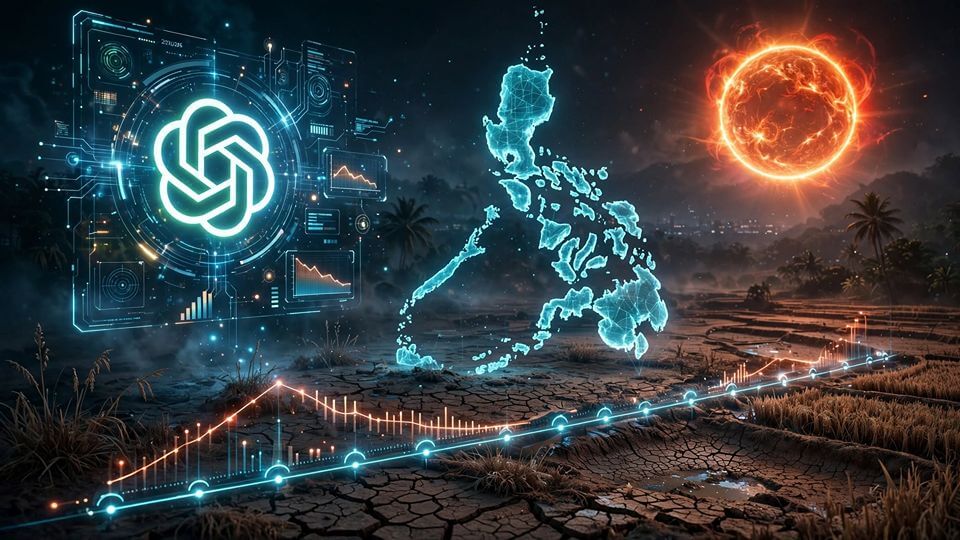
I Asked ChatGPT to Show Me /timelineview: The Philippines’ El Niño Timeline, October 2026 to 2027
What happens when you take a complicated climate forecast and put it on a timeline?
That was my question to ChatGPT.
Not: “Will El Niño happen?”
That question has already been answered.
The better question is:
“What could the next several months look like for ordinary Filipinos?”
So I asked ChatGPT to build a /timelineview.
🌡️ First, the important part: El Niño is already here
According to the latest climate advisories available in September 2026, the Philippines is dealing with an active El Niño event.
DOST-PAGASA says the current Strong El Niño is expected to intensify into a Very Strong El Niño during the September–December 2026 period and may persist through the first half of 2027.
The World Meteorological Organization likewise says El Niño is expected to strengthen further and has placed the likelihood of its persistence through February 2027 at nearly 100 percent.
That sounds frightening.
But there is an important distinction.
A climate forecast is not a daily weather forecast.
El Niño changes the odds.
It does not tell us that every Filipino will experience the same weather every day.
🧠 AIWhyLive Explains: What is El Niño?
El Niño is a recurring climate phenomenon associated with unusually warm ocean temperatures in the central and eastern tropical Pacific.
That ocean warming can influence atmospheric circulation far beyond the Pacific.
For the Philippines, one important consequence is an increased likelihood of below-normal rainfall, dry spells and drought in some areas.
But here's the part that often gets lost in headlines:
El Niño does not mean “zero rain.”
The Philippines can still experience thunderstorms, monsoon rains and tropical cyclones during an El Niño event.
That is why the timeline below should be read as a picture of increasing or decreasing risk, not as a promise about what the weather will do on a particular Tuesday.
📅 /timelineview: October 2026 → 2027
Here is the simple version.
🔴 October 2026 — The intensification becomes harder to ignore
El Niño is strengthening.
For parts of the Philippines, the concern is not simply one unusually hot day. It is the possibility of rainfall deficits accumulating over time.
Farmers begin watching soil moisture.
Communities begin watching water supplies.
Households begin noticing the heat.
The story is shifting from “El Niño is coming” to “El Niño is affecting decisions.”
🔴 November 2026 — Very Strong El Niño develops
International forecasts indicate further strengthening during late 2026.
This is where the timeline becomes particularly important.
Less rainfall does not automatically create a crisis.
But repeated rainfall deficits can gradually create problems for:
- agriculture
- irrigation
- reservoirs
- water supply
- livelihoods dependent on weather
The danger is cumulative.
🔴 December 2026 — Around the expected global peak period
This is one of the months to watch closely.
WMO forecasts indicate that El Niño should reach very strong intensity and peak toward the end of 2026.
NOAA's September 2026 assessment also puts the probability of a very strong event above 90 percent for the Northern Hemisphere fall and winter, while its outlook gives a substantial probability to an event reaching historically strong levels under its specific RONI measurement.
But there is a critical warning:
A global El Niño peak does not mean every part of the Philippines reaches its worst conditions in December.
Local rainfall, geography, monsoon behavior and individual weather systems still matter.
🔴 January 2027 — The event may still be strong
Here's where a common misunderstanding appears.
Suppose El Niño reaches its strongest point around late 2026.
Does everything return to normal on January 1?
No.
Climate impacts have momentum.
If rainfall deficits have already accumulated, farms, reservoirs, rivers and communities may still feel the effects even if the ocean signal begins changing.
The peak of the phenomenon and the peak of its local consequences do not necessarily occur on the same day.
🟠 February 2027 — Still active
WMO's current outlook gives an exceptionally high likelihood that El Niño persists through February 2027.
For the Philippines, this means the country should not assume that the problem disappears simply because the calendar has changed.
Water and agricultural conditions remain important things to monitor.
🟠 March–April 2027 — Possible transition
This is where the forecast becomes increasingly uncertain.
PAGASA currently expects El Niño to persist into the first half of 2027.
As the event eventually weakens, the next question becomes:
How quickly can the Philippines recover?
Rainfall can return before reservoirs, groundwater, soil moisture and agricultural production fully recover.
In other words:
El Niño can end before all of its consequences end.
🟢 May–June 2027 — Possible recovery period
PAGASA's current outlook extends the potential duration of El Niño through the first half of 2027.
If the event weakens as expected, rainfall patterns may gradually become less dominated by the El Niño signal.
But “El Niño ending” should not be confused with “everything immediately back to normal.”
Recovery depends on actual rainfall and local conditions.
🌾 What could El Niño mean for Filipino farmers?
A farmer does not experience El Niño as a number on a climate chart.
A farmer experiences it as a question:
“Will there be enough water when my crop needs it?”
Below-normal rainfall can reduce soil moisture and put pressure on irrigation.
That can affect planting schedules, crop growth and farm decisions.
The impact will not be identical everywhere. Some locations can be wetter than others during particular seasons or weather events.
That geographic difference matters.
💧 What could El Niño mean for water?
This may eventually become one of the most important everyday questions.
How much water is available?
How much is being used?
How quickly are reservoirs recovering?
How much rainfall has actually fallen?
El Niño does not create a nationwide water shortage automatically.
But prolonged rainfall deficits can increase pressure on water resources in affected areas.
Water is where a climate story becomes a household story.
⚡ What about electricity?
Energy systems can also be affected by climate conditions.
Water availability can matter for hydropower, while high temperatures can increase electricity demand for cooling.
However, the actual effect on the Philippine power system depends on many factors beyond El Niño alone.
So this is another area where we should avoid the easy headline:
“El Niño will cause a power crisis.”
That is not something a climate forecast can guarantee.
🌡️ What about heat?
Heat may be the easiest El Niño impact for ordinary people to understand.
You do not need to study sea-surface temperature anomalies to notice that a hot afternoon feels uncomfortable.
But heat is also a health issue.
Long periods of unusually warm conditions can increase heat stress, particularly for vulnerable people and those working outdoors.
That means the El Niño conversation is not only about farmers.
It is also about construction workers, drivers, street vendors, athletes, children, older people and anyone whose daily life happens outside an air-conditioned room.
🍗 Lechon Manok: The calendar is not a crystal ball
Here's where we roast our own timeline.
We humans love dates.
Tell us something will happen in December and we immediately imagine December 15 at 2:37 PM.
Climate does not work that way.
“El Niño peaks toward the end of 2026” does not mean:
“Bring an umbrella on November 29, because December will be dry.”
Weather has too many moving parts.
So please don't turn a climate outlook into a horoscope.
The timeline shows risk. It does not predict your Tuesday.
🐘 Elephant in the Room: What happens if the forecast is right?
This is the uncomfortable question.
What if the very strong El Niño forecast materializes and some areas experience prolonged rainfall deficits?
The consequences would not necessarily arrive as one giant disaster.
They could arrive quietly:
- a farm postpones planting
- a reservoir drops
- a household changes its water habits
- a worker struggles with heat
- a crop produces less
- a community spends more on water
- a business adjusts its operations
One event can become a chain of smaller decisions.
That is why early warning matters.
👦 ELI12: Explain El Niño like I'm 12
Imagine the Pacific Ocean is a giant heat battery.
Now imagine that battery gets unusually warm.
That extra heat changes the atmosphere.
The atmosphere changes weather patterns.
Some places get more rain.
Some places get less.
For the Philippines, El Niño often increases the chance of hotter and drier conditions.
But it does not control every cloud.
It changes the odds.
Think of El Niño as changing the rules of the game—not deciding every play.
🧠 AIWhyLive Explains: Why a timeline is useful
Climate reports are full of probabilities, indices, anomalies and seasonal outlooks.
That information is important.
But most people don't think in Niño 3.4 values.
They think:
- Will my farm have enough water?
- Will our reservoir have enough supply?
- Will it be hotter?
- Will food become more expensive?
- Will my work be affected?
- When does this end?
A timeline translates a technical forecast into questions people can understand.
And that is one useful role for AI:
Not replacing the scientists—but helping ordinary people understand what the scientists are saying.
📌 What should Filipinos actually watch?
Instead of obsessing over a single forecast date, watch these signals:
- PAGASA advisories — especially updates to the ENSO Alert System.
- Rainfall forecasts — because El Niño impacts vary by location.
- Water levels — reservoirs and local water resources matter more to daily life than an ocean-temperature number.
- Soil moisture — particularly for farmers.
- Heat conditions — especially for outdoor workers and vulnerable groups.
- Agricultural advisories — planting and irrigation decisions should follow local conditions.
The forecast will also change.
That is normal.
A good timeline should be updated when the evidence changes.
❓ Frequently Asked Questions
When is El Niño expected to peak?
Current international forecasts indicate strengthening toward the end of 2026, with WMO expecting very strong intensity before a peak toward the end of the year. The exact peak and its local Philippine impacts can change as new observations become available.
How long could El Niño last in the Philippines?
PAGASA says the current event may persist through the first half of 2027. WMO's September 2026 update gives an exceptionally high likelihood of persistence through February 2027.
Does El Niño mean there will be no rain in the Philippines?
No. El Niño increases the likelihood of below-normal rainfall and dry spells in some areas, but individual weather systems can still bring rain, thunderstorms and tropical cyclones.
Will every part of the Philippines experience drought?
No. El Niño does not affect every location in exactly the same way. PAGASA notes that rainfall patterns can vary across the country and that some western areas can experience above-normal rainfall during the Southwest Monsoon.
What could be affected by El Niño?
Potential impacts include rainfall, water resources, agriculture, heat exposure and other climate-sensitive activities. The severity depends on location, duration and the interaction with other weather and climate patterns.
🎤 Drop Mic: The timeline is not the story
The timeline is only a way of seeing the story.
The real story is what people do with the warning.
We already know that El Niño is active.
We already know that the forecasts point toward a very strong event.
We already know that PAGASA expects it to potentially continue into the first half of 2027.
The question is no longer simply:
“When will El Niño happen?”
It is:
“What can we do before the consequences become harder to manage?”
That's the difference between a forecast and preparedness.
And perhaps that is the real reason I asked ChatGPT for a /timelineview.
Not to predict the future.
To make the future easier to see.
🪧 A Lineage of Warnings At AIWhyLive.com, this isn’t the first alarm bell. Back on July 6, 2023, we asked: Read more
Precision farming isn’t just a buzzword—it’s a global shift. And the Philippines is catching flight. 🌍 I. The Global Takeoff: Read more
Prepare for the impact of El Niño in the Philippines with valuable insights and life-saving strategies. Learn how to identify Read more

Why the Philippines Cares More About Concrete Than Curiosity—And Why That’s Dooming Our Future 😒 FLOOD CONTROL WITHOUT FLOOD CONTROL? Read more