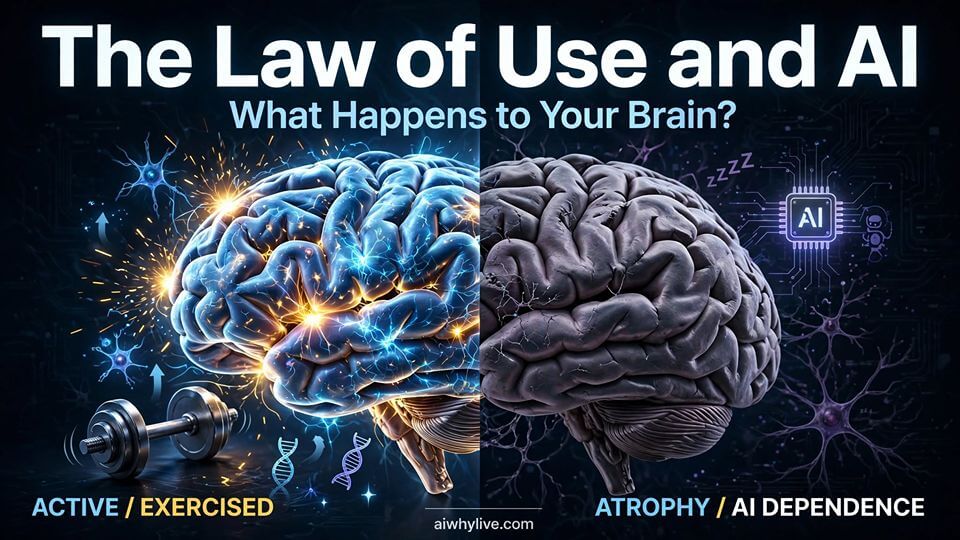
Use It, Lose It—or Give It to AI? What Happens When AI Does the Thinking?
There is an old principle that appears in many forms:
Use it or lose it.
Don't exercise your muscles?
They weaken.
Stop practicing a language?
Words become harder to retrieve.
Don't play the piano for ten years?
Your fingers may remember less than your ego does.
😂
Then artificial intelligence arrived.
And suddenly humanity received an extraordinary offer:
You don't have to do everything yourself anymore.
Can't write?
AI can write.
Can't code?
AI can code.
Can't summarize?
AI can summarize.
Can't translate?
AI can translate.
Can't brainstorm?
AI can brainstorm.
Can't calculate?
AI can calculate.
Can't remember?
AI can retrieve it.
Can't decide?
Well...
AI has some suggestions.
This is wonderful.
But it creates one of the most important questions of the AI era:
And perhaps an even more provocative question:
What happens to the human brain when we use more AI—and exercise our own thinking less?
🧠 AIWhyLive Explains: What Is the Law of Use?
For this article, let's define the Law of Use simply:
This is not a universal scientific law saying that every unused ability automatically disappears.
And we should not confuse a catchy phrase with neuroscience.
But the underlying principle is familiar across physical skills, learning and human performance.
Muscles need activity.
Skills need practice.
Languages need use.
Judgment needs decisions.
Writing improves through writing.
Problem solving improves through solving problems.
Thinking improves through...
Well.
That's where things become uncomfortable.
Because humanity has just created machines capable of performing parts of that thinking for us.
What Happens to the Human Brain If We Use Too Much AI?
Current research does not show that simply using AI will make your brain shrink, permanently damage it or automatically make you less intelligent.
That would be sensationalism.
But researchers are investigating a more credible concern:
cognitive offloading.
Cognitive offloading happens when we transfer mental work to an external tool.
Humans have always done this.
We write shopping lists instead of memorizing everything.
We use calculators instead of doing every calculation mentally.
We use GPS instead of memorizing every road.
We use calendars instead of remembering every appointment.
AI dramatically expands what can be offloaded.
Now we can outsource parts of:
- writing,
- remembering,
- researching,
- summarizing,
- reasoning,
- brainstorming,
- coding,
- planning,
- evaluating information,
- and decision-making.
That can reduce mental workload and improve performance.
But if AI repeatedly removes the mental effort through which a skill is learned or maintained, researchers are asking whether some human abilities may receive less practice.
It is:
"What happens to cognitive skills when we repeatedly outsource the mental processes that exercise them?"
Does AI Make the Brain Lazy?
The word "lazy" is catchy, but scientifically imprecise.
Your brain does not simply switch off because ChatGPT is open.
Different ways of using AI require different kinds of cognitive effort.
Someone blindly copying an AI answer is doing something very different from someone who:
- questions the answer,
- checks the evidence,
- finds contradictions,
- rewrites the argument,
- tests the code,
- compares alternatives,
- and makes the final judgment.
Both people are technically:
"using AI."
But their brains are not doing the same work.
This distinction may be more important than how many hours someone spends using AI.
What Research Says About AI, Mental Effort and Critical Thinking
Recent research is beginning to show why the distinction matters.
A study comparing young adults performing a reasoning task with and without ChatGPT found that the AI-assisted group achieved more correct responses while reporting significantly lower mental effort.
That sounds like a win.
And in terms of immediate task performance, it can be.
But the researchers also observed different patterns of use.
Some participants strategically engaged with AI.
Others delegated more of the reasoning.
The researchers concluded that AI did not uniformly improve or reduce critical thinking.
How people used it mattered.
Or it can become a replacement for thinking.
That difference may be the Law of Use in action.
What About the Famous "Your Brain on ChatGPT" Study?
One widely discussed MIT Media Lab experiment used EEG recordings while participants wrote essays under different conditions.
One group used a large language model.
Another used search engines.
Another worked without online assistance.
The researchers reported different patterns of neural connectivity, with the brain-only group showing the strongest and most widespread connectivity and the LLM-assisted group showing weaker overall coupling during the task.
Participants using the LLM also showed poorer ability in some sessions to quote from essays they had just produced and reported lower ownership of the writing.
That's fascinating.
But there is an important warning.
The researchers themselves described the work as preliminary, and the original 2025 paper was released as a preprint rather than a peer-reviewed final verdict. Scientists commenting on the study cautioned against drawing sweeping conclusions from one relatively small experiment.
An EEG difference during one kind of task is not proof that someone's brain is shrinking, deteriorating or permanently losing intelligence.
But the study contributes to a much more reasonable question:
Does letting AI perform more of a cognitive task change how deeply we engage with that task?
That deserves serious study.
The Brain Changes With Experience
The human brain is adaptable.
Experiences, learning and repeated activity influence how neural systems operate.
This adaptability is broadly associated with neuroplasticity.
That doesn't mean:
"Don't use something for a week and those neurons die."
The brain is far more complicated than that.
But it does mean our cognitive habits matter.
If we spend years practicing a skill, we become different from someone who never practices it.
If technology changes what we repeatedly practice, it can also change the skills we develop.
The critical AI question therefore becomes:
Are we practicing questioning?
Evaluation?
Reasoning?
Creation?
Verification?
Or mostly:
Accept.
Copy.
Paste.
AI Is the Greatest "Don't Worry, I'll Do It" Machine Ever Invented
Think about calculators.
They didn't destroy mathematics.
But many people stopped performing certain calculations manually.
GPS didn't destroy geography.
But some of us became remarkably helpless when navigation stopped working.
Autocorrect didn't destroy language.
But occasionally we stare at a perfectly normal word and think:
"That spelling looks suspicious."
Search engines arrived.
Why memorize something if you can retrieve it instantly?
Smartphones arrived.
How many phone numbers can you remember today?
Then AI arrived and said:
Why stop at memory?
I'll write it.
I'll explain it.
I'll organize it.
I'll compare it.
I'll analyze it.
I'll summarize it.
I'll generate the code.
I'll give you the answer.
And increasingly:
I'll reason through the problem for you.
That's different.
🐘 Elephant in the Room: What Happens to Skills We Stop Exercising?
Suppose you write every day.
You probably become a better writer.
Now suppose AI writes virtually every sentence for you for five years.
What happens?
Maybe you become incredibly productive.
Maybe you become an excellent editor.
Maybe you learn to direct AI brilliantly.
But there is another possibility.
You become extremely good at saying:
"Make this sound more professional."
😂
And increasingly uncomfortable writing the same thing from scratch.
Now apply the question to:
Research.
Coding.
Translation.
Calculation.
Memory.
Navigation.
Analysis.
Problem solving.
Decision making.
Even imagination.
🍗 Lechon Manok: The AI Gym
Human:
"AI, do 20 push-ups for me."
AI:
"Done."
Human:
"Great. Another 20."
AI:
"Done."
Human:
"Excellent. I'm getting stronger."
AI:
"..."
Human:
"What?"
AI:
"Nothing."
😂
Obviously AI cannot exercise your muscles for you.
But mentally, we can make a similar mistake.
We can confuse receiving a good output with performing the cognitive work that produced it.
Reading a brilliant AI essay is not the same mental exercise as constructing the argument yourself.
Reading working code is not the same as struggling to understand why it works.
Receiving an answer is not the same as discovering one.
And having AI recommend a decision is not necessarily the same as developing judgment.
Does Using AI Reduce Memory?
AI can reduce the need to remember information yourself, but whether that is harmful depends on what is being offloaded and whether learning is the goal.
Humans have always used external memory.
Books are external memory.
Notebooks are external memory.
Calendars are external memory.
The Internet is an enormous external memory system.
There is nothing inherently wrong with this.
You don't need to memorize every fact humanity has discovered.
But learning requires more than having information available somewhere.
A randomized controlled study of university students reported lower long-term retention in a group that used ChatGPT as a study aid compared with a traditional-learning group on a surprise test 45 days later.
The proposed explanation was not that AI somehow harmed their brains.
Rather, reducing the cognitive effort involved in learning may also reduce some of the processing that helps create durable memory.
The Dangerous Part Isn't Simply Losing Skills
It would be easy to conclude:
"AI is making everyone stupid!"
That's too simplistic.
Human civilization is built on outsourcing.
You probably don't grow all your food.
You don't manufacture your shoes.
You probably don't generate your own electricity.
You cannot build the processor inside your phone.
Specialization and tools are major reasons civilization advances.
Losing the need to perform some tasks manually isn't automatically bad.
I don't mourn my inability to calculate a 30-year mortgage with pencil and paper.
I don't want surgeons refusing modern equipment because:
"Real doctors do it manually."
😂
The question isn't:
Are humans going to lose some skills?
The better question is:
Some Mental Skills Are Not Just Skills. They Are Defenses.
Suppose AI becomes better than you at multiplication.
Fine.
Use the calculator.
Suppose AI becomes better at correcting grammar.
Fine.
Use the grammar checker.
Suppose AI finds the fastest route.
Wonderful.
Use GPS.
But suppose you gradually stop exercising:
critical thinking.
skepticism.
judgment.
curiosity.
the ability to recognize nonsense.
Now we have a different problem.
Because those are not merely productivity skills.
They are defenses.
They help protect you against:
- misinformation,
- manipulation,
- scams,
- propaganda,
- bad decisions,
- and incorrect AI answers.
Paradoxically, the better machines become at producing convincing information, the more valuable human judgment may become.
The Law of Use Meets the Law of Convenience
Humans love convenience.
Of course we do.
Why walk if you can ride?
Why calculate if you can click?
Why write 1,000 words if AI can produce them in seconds?
Convenience is one of civilization's great engines.
But convenience can hide a trade-off.
Whenever technology removes effort, ask:
Walking produces transportation.
It also produces exercise.
Writing produces words.
It can also develop thinking.
Research produces information.
It can also develop judgment about sources.
Coding produces software.
It can also develop problem-solving ability.
Making decisions produces outcomes.
It can also develop judgment.
AI can give us the output without necessarily giving us all the cognitive side effects of producing that output ourselves.
👦 ELI12: AI and the Bicycle
Imagine you're learning to ride a bicycle.
You own a robot that can ride perfectly.
You tell the robot:
"Ride to school for me."
The robot does.
Fast.
Safe.
Perfect.
You arrive at school.
Mission accomplished.
But did you become better at riding a bicycle?
No.
Now imagine something different.
The robot runs beside you.
It tells you when you're leaning too far.
It catches you when you're about to fall.
It explains what you did wrong.
As you improve, it gradually helps less.
Same robot.
Same technology.
Completely different result.
AI replaces the skill.
In the other:
AI develops the skill.
That distinction may determine whether AI makes human capability weaker or stronger.
Maybe We Are Asking the Wrong Question About AI and Jobs
Everyone asks:
What jobs will AI replace?
Maybe we should also ask:
What human abilities will AI replace inside people who keep their jobs?
A lawyer may remain a lawyer but draft less.
A programmer may remain a programmer but manually write less code.
A student may graduate while AI performs much of the writing.
A manager may remain responsible for decisions while AI increasingly recommends what those decisions should be.
Nobody technically lost their job.
But parts of the cognitive work changed hands.
That may be the quieter AI revolution.
What If AI Makes Us Better at Different Skills?
There is another possibility.
A programmer before generative AI may have spent enormous time typing routine code.
With AI, more of the programmer's value may shift toward:
Architecture.
Verification.
Security.
Testing.
Problem definition.
System design.
Judgment.
That isn't necessarily cognitive decline.
It can be cognitive migration.
The old skill changes into a higher-level skill.
But there is one important condition:
A programmer doesn't necessarily need to type every function.
But can they recognize dangerous code?
A writer doesn't need to draft every sentence.
But can they recognize weak reasoning?
An accountant doesn't need to perform every arithmetic operation.
But can they recognize when the numbers make no sense?
The future may not reward people who can do everything without AI.
It may reward people who know enough without AI to use AI safely.
The Pilot Problem: What Happens When Automation Fails?
Modern aviation offers a useful analogy.
Automation reduces workload.
It improves consistency.
It handles routine tasks.
But there is a reason human pilots still train.
When everything works, automation is excellent.
The human becomes particularly important when something doesn't.
AI may create a similar pattern across knowledge work.
When AI is correct:
You save time.
When AI is wrong:
Your remaining human skill becomes the backup system.
And a backup system that is never exercised may become less reliable.
What Happens When AI Is Right 99% of the Time?
Bad AI may actually keep us alert.
If AI constantly makes obvious mistakes, humans check everything.
But imagine AI becomes extraordinarily reliable.
Monday:
Correct.
Tuesday:
Correct.
Wednesday:
Correct.
For years:
Correct.
Eventually you stop checking.
Then comes the one answer that matters.
Wrong.
And your ability to recognize the mistake may have received very little exercise because you haven't needed it for years.
The danger may be AI that succeeds often enough to make human competence feel unnecessary—until suddenly it isn't.
The Law of Use Works Both Ways
Now for the optimistic half.
AI can reduce the practice of a skill through replacement.
But AI can also make people use abilities they rarely used before.
Before AI, someone might write once a month.
With AI assistance, they may write every day.
Before AI, someone might never code.
Now they build applications.
Before AI, someone might avoid writing in English because they fear making mistakes.
Now AI helps them communicate internationally.
Before AI, a small entrepreneur might never analyze business data.
Now they can.
Before AI, someone might never read philosophy.
Now they're arguing with Socrates at midnight through a chatbot.
😂
AI does not automatically reduce human mental activity.
AI can unlock it.
AI as an Exoskeleton for the Brain
Perhaps the healthiest model is not:
AI thinks so I don't have to.
But:
I think—and AI lets me think farther.
Not:
AI writes because I don't want to think through the argument.
But:
I develop the argument, AI challenges it, and I improve it.
Not:
AI decides.
But:
AI gives me alternatives I didn't see, and I decide.
Not:
AI remembers everything, therefore I need to understand nothing.
But:
AI retrieves the information, while I understand what it means.
That is augmentation rather than surrender.
🍗 Lechon Manok: Two AI Users
User A:
"Write my article."
AI:
"Done."
User A:
"Publish."
User B:
"Here is my idea. Attack it."
AI:
"Here are five weaknesses."
User B:
"Good. Give me the strongest argument against me."
AI:
"Here."
User B:
"I disagree. Here's why."
AI:
"Then your argument needs stronger evidence here."
User B:
"Find the evidence."
AI:
"Here are the sources."
User B:
"I'll read them. Then let's rewrite."
Which human used more AI?
Maybe User B.
Which human did more thinking?
Also User B.
The Real Divide: Replacement AI vs Amplification AI
We often frame the future as:
Humans vs AI.
That may be the wrong battlefield.
The more interesting divide could be:
versus
Humans who use AI to amplify their thinking.
Both may become more productive.
Both may create impressive outputs.
For a while, they may even look identical.
But after ten years?
One has spent ten years practicing delegation to increasingly capable machines.
The other has spent ten years reasoning with increasingly capable machines.
That difference may compound.
The AI Brain Fitness Test
Take something AI regularly does for you.
Writing.
Coding.
Summarizing.
Translation.
Research.
Planning.
Calculation.
Then occasionally perform part of it yourself.
Not because manual work is morally superior.
Not because AI is cheating.
Not because humanity should return to 1997.
Do it for the same reason pilots use simulators.
Check whether the human backup system still works.
- Can you still write the paragraph?
- Can you explain the code AI generated?
- Can you summarize something after reading it?
- Can you recognize a suspicious number?
- Can you argue against the AI's recommendation?
- Can you solve an occasional problem without immediately reaching for AI?
- Can you explain what you supposedly learned without reopening the chatbot?
- Can you form an opinion before asking AI what your opinion should be?
If yes:
Wonderful.
AI may be amplifying you.
If not:
Maybe the technology hasn't merely saved time.
Maybe it has quietly acquired one of your abilities.
How to Use AI Without Stopping Your Brain From Thinking
There is no need to abandon AI to protect human cognition.
A better strategy is to change how we use it.
- Think first, prompt second. Form your own initial answer before asking AI when learning matters.
- Ask AI to challenge you. Request counterarguments, weaknesses and missing assumptions.
- Explain the answer back. If you cannot explain it simply, you may possess the output without understanding it.
- Verify important claims yourself. Make judgment part of the workflow.
- Use AI as a tutor occasionally, not merely an answer machine. Ask it to question you before revealing the solution.
- Keep some no-AI repetitions. Write, calculate, recall, reason or code manually sometimes when maintaining the underlying skill matters.
- Let AI remove low-value effort, not every form of effort. Some struggle is part of learning.
The goal is not maximum mental difficulty.
The goal is maintaining the abilities worth keeping.
Frequently Asked Questions About AI and the Human Brain
What happens to your brain if you use too much AI?
There is currently no good evidence that ordinary AI use automatically damages or shrinks the brain. The more credible concern is cognitive offloading: if AI repeatedly performs tasks involving memory, reasoning, writing or problem solving, users may practice some of those cognitive processes less. The effect depends strongly on how AI is used.
Does AI make your brain lazy?
"Lazy brain" is an oversimplification. AI can reduce mental effort for some tasks, but reduced effort can be either useful or problematic. Automating routine work can free attention for higher-level thinking, while delegating the thinking that a person needs to learn or maintain can reduce valuable cognitive practice.
Does ChatGPT reduce critical thinking?
Research suggests the relationship is not simple. Some studies find that greater reliance on generative AI is associated with reduced critical-thinking effort, whereas strategic use can support reasoning. How a person interacts with AI—blind delegation versus questioning, verification and integration—appears to matter greatly.
Can AI affect memory?
AI can reduce the need to remember information because information can be retrieved externally. That is not automatically harmful. However, when AI bypasses the effortful processing involved in learning, some research suggests long-term retention can suffer. Using AI to explain, quiz and challenge you may produce different outcomes from simply asking it to provide the final answer.
Does ChatGPT change brain activity?
A preliminary MIT Media Lab study reported different EEG connectivity patterns during essay writing among participants using an LLM, search engines or no online tools. The LLM group showed lower overall neural connectivity during the task. However, the research does not establish that ChatGPT damages the brain, and scientists have cautioned against drawing broad conclusions from the small preliminary study.
Can AI actually make people smarter?
AI can expand human capability by providing explanations, feedback, alternative perspectives, rapid experimentation and access to knowledge. Whether this develops the user's own abilities depends partly on whether the person actively engages with the material or simply delegates the cognitive work.
Should students avoid AI?
Not necessarily. The more useful question is how students use it. AI can support tutoring, feedback and exploration, but learning can suffer when it bypasses the reasoning, retrieval, practice and productive struggle required to develop durable skills.
How can I keep my brain active while using AI?
Think before prompting when possible, predict answers, explain AI outputs in your own words, verify claims, solve some problems independently, ask AI for questions rather than answers, challenge its conclusions and periodically practice important skills without assistance.
🎤 Drop Mic: Don't Compete With AI. Exercise With It.
AI will do more for us.
It will write more.
Code more.
Analyze more.
Remember more.
Recommend more.
Plan more.
Perhaps eventually decide more.
And humanity will face a temptation no previous generation has experienced at this scale:
Sometimes the correct answer will be:
You shouldn't.
Let the machine do it.
Nobody gets extra points in life for deliberately being inefficient.
But sometimes the answer should be:
Because the doing changes me.
Exercise isn't valuable because moving a dumbbell from the floor accomplishes something important for the dumbbell.
It changes the person lifting it.
Writing isn't only about producing words.
Thinking isn't only about producing answers.
Learning isn't only about passing exams.
Decision-making isn't only about selecting Option A or Option B.
The process can change the human performing it.
And that's the part automation can accidentally remove.
So use AI.
Use it aggressively.
Let it remove boring work.
Let it give you options.
Let it challenge you.
Let it teach you.
Let it find what you missed.
Let it multiply what you can accomplish.
But occasionally ask:
Because perhaps the greatest danger in the Age of AI isn't that machines become capable of everything.
It is that humans gradually stop practicing the things we still need to be capable of.
And perhaps the greatest opportunity is the opposite.
AI doesn't have to become the machine that makes us use our brains less.
It can become the machine that allows us to use them more.
The old rule was:
Use it or lose it.
The AI-era version may be:
But don't stop using yourself.
Automate the task when it makes sense.
Exercise the human when it matters.
The goal was never to prove humans can do everything without machines.
The goal is to make sure that as our machines become more capable...
we don't become less capable simply because we can.
AIWhyLive — Think beyond the prompt.
🌪️ Forget Prompt Engineering We’ve been told that to survive the AI revolution, we need to master “Prompt Engineering.” Wrong. Read more

The Cognitive Cost of Infinite Attention in the Age of AI 📖 The Mental Browser Crash It’s 2026. You’re not Read more
The Infinite Scroll Disease In 2026, AI doesn’t just generate content—it generates Brain Rot. Before the AI revolution, Brain Rot Read more

The Hidden Energy Drain of Notifications, Feeds, and AI Loops 📖 Abstract We wake up, check GCash for a balance, Read more