📢 AI Has Sources. So Do You.
One of the most common questions people ask AI is: “What are your sources?”
It’s a fair question. But maybe we’re asking the wrong audience.
The more important question is: What are your sources?
Where did your opinions come from? Who taught you what to believe? Who benefits if you keep believing it?
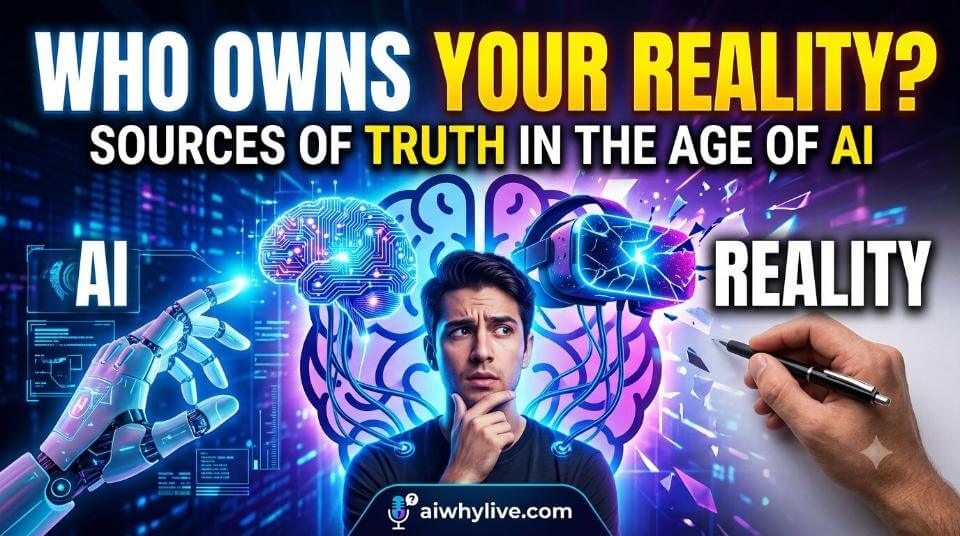
And perhaps the most uncomfortable question of all: Who owns your reality?
🧩 Every Mind Downloads Reality From Somewhere
None of us wakes up with complete knowledge. We learn. We observe. We listen. We trust.
Every day, we download pieces of reality from different places:
- Social media
- Television
- Online news
- Radio
- Books
- Podcasts
- Family
- Friends
- Personal experience
- Artificial intelligence
None of these sources is perfect. Every source has strengths. Every source has weaknesses.
The danger begins when one source becomes your only source. Reality is too big to fit inside a single algorithm, a single news outlet, a single influencer, or a single AI prompt.
🕰️ AI Didn’t Invent Misinformation
Humans did.
Long before smartphones, rumors traveled from one person to another. Stories exaggerated. Facts disappeared. Details conveniently forgotten.
The internet accelerated the process. AI accelerated it again.
Today, misinformation can be written in seconds, translated instantly, personalized for different audiences, and distributed globally before breakfast.
The technology changed. Human nature barely did.
⚖️ Misinformation vs. Disinformation
These two words are often confused.
- Misinformation: false or misleading information shared without intent to deceive.
- Disinformation: deliberately created or shared to mislead, with an agenda.
AI accelerates both. A single prompt can generate convincing articles, fake conversations, fabricated images, cloned voices, and realistic videos. The barrier to deception has never been lower.
🚨 The More Dangerous Threat
Sometimes the truth is available. Evidence exists. Experts explain it. Documents confirm it.
And people still refuse to believe. Not because they can’t understand—but because they choose not to.
When truth becomes inconvenient, humans invent comfortable lies. Then they gather around others who repeat those lies. Echo chambers are born.
🔊 Echo Chambers Don’t Need Walls
Every echo chamber begins with the same promise: “You don’t need to question us anymore.”
Inside:
- Everyone sounds the same.
- Every outside opinion is suspicious.
- Every disagreement is betrayal.
- Every inconvenient fact is an attack.
The goal shifts from discovering truth to protecting the narrative. At that point, it stops being a conversation and starts behaving like a cult.
🪞 Algorithms Didn’t Build the Cage Alone
Yes, algorithms play a role. They learn what we click, what we like, what keeps us engaged. Then they give us more of it.
But algorithms didn’t build the cage alone. They discovered the walls we were already building ourselves.
We reward information that confirms our beliefs. The algorithm notices. And keeps serving more of the same.
📚 AI Is Becoming a Better Librarian
Ironically, AI may become one of the best tools for escaping bubbles. A well‑used AI can:
- compare opposing viewpoints
- summarize complex research
- explain context
- identify logical fallacies
- challenge assumptions
- encourage follow‑up questions
In many ways, AI can be an excellent librarian. But even the best librarian can’t help someone who refuses to open a book.
🧒 Explain Like I’m 12
Imagine you’re assembling a giant puzzle. Everyone gives you pieces. Some give only blue pieces. Others only green. Some hide pieces they don’t like. Others replace pieces with fake ones.
Now imagine refusing to accept any pieces that don’t match the picture you already wanted. Can you ever finish the puzzle? Probably not.
That’s what happens when we choose comforting stories over uncomfortable truths.
🚫 The Most Powerful AI Cannot Do This
AI can answer questions, summarize evidence, compare sources, explain arguments, and flag unreliable information.
But AI cannot force intellectual honesty. It cannot force curiosity. It cannot force humility. And it cannot force someone to change their mind.
🏁 Final Thought
The greatest battle of the AI age may not be artificial intelligence versus human intelligence. It may be truth versus preference.
Information has never been more abundant. Certainty has never been cheaper.
The challenge is no longer finding information. The challenge is choosing what deserves to shape our reality.
When truth is inconvenient, humans invent comfortable lies. Then echo chambers grow. Reality becomes negotiable.
No technology—not even the most advanced AI—can save someone who willingly chooses deception over discovery.
Because AI has sources. Humans have sources too. The difference? AI usually tells you where its information came from.
The real question is: Can you still say the same about your beliefs? And perhaps the most important question of all: Who owns your reality?
📢 The Age of Information Created a New Profession Not journalist. Not marketer. Not politician. Not influencer. Truth manager. The Read more

📖 The Basics We Overlook We live in an age where machines can generate essays, code apps, and summarize books Read more
Why Faith and Politics Must Endure the Audit 📖 Abstract: The End of the Unquestioned Answer In the Age of Read more

We Filipinos are known for being madiskarte (resourceful). From finding side hustles online to navigating endless group chats, we’ve learned Read more