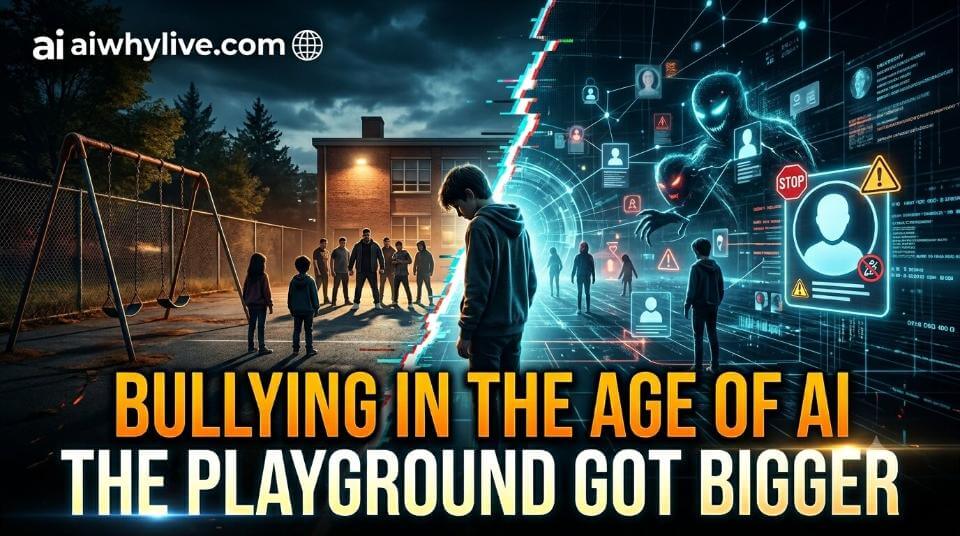
📢 The Bully Didn’t Disappear. The Playground Expanded.
For generations, bullying was limited by geography:
- a classroom
- a neighborhood
- a workplace
- a small social circle
The damage could be painful, sometimes devastating, but at least there were boundaries. The school bell eventually rang. People went home. The audience was limited.
Then the internet arrived. Then social media arrived. And now, artificial intelligence is arriving.
The bully didn’t vanish. The playground simply became much bigger.
👀 The Old Bully Needed a Crowd
Bullies have always relied on something beyond insults: an audience.
Without attention, bullying loses much of its power. Historically, that audience was small—classmates, coworkers, neighbors.
Today? The audience can be millions. And unlike a schoolyard, the internet never closes.
🤖 AI Didn’t Invent Bullying
Let’s be fair. Humans were bullying each other long before computers existed.
AI didn’t create cruelty. AI didn’t invent humiliation. AI didn’t manufacture envy.
Those came standard with humanity.
What AI changed was scale. And scale changes everything.
🎭 Welcome to Artificial Humiliation
Imagine someone wants to embarrass another person. In the past, they needed:
- a rumor
- a story
- witnesses
Today, they might create:
- Fake screenshots
- Fake conversations
- Fake images
- Fake audio
- Fake videos
Not because AI is evil. Because AI is powerful. And powerful tools magnify both wisdom and foolishness.
🌀 The New Bullying Doesn’t Always Look Like Bullying
Many imagine bullying as direct insults. Reality has evolved.
Modern bullying often arrives disguised as:
- Jokes
- Memes
- “Just asking questions”
- Engagement farming
- Reaction content
- Public pile‑ons
- Endless reposts
Thousands can participate without realizing they’ve become part of the attack. Nobody throws a punch. Yet the damage can be enormous.
💰 The Business Model of Humiliation
Here’s the uncomfortable truth: some forms of bullying are profitable.
The internet rewards attention. Attention generates:
- views
- clicks
- engagement
- advertising revenue
And outrage travels faster than empathy.
Humiliation becomes content. Content becomes engagement. Engagement becomes money. The cycle continues.
⚡ Technology Advanced Faster Than Empathy
Humanity now possesses tools previous generations could barely imagine. We can:
- generate images instantly
- translate languages
- automate complex tasks
- communicate globally
Yet one problem remains stubbornly familiar: people still enjoy watching others fall.
Technology evolved. Human nature didn’t evolve at the same speed.
🧒 Explain Like I’m 12
Imagine the loudest kid in school suddenly receives:
- a microphone
- a camera
- a computer
- an audience of millions
That doesn’t make the kid wiser. It just makes the voice louder. That’s what technology sometimes does.
🛡️ Can AI Help Stop Bullying?
Yes and no.
AI can:
- detect harassment
- identify harmful patterns
- flag abusive behavior
- remove malicious content
But AI faces a limitation. It can identify behavior. It cannot change character.
A machine can delete a harmful comment. It cannot teach kindness.
❓ The Bigger Question
Perhaps the challenge isn’t whether AI becomes smarter. Perhaps it’s whether humans become more responsible while wielding increasingly powerful tools.
Every breakthrough creates the same test: Will we use it to build? Or will we use it to tear down?
🪞 The Mirror Nobody Wants to Look Into
Bullying survives because it feeds on something deeper than technology:
- attention
- curiosity
- tribalism
- entertainment
Bullies need participants. Passive ones are enough. Every view. Every share. Every laugh. Every repost.
The crowd matters. And sometimes the crowd forgets its role.
🏁 Final Thought
The age of AI didn’t create bullies. It created bigger stages. Bigger audiences. Bigger consequences. Bigger responsibilities.
The real danger isn’t artificial intelligence. The real danger is giving ancient human behavior modern superpowers.
AI can generate images. AI can generate videos. AI can generate voices. But it still cannot generate empathy. That part remains our job.
And perhaps that is the most important test of the AI era. Not whether machines become intelligent. But whether humans finally become wise enough to deserve them.
The global economy is currently undergoing a silent, brutal reclassification of labor. For the last thirty years, the white-collar world Read more
🌑 The Most Human Thing Left? AI can now: write articles generate images summarize meetings answer questions build code automate Read more
In the Age of AI, "Protecting Your Money" is the Only Skill That Doesn't Depreciate. 🧠 Abstract: The New Capital Read more

🤺 The New Face of Digital Warfare Every scroll on Facebook can feel like a skirmish. Your karaoke-night–friendly neighbor morphs Read more