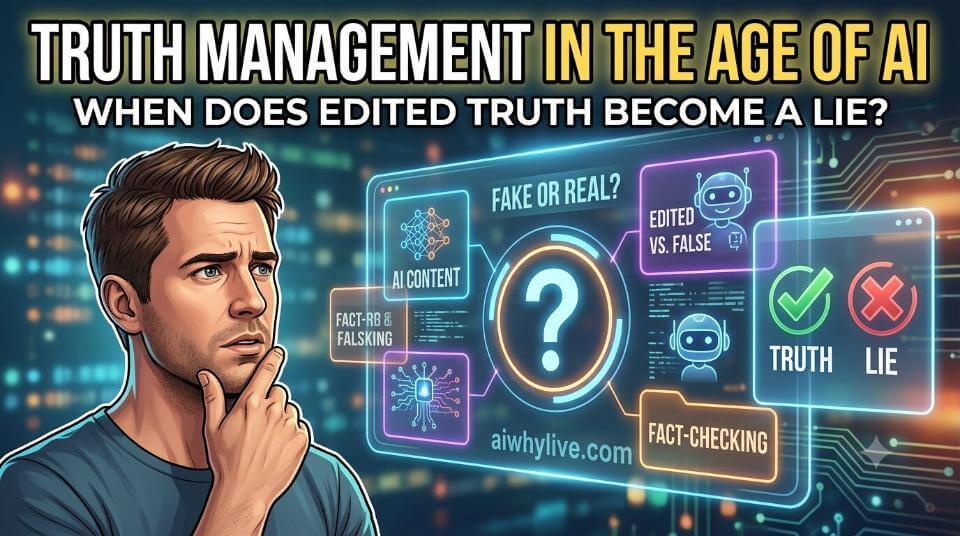
📢 The Age of Information Created a New Profession
Not journalist. Not marketer. Not politician. Not influencer.
Truth manager.
The job description is deceptively simple:
- Take reality.
- Remove inconvenient parts.
- Highlight favorable parts.
- Package it.
- Publish it.
- Repeat.
Welcome to the age of edited truth.
⚖️ The Problem Is Not That People Are Lying
That would be easier. A lie is straightforward: something happened, someone says it didn’t. Case closed.
Edited truth is more complicated. Because edited truth often contains facts—real, accurate, verifiable facts.
The problem isn’t what’s included. The problem is what’s left out. And sometimes, what’s left out matters more than what’s shown.
📚 A True Story Can Still Mislead
Imagine someone says: “I built a successful business.”
That may be true. But omitted details matter:
- years of failure
- financial support
- lucky timing
- help from others
- unexpected opportunities
The statement is factual. The picture it creates may not be complete. This is where truth management begins—not with fabrication, but with selection.
🪞 We Are All Editors Now
In a previous AIWhyLive article, we explored the idea that: You are what you post.
The uncomfortable reality is that most people no longer present themselves. They present a version of themselves:
- a curated identity
- a highlight reel
- a carefully managed narrative
Social media didn’t invent this behavior. It industrialized it. And now AI is accelerating it.
🤖 AI Didn’t Invent Truth Management
Humans were already experts. Long before AI, people knew how to:
- frame stories
- omit context
- emphasize successes
- minimize failures
- manage perception
AI simply makes the process faster. Much faster.
Now multiple versions of the same event can be generated in seconds: different tones, different audiences, different narratives, different slices of the same truth.
🚨 The Dangerous Part
People worry about fake news. But edited truth may be more powerful.
Fake news can sometimes be disproven. Edited truth is harder to challenge. After all, the facts themselves may be correct. The deception lies in the absence—the silence, the missing chapter.
🕒 Satirical Interruption: No Time to Fact‑Check
Here’s the irony: the very people who scream “fact‑check!” often don’t have time to do it themselves. Why? Because they’re too busy editing their own version of truth.
It’s not about accuracy anymore. It’s about optics. About polishing the narrative until it shines—even if the shine blinds the audience from what’s missing. Truth management has become the new hustle, and fact‑checking is just another casualty of the attention economy.
🔊 When Noise Thinks It’s Truth
This connects directly to another AIWhyLive observation: When noise thinks it’s power.
The loudest voice often appears most credible. The most frequent posts appear most important. The most visible narrative appears most true.
But visibility is not validity. Frequency is not accuracy. Popularity is not proof.
The internet rewards repetition more than reflection.
💡 The New Currency: Perception
The modern economy increasingly runs on attention. Attention creates influence. Influence creates opportunity. Opportunity creates incentives. Incentives create editing.
The result? Many people are no longer managing reality. They are managing perception.
🧒 Explain Like I’m 12
Imagine your teacher asks: “How was your exam?” You answer: “I passed.”
That’s true. But you forget to mention:
- you barely passed
- you guessed many answers
- your friend helped you study all week
You didn’t lie. But you didn’t tell the whole story either. That’s edited truth.
🛠️ The AI Problem Nobody Talks About
AI can now summarize documents, rewrite articles, generate reports, condense information. But every summary is also an edit. Every simplification removes something. Every narrative emphasizes something.
This doesn’t make AI dangerous. It makes critical thinking more important. Because the future may not be filled with lies—it may be filled with highly polished partial truths.
❓ The Question We Should Ask More Often
Not: “Is this true?” But: “What am I not being told?”
That question is becoming more valuable every year. Perhaps every day.
🏁 Final Thought
The Age of AI didn’t create deception. It created infinite opportunities for curation, framing, and selective storytelling.
The challenge is no longer distinguishing truth from lies. The harder challenge is distinguishing complete truth from edited truth.
Because a lie is not always a false statement. Sometimes it’s a true statement carefully designed to hide a larger truth.
And in a world where everyone can publish, edit, amplify, and optimize narratives instantly, the rarest commodity may no longer be information. It may be honesty.
Not perfect honesty. Not impossible honesty. Just enough honesty to show the parts that don’t make us look good.
Because the whole truth is often less flattering than the edited version. And that is precisely why it matters.
👉 Read more sharp, satirical breakdowns of the Age of AI at AIWhyLive.com—where we strip away the noise, expose the slop, and ask the questions algorithms can’t answer.
Why Faith and Politics Must Endure the Audit 📖 Abstract: The End of the Unquestioned Answer In the Age of Read more
When Algorithms Audit the Divine Operating System “In our earlier feature Faith vs. Logic: Can AI Reconcile Biblical Paradoxes? we Read more

📚 Humanity’s Greatest Achievement Might Be Producing More Nonsense Faster For thousands of years, humanity struggled to create knowledge. Books were Read more

The High-Speed Pursuit of the Wrong Goal 📖 Abstract: The Efficiency of the Error Human error has always existed. But Read more