Why Is It Getting Harder to Find Something Worth Reading?
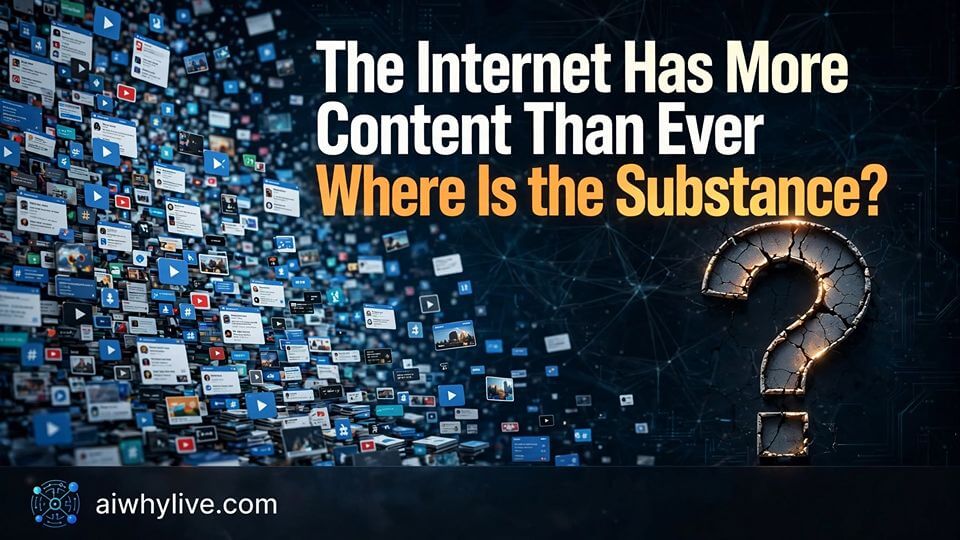
We have never had more information—and perhaps never had more difficulty finding something worth reading.
Open your phone. Scroll through a social media feed. Visit a news website. Search for an answer. Watch a video. Open your favorite platform.
There is always something waiting for you.
Another article. Another video. Another expert explaining something. Another shocking headline. Another opinion. Another list of things you supposedly need to know before tomorrow.
And then another.
The internet is not running out of content. It is overflowing with it.
But here is the uncomfortable question: When was the last time you found something online that genuinely made you think, taught you something useful, or changed the way you understood the world?
We have more content than ever. But quantity and substance are not the same thing.
The Internet Has Become a Content Factory
There was a time when publishing something online required more effort. You needed an idea, some knowledge, time to write, and a reason to share it.
Today, the barriers are much lower.
AI can produce an article draft in seconds. Image generators can create illustrations. Video tools can turn text into clips. Automated systems can publish, schedule, and distribute content across multiple platforms.
These are remarkable capabilities. They can help a small business communicate, allow independent creators to compete, and make knowledge easier to access.
But there is another side.
When producing content becomes extremely cheap and fast, the internet can be flooded with material created primarily because it is easy to produce—not because it is worth consuming.
Welcome to the age of content abundance.
And increasingly, the age of content noise.
AI Slop Is Only Part of the Problem
The term AI slop has become a convenient way to describe low-quality, mass-produced AI content. Think of repetitive articles, strange generated images, generic videos, recycled explanations, and posts that look polished but offer very little value.
But blaming AI alone misses the bigger picture.
Low-quality content existed long before generative AI.
- Content farms: Websites built to publish large volumes of articles targeting search traffic rather than delivering meaningful insight.
- Engagement bait: Posts designed to provoke comments, arguments, reactions, and shares, regardless of whether the discussion is useful.
- Clickbait: Headlines that promise extraordinary revelations but deliver ordinary information.
- Recycled opinions: The same arguments repackaged repeatedly, often without new evidence or deeper thinking.
- Manufactured expertise: Confident explanations that sound authoritative but lack meaningful experience, research, or accountability.
AI did not invent these problems. It made some of them easier to scale.
AIWhyLive Explains: AI is a production tool. It can help create something useful or help produce more noise. The tool does not automatically determine the value of the result. Human judgment, verification, originality, and purpose still matter.
The Attention Economy Doesn't Always Reward Substance
Here is where the problem becomes bigger than individual creators.
Many online platforms compete for attention. The longer people stay, the more opportunities there may be to show advertisements, recommend content, collect engagement signals, and generate revenue.
That creates an economic incentive to publish material that attracts attention.
Unfortunately, attention and value are not always the same thing.
A thoughtful explanation may take ten minutes to read and leave you with something useful. A provocative headline may make you angry in three seconds and keep you scrolling for another thirty minutes.
Both can generate engagement. But only one may leave you better informed.
Consider the difference:
- A useful article answers a question. Engagement bait creates another argument.
- A thoughtful video explains a subject. A shallow clip may simply trigger a reaction.
- A credible report provides context. A sensational headline may remove it.
- A meaningful discussion helps people understand. An outrage-driven thread keeps people fighting.
This does not mean every entertaining post is worthless or every serious article is valuable. Entertainment has its place. Humor, creativity, and light content are part of a healthy internet.
The problem begins when attention becomes the objective and substance becomes optional.
Why More Content Can Mean Less Discovery
Imagine walking into a library where every book is suddenly duplicated a thousand times. The building is full. The shelves are overflowing. Yet finding the one book you actually need becomes more difficult.
That is one way to understand the modern content problem.
When the volume of published material grows faster than our ability to evaluate it, discovery becomes harder.
Search results, recommendations, and social feeds must help people navigate an enormous supply of information. But no system can make every result useful to every person.
Readers must now do more work:
- Check whether the source is credible.
- Look for original reporting or evidence.
- Separate facts from opinions.
- Recognize recycled material.
- Determine whether an article actually answers the question.
- Decide whether the content deserves their time.
In other words, access to information has become easier, but evaluating information remains hard.
The New Content Race: Publish Faster, Think Less?
AI has created a tempting shortcut for creators and businesses.
Instead of asking, "What useful thing can I contribute today?" the temptation is to ask, "How many posts can I publish today?"
That is a dangerous change in priorities.
Publishing more can be useful when quality remains high. A business can use AI to produce helpful product guides, answer common customer questions, and communicate consistently.
A teacher can use it to prepare learning materials. A researcher can use it to organize information. A creator can use it to turn a good idea into multiple formats.
But if the goal is simply to fill a publishing calendar, the result may be a growing pile of material that nobody really needs.
Speed is an advantage only when it helps deliver value sooner.
Otherwise, it just helps produce more clutter.
What Makes Content Worth Consuming?
Not every article needs to be groundbreaking. Not every video needs to change the world. A simple recipe, funny story, practical tutorial, or personal experience can be valuable.
Substance is not about sounding intellectual. It is about giving the audience something worth their time.
Here are five practical tests:
1. Does it teach something?
Does the content help someone understand a subject, develop a skill, or make a better decision?
2. Does it offer something original?
Originality does not mean inventing an entirely new idea. It can mean providing a fresh perspective, real experience, useful examples, or a clearer explanation.
3. Does it provide evidence?
Are factual claims supported? Are sources identified? Can readers distinguish verified information from speculation?
4. Does it respect the reader's time?
Does it get to the point? Is the information organized? Does every paragraph contribute something?
5. Does it leave the reader better off?
After consuming the content, does someone know more, understand something better, feel appropriately entertained, or have a useful next step?
If the answer to every question is no, perhaps the content did not need to exist.
The Elephant in the Room: We Helped Create This Problem
It is easy to blame platforms, algorithms, content farms, and AI tools.
But creators do not publish into an empty space. They respond to an audience. And audiences influence what gets rewarded.
We click on sensational headlines. We share outrageous posts without checking them. We comment on arguments we do not fully understand. We reward creators for making us angry, even when we complain about the quality of online content.
We sometimes consume the very material we claim to dislike.
That does not mean audiences are solely responsible. Platform design, commercial incentives, and automated distribution also shape what people see.
But we are not powerless.
Every click, share, follow, subscription, and recommendation is a small signal about what deserves attention.
If we want a better internet, we cannot demand substance while consistently rewarding noise.
What Creators and Businesses Should Do Instead
The answer is not to stop using AI or stop publishing content. The answer is to use these tools with a clearer purpose.
Before publishing, ask:
- Am I adding information, insight, experience, or useful entertainment?
- Would this still be worth reading if the headline were less dramatic?
- Have I checked the claims and facts?
- Am I repeating something simply because it is trending?
- Would I recommend this to someone whose time I genuinely respect?
For small businesses, this can be a competitive advantage. A useful guide that answers a customer's real question may be more valuable than dozens of generic promotional posts.
For independent creators, personal experience, honest analysis, and a recognizable point of view can distinguish their work from mass-produced material.
For publishers, trust is an asset. It takes time to build and can be damaged by careless publishing.
And for anyone using AI, the most important question is not whether the machine can produce another article.
It is whether that article deserves to exist.
ELI12: Explain It Like I'm 12
Imagine your school has a thousand posters on the wall. Every poster says something, but most repeat the same message, make exaggerated promises, or contain information nobody checked.
Having a thousand posters does not mean your school has a thousand useful ideas.
Now imagine one student creates a poster that explains a difficult lesson clearly, with accurate information and examples. That one poster may be more valuable than all the others combined.
That is the difference between content and substance.
Content fills space. Substance gives people something worth keeping.
A Better Internet Starts With Better Questions
We do not need an internet with fewer ideas. We need one where useful ideas are easier to discover.
We do not need to reject AI. We need to reject the belief that anything produced quickly is automatically worth publishing.
We do not need every creator to become an expert. We need creators to be honest about what they know, what they do not know, and what they are trying to contribute.
And perhaps we need to become more intentional readers.
Follow people who teach you something. Support creators who do the work. Read beyond the headline. Check the source. Share something because it is useful, not merely because it is provocative.
The internet will probably continue producing more content. AI will make production even faster and more accessible.
That is not necessarily bad news.
But as content becomes cheaper, genuine substance may become more valuable.
The real opportunity: In a world where almost anyone can publish something, the ability to create something genuinely useful becomes a meaningful advantage.
Frequently Asked Questions
What is AI slop?
AI slop is an informal term for low-quality, mass-produced AI-generated material that offers little value, originality, or accuracy. It can include articles, images, videos, and social media posts.
Is AI responsible for the decline in online content quality?
AI is one contributing factor because it can make mass production easier. However, clickbait, content farms, recycled opinions, and engagement bait existed before generative AI. The broader issue involves incentives that reward attention and volume over usefulness.
What is the attention economy?
The attention economy describes a digital environment in which businesses and platforms compete for people's limited attention. User engagement can create opportunities for advertising, subscriptions, recommendations, and other forms of revenue.
How can readers identify low-quality online content?
Look for unsupported claims, missing sources, misleading headlines, repetitive information, exaggerated promises, and material that does not deliver what it initially offers. Compare important claims with reliable sources.
Can AI still help create meaningful content?
Yes. AI can help with research, drafting, editing, translation, organization, and accessibility. Meaningful content still requires human judgment, fact-checking, relevant experience, and a clear purpose.
Does publishing more content improve website traffic?
Not automatically. Publishing consistently can help a website reach readers, but volume alone does not guarantee visibility, trust, or engagement. Useful, original, well-organized content is a stronger long-term foundation.
AIWhyLive Explains
The internet's problem is not that people have too much to say. It is that the systems surrounding online publishing can reward the production and distribution of material without requiring much substance.
AI makes creation faster. Platforms make distribution easier. But neither guarantees accuracy, originality, or usefulness.
The next competitive advantage may not belong to whoever publishes the most.
It may belong to whoever consistently gives people a reason to stop scrolling.
It needs more reasons to read them.
What do you think? Is the internet becoming more informative, or are we drowning in content that looks like information but contributes very little? Share an example of something online that genuinely made you think.
Editorial note: This article discusses broad trends in online publishing and digital media. It does not claim that all AI-generated content is low quality or that all engagement-driven content lacks value.

📚 Humanity’s Greatest Achievement Might Be Producing More Nonsense Faster For thousands of years, humanity struggled to create knowledge. Books were Read more
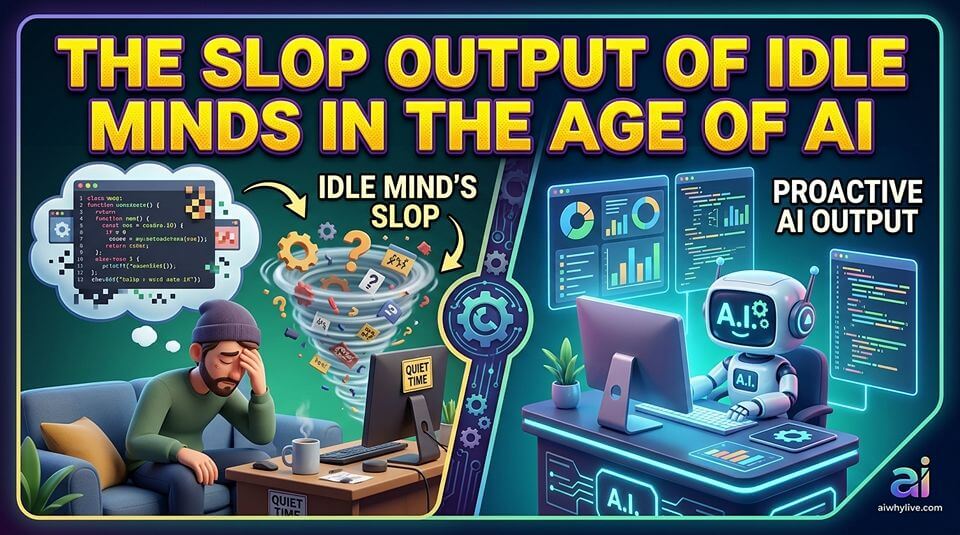
"Idle hands are the devil's workshop." Generations of elders used to warn us about the dangers of sitting around with Read more

When Did Doing Nothing Become So Uncomfortable? You're waiting for someone. They're ten minutes late. You sit down. Nothing to Read more

Personality Transplant, Anyone? Who Are You When AI Writes You Better Than You? Need to sound smarter? AI. More confident? Read more