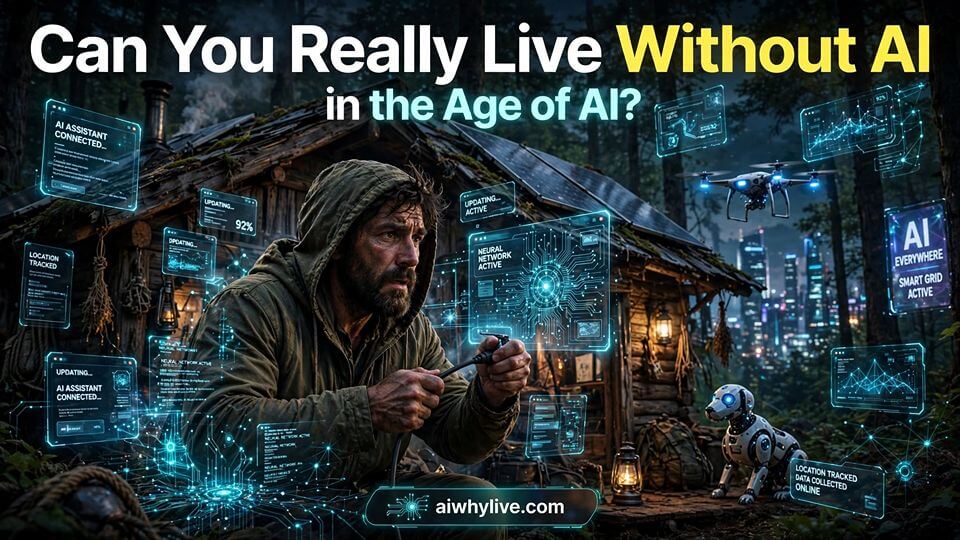
Can You Really Live Without AI in the Age of AI?
"I don't use AI. I don't need ChatGPT. I can think for myself."
Fair enough.
You can live without ChatGPT. You can refuse to generate pictures, write emails with AI, ask a chatbot for advice or let an AI assistant organize your schedule.
You can even delete every AI chatbot from your phone.
Congratulations.
But here's a little experiment.
Did you use Google Maps today?
Did your email automatically separate spam from legitimate messages?
Did your phone suggest the next word while you were typing?
Did YouTube recommend a video?
Did your bank flag an unusual transaction?
Did your smartphone camera automatically improve a photograph?
Did an online shopping platform recommend a product?
If you did any of these things, you may already have interacted with AI-powered technology.
And you probably didn't think about it.
🧠 AIWhyLive Explains: There Are Two Ways to Use AI
When people hear "AI," they usually imagine a chatbot.
A conversation. A prompt. A generated picture. A computer writing an article.
That's visible AI.
But there's another kind:
It works behind the scenes, sometimes without requiring you to type a single prompt.
Think about these everyday examples:
| What you do | How AI may be involved |
|---|---|
| Navigate using a map | Predicting traffic and estimating arrival times |
| Check your email | Classifying suspicious or unwanted messages |
| Type on your phone | Predicting words and suggesting corrections |
| Watch online videos | Recommending content based on viewing patterns |
| Shop online | Ranking and recommending products |
| Use face recognition | Identifying or matching facial features |
| Use online banking | Detecting unusual transaction patterns |
| Search the Internet | Ranking and interpreting search results |
Important distinction: not every feature in every product uses AI. Some rely on conventional algorithms, fixed rules or simpler automation. The technology differs by product and implementation.
But machine learning and other AI techniques are already part of many everyday services.
AI isn't limited to the chatbot you consciously open.
The Great AI Irony: You Can Reject AI and Still Use AI
Imagine somebody declaring:
"I refuse to use AI!"
Then they open their smartphone, check their email, navigate using a map, watch recommended videos, search for information, buy something online and use face recognition to unlock their phone.
They may have avoided generative AI.
But they haven't necessarily avoided AI-powered systems.
You can refuse to talk to AI while still depending on services that use it.
You can dislike AI-generated pictures while using a camera that relies on machine-learning image processing.
You can refuse to ask AI for directions while using a navigation service that applies predictive technology.
You can refuse to use an AI chatbot while receiving recommendations selected by AI.
🍗 Lechon Manok: The Person Who Doesn't Use AI
Friend 1: "I don't use AI."
Friend 2: "You use Google Maps?"
Friend 1: "Yes."
Friend 2: "You watch YouTube?"
Friend 1: "Of course."
Friend 2: "You use online banking?"
Friend 1: "Yes."
Friend 2: "Your phone predicts your words?"
Friend 1: "Yes."
Friend 2: "Your email filters spam?"
Friend 1: "Yes."
Friend 1: "But I don't use ChatGPT!"
Friend 2: "Ah. So you don't use AI. You just use some of its relatives."
😂
Can You Actually Live Without AI?
Let's separate the question into three levels.
1. Can You Live Without Generative AI?
Absolutely.
You can avoid ChatGPT, Gemini, Claude and other generative AI tools.
You can write your own emails, research manually, create your own graphics and solve problems without asking a chatbot.
It may take longer, but it is possible.
2. Can You Live Without Directly Interacting With AI?
Yes, to a considerable extent.
You can choose not to use AI assistants, image generators, AI writing tools or AI-powered voice assistants.
You can also choose services and devices that minimize AI features.
But you may still encounter AI-powered functions in the services you use.
3. Can You Live Without AI Anywhere in Your Digital Environment?
That's much harder.
Modern digital services are interconnected.
Search, advertising, recommendations, cybersecurity, financial systems, logistics, communication and business operations increasingly use machine learning or other AI techniques.
You might avoid some of them.
But avoiding all AI-powered systems would require much more than uninstalling an application.
🐘 Elephant in the Room: You May Be Using AI Without Knowing It
This is not just an amusing observation.
It's an awareness problem.
A Gallup survey conducted in the United States in late 2024 found that only 36% of adults recognized having used an AI-enabled product in the previous week.
Yet when researchers asked about six everyday categories of products with AI features, 99% reported using at least one.
The difference is revealing.
People may recognize ChatGPT as AI but fail to recognize AI features embedded in familiar products.
This was a US survey, not a Philippine survey. It does not establish the same percentages for Filipinos.
But the underlying question is relevant everywhere:
AI literacy should mean more than learning how to write prompts.
It should also mean understanding where AI is already operating, what decisions it influences and when those decisions deserve our attention.
The Philippines: We May Be Using More AI Than We Think
Consider an ordinary day.
You check Facebook.
You watch videos.
You use a navigation application.
You send messages.
You shop online.
You transfer money.
You check your bank account.
You search for a product.
You use your phone's camera.
You ask a customer-service chatbot a question.
You may never have opened ChatGPT.
But your digital life may already be interacting with several AI-powered services.
This matters to Filipino consumers, employees, students, business owners and professionals.
The question isn't simply whether we like AI.
It's whether we understand the technology influencing our everyday choices.
For example:
- Why was this particular product recommended?
- Why did this video appear in my feed?
- Why was my transaction flagged?
- Why did this search result appear first?
- Why did the system classify this message as suspicious?
- What information is being collected and processed?
These are not necessarily reasons to reject technology.
They're reasons to become more informed users.
AI Is Not Always Your Friend. And It Is Not Always Your Enemy.
Let's avoid another mistake.
Just because AI is already everywhere doesn't mean everything it does is beneficial.
AI-powered systems can make mistakes.
Recommendations can reinforce existing preferences.
Automated decisions can be biased.
Fraud detection can flag legitimate transactions.
Search and recommendation systems can influence what information people encounter.
Generative AI can produce convincing but inaccurate answers.
The goal isn't to blindly embrace AI.
Nor is it to reject every technology associated with it.
👦 ELI12: You Don't Have to See the Electricity to Use It
Imagine saying:
"I don't use electricity."
But you live in a house with electric lights, a refrigerator, a television and a computer.
You don't personally operate the power plant.
You don't see the electricity traveling through the wires.
But you still benefit from it.
AI is not exactly electricity, of course. But the analogy helps explain something:
You don't need to interact directly with a technology to benefit from systems that use it.
And you don't necessarily need to recognize it for it to influence your experience.
The New Digital Divide May Not Be Who Uses AI
We often divide people into two groups:
People who use AI.
People who don't.
But that distinction may become less useful as AI becomes embedded in ordinary services.
A more meaningful divide could be:
And:
People who don't realize how much influence it already has.
The first group asks questions.
- What is this system doing?
- What data does it use?
- Why did it recommend this?
- Can I verify the result?
- What happens if it gets something wrong?
The second group simply accepts the result without thinking about the technology behind it.
Both may use the same applications.
But they don't necessarily understand them in the same way.
You Don't Have to Love AI to Understand It
This is important.
You don't have to become an AI enthusiast.
You don't have to subscribe to ChatGPT.
You don't have to generate a single image.
You don't have to automate your entire business.
You don't have to ask AI for advice about your personal life.
You don't even have to like it.
But understanding AI is becoming a form of digital literacy.
Just as people learned to use computers, the Internet and smartphones, people increasingly need to understand the systems shaping their digital experiences.
You can choose not to use a particular AI product.
You can question AI.
You can criticize AI.
You can demand transparency.
You can protect your data.
You can decide when human judgment should take priority.
Frequently Asked Questions About Living Without AI
Can I live without using AI?
Yes. You can avoid directly using generative AI tools such as ChatGPT, Gemini and Claude. However, avoiding every AI-powered system embedded in modern digital services is much more difficult.
Am I using AI without knowing it?
Possibly. AI-powered features may be integrated into navigation, spam filtering, recommendations, online shopping, banking security, image processing and other everyday services. The exact features depend on the product.
Is Google Maps AI?
Some Google Maps features use machine learning and predictive models, including traffic forecasting and estimated arrival times. Not every function in the application is necessarily AI-powered.
Does YouTube use AI?
YouTube uses recommendation and machine-learning systems to personalize content suggestions and support other platform functions. The exact systems and features can change over time.
Is an algorithm always artificial intelligence?
No. An algorithm is a set of instructions or procedures for solving a problem. Some algorithms use AI or machine learning; many do not. The terms should not be treated as interchangeable.
Should I use AI even if I don't like it?
Not necessarily. You can choose which AI tools to use and which to avoid. However, understanding AI's role in everyday technology is increasingly important, even if you never use a chatbot.
Is AI replacing human intelligence?
AI can automate or assist with certain cognitive tasks, but that does not mean it replaces human understanding, judgment, responsibility or experience. The important question is how people choose to use it and where human oversight remains necessary.
🎤 Drop Mic: You May Not Use AI. But Does AI Use You?
You can delete ChatGPT.
You can avoid Gemini.
You can refuse to generate AI images.
You can write every email yourself.
You can insist on doing things the old-fashioned way.
That's your choice.
But what about the technology you don't see?
The system recommending what you watch.
The software predicting your route.
The filter screening your messages.
The platform ranking your search results.
The bank detecting unusual activity.
The applications making predictions about what you might want next.
You may not be talking to AI.
But you may already be living with it.
You don't have to love AI.
You don't have to trust AI.
You don't have to use every AI tool.
But don't confuse not opening a chatbot with living in a world without artificial intelligence.
Because the Age of AI isn't waiting for everybody to agree.
It has already started.
AIWhyLive — Think beyond the prompt.

How to Survive (and Get Rich) When Algorithms Control Everything 🚨 WAKE UP CALL: YOUR FINANCIAL LIFE IS ALREADY BEING Read more
In the rigid world of search engine algorithms, there is a sacred acronym: YMYL. It stands for Your Money or Read more
Life doesn’t always go as planned. Careers shift, businesses struggle, and dreams sometimes feel out of reach. But in the Read more

Scan. Pay. Gone: The QR Code Scam Hiding in Plain Sight You enter a store. You buy something. ₱350. "GCash Read more