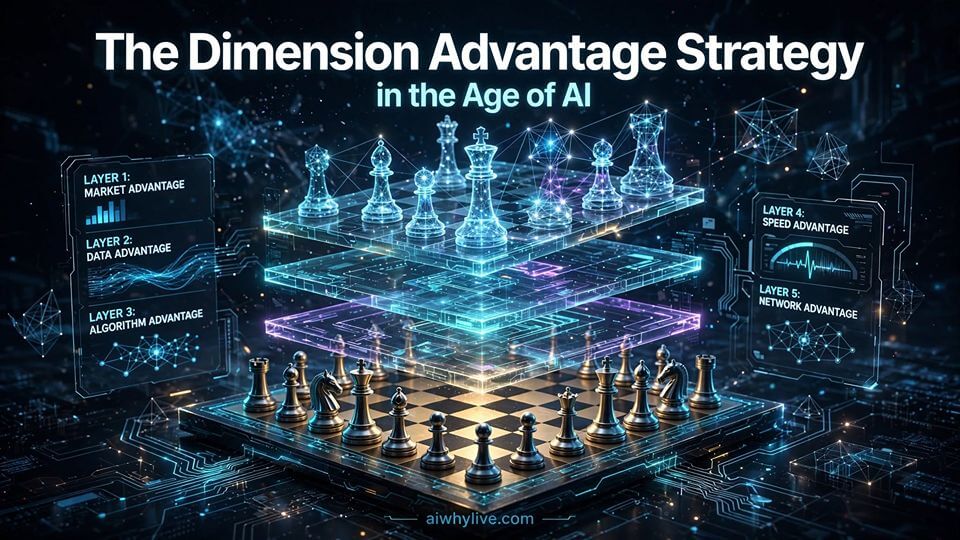
Stop Competing Where AI Is Strongest: The Dimension Advantage Strategy
In the age of artificial intelligence, the biggest advantage may not belong to the person who produces the most, works the fastest, or owns the most powerful AI tools. It may belong to the person who knows where everyone else is competing—and chooses a different dimension.
Imagine two people running online businesses.
Both use AI. Both create content. Both automate routine work. Both have access to similar tools.
One produces 100 posts a week.
The other produces only 10—but each post reaches a specific audience, answers a real problem, builds trust, and generates business.
Who has the advantage?
The obvious answer might be the person producing more.
But what if the real winner is the person competing on a completely different dimension?
Welcome to the Dimension Advantage Strategy.
The New Problem: Everyone Has the Same Superpower
AI has changed the rules of competition.
A small business can now access capabilities that once required a team. A solo creator can produce content at a scale that used to demand an entire production department. A beginner can use AI to write, design, analyze, research, and code.
That sounds like a level playing field.
But there is a catch.
When everybody gets access to similar capabilities, those capabilities gradually become ordinary.
Speed becomes ordinary. Content production becomes ordinary. Basic research becomes ordinary. Even technical skills become more accessible.
The advantage does not disappear. It moves.
And that is where many people get stuck.
They keep trying to become faster at something that AI has already made fast for everybody.
They compete on the same dimension, using the same tools, producing the same kind of output, and wondering why the results are becoming less impressive.
The problem may not be that you are losing. You may be competing on the wrong dimension.
What Is the Dimension Advantage Strategy?
The Dimension Advantage Strategy is a way of thinking about competition.
Instead of asking:
How can I do the same thing better than everyone else?
Ask:
What other dimension can I compete on where my combination of abilities, experience, insight, relationships, and resources creates a meaningful advantage?
Think of a business competing on price.
If competitors keep lowering their prices, the business can get trapped in a race to the bottom.
But what if it competes on convenience, reliability, specialization, customer experience, or trust?
It has changed the dimension of competition.
The same principle applies to careers, content creation, education, entrepreneurship, and personal development.
AI makes this strategy more important because it reduces the cost of producing ordinary output.
The opportunity is to become exceptional at something that ordinary output cannot easily replace.
Seven Dimensions Where You Can Build an Advantage
1. The Speed Dimension: Be Faster, but Don't Stop There
AI can help you finish tasks in minutes instead of hours.
That is useful. But speed alone is not a permanent advantage when everyone has access to similar tools.
Use speed to create more room for better decisions, stronger relationships, and more meaningful work.
Don't just produce faster. Use the time you save to do something competitors are not doing.
2. The Depth Dimension: Know More Than the Prompt
AI can summarize information. But knowing which questions matter, recognizing missing context, and understanding the consequences of an answer still require judgment.
A person who understands a subject deeply can use AI more effectively than someone who simply knows how to write impressive prompts.
The advantage is not just access to information.
It is knowing what to do with it.
3. The Trust Dimension: Become Someone People Believe
AI can generate a convincing explanation, a polished proposal, or a professional-looking advertisement.
But a polished output does not automatically create trust.
Trust is built through consistency, accountability, honesty, and delivering what you promise.
For businesses, this means customers may remember how you treated them more than how impressive your website looked.
For professionals, it means your reputation can become more valuable as routine work becomes easier to automate.
4. The Context Dimension: Understand What the Machine Cannot See
A general AI tool may understand a broad topic.
But the real situation may involve local conditions, customer history, company culture, personal preferences, budget limitations, or details that were never included in the prompt.
Context changes the value of an answer.
A generic business strategy may sound excellent on paper but fail when applied to a small business with limited cash flow.
A generic marketing campaign may look professional but miss the audience's actual concerns.
The person who understands the situation can turn a generic AI capability into a useful result.
5. The Taste Dimension: Know What Is Worth Creating
AI can generate hundreds of options.
But more options do not automatically produce better decisions.
Someone still has to recognize what is useful, what is boring, what is misleading, what is unnecessary, and what deserves attention.
This is the dimension of taste, judgment, and discernment.
In a world flooded with AI-generated content, the ability to identify quality may become more valuable than the ability to produce quantity.
6. The Relationship Dimension: Build What Cannot Be Downloaded
AI can help you write an introduction, prepare a sales pitch, or organize a meeting.
But relationships are built through human interaction over time.
People remember who helped them, who listened, who showed up, and who remained dependable when things became difficult.
Technology can support relationships. It cannot simply manufacture the history behind them.
7. The Execution Dimension: Turn Possibilities Into Results
AI can give you a business plan, a marketing strategy, a software prototype, or a list of opportunities.
But a plan is not a business.
A generated idea is not a completed project.
A beautiful presentation is not a signed agreement.
The advantage belongs to those who can turn information into action, action into measurable results, and results into sustainable value.
AI can help you prepare. You still need to execute.
The Same AI. Different Dimensions. Different Results.
Consider three people using the same AI assistant.
| Person | What They Do | Where They Compete |
|---|---|---|
| Creator A | Publishes 100 AI-generated posts | Quantity |
| Creator B | Publishes 10 researched, useful posts | Depth and trust |
| Creator C | Builds a community around a specific problem and helps members solve it | Context and relationships |
All three use AI.
But they are not playing the same game.
The point is not that quantity is always bad or that fewer posts automatically mean better results.
The point is that the tool does not determine the strategy.
The dimension you choose to compete on changes the value of what you produce.
How to Apply the Dimension Advantage Strategy
You do not need to master all seven dimensions. Start by identifying where you can create the most meaningful difference.
Step 1: Identify the Crowded Dimension
What is everybody competing on? Price? Speed? Content volume? Technical skills? Convenience?
Step 2: Identify What AI Has Made Easier
Which tasks are becoming cheaper, faster, or more widely available?
These may be areas where your advantage will gradually shrink.
Step 3: Find the Overlooked Dimension
Could you compete through specialization, local knowledge, trust, customer experience, original insight, or execution?
Step 4: Combine Your Existing Strengths With AI
Your experience, knowledge, network, and understanding of a particular audience are starting points. AI can help you extend them.
Step 5: Test the Difference
Do not assume that a new dimension will work. Test it with real customers, readers, colleagues, or measurable outcomes.
A strategy is only an advantage when it produces value.
The Elephant in the Room: AI Is Not Your Only Competition
Perhaps the biggest mistake is treating AI as the enemy.
AI is a tool. Your actual competition may be someone who knows how to combine technology, experience, judgment, and execution better than you do.
The person who uses AI to produce more of the same may be easier to compete with than the person who uses AI to create something genuinely different.
And there is another uncomfortable possibility:
You may not need more AI tools.
You may need a better understanding of your own strengths, your customers, your market, and the problem you are trying to solve.
Sometimes the missing advantage is not technological.
It is strategic.
ELI12: Explain It Like You're 12
Imagine a school race.
Everyone is running on the same track. One student gets faster shoes. Another starts running faster. Soon, almost everyone has better shoes.
Now imagine a student who discovers a different way to win: perhaps a relay race, a different event, or a skill that the others have not developed.
The lesson is not to avoid running.
It is to recognize that there may be more than one way to compete.
AI gives people better shoes.
The Dimension Advantage Strategy asks whether you are running the right race.
AIWhyLive Explains: Don't Just Improve. Reposition.
There is a difference between improving your performance and changing your position.
Improving means doing the same thing more efficiently.
Repositioning means finding a different reason why people should choose you.
A freelancer may stop competing only on hourly rates and specialize in solving a particular business problem.
A small store may stop competing only on price and become known for dependable service and convenience.
A content creator may stop chasing every trending topic and become a trusted source on one subject.
A professional may stop selling only technical skills and start offering a combination of expertise, communication, judgment, and accountability.
AI can help all of them.
But the strategic decision comes first.
The Bottom Line: Don't Fight AI on Its Strongest Dimension
AI is exceptionally good at making many tasks easier to reproduce.
That does not mean human contribution has become worthless.
It means the value of human contribution may shift toward the things that make an outcome meaningful: judgment, context, responsibility, trust, relationships, and the ability to act.
You can spend your time trying to beat everyone at producing more.
Or you can find a dimension where producing more is not the most important thing.
The next advantage may not belong to the person with the most powerful AI, the biggest team, or the largest content output.
It may belong to the person who understands where the real value is—and chooses to compete there.
Drop Mic
When everybody has access to the same intelligence, the advantage belongs to those who know what to do with it—and where to use it.
AI can change how you compete. Strategy determines where you compete.
AIWhyLive.com — Think beyond the prompt.
Frequently Asked Questions
What is the Dimension Advantage Strategy?
The Dimension Advantage Strategy is an approach to competition that encourages people and businesses to find a meaningful dimension on which to differentiate themselves instead of competing only on common measures such as speed, price, or output.
Why is the Dimension Advantage Strategy important in the age of AI?
AI makes many tasks faster and more accessible. As more people gain similar capabilities, basic speed and production may become less distinctive. Differentiation through context, trust, judgment, relationships, specialization, and execution can help create additional value.
What are the seven dimensions of competitive advantage discussed here?
The seven dimensions are speed, depth, trust, context, taste, relationships, and execution. They are practical lenses for thinking about how to create value beyond simply producing more output.
Can small businesses use the Dimension Advantage Strategy?
Yes. A small business can use AI to improve efficiency while differentiating through customer service, local knowledge, reliability, specialization, convenience, and relationships.
Does the Dimension Advantage Strategy mean avoiding AI?
No. It means using AI strategically. The goal is not to reject technology but to combine it with human capabilities and business strengths to create meaningful differentiation.
What is the biggest human advantage in the age of AI?
There is no single universal human advantage. Depending on the situation, judgment, context, trust, accountability, creativity, relationships, and execution can all contribute to meaningful value.

🧘 Silence Isn’t Absence Nope, I’m not taking a break. This is a short lull—better yet, germination. A pause that Read more

Evolution of Epal in the Philippines from tarpaulin and social media to AI-driven epal Before artificial intelligence, before social media, Read more

🛫 Create Your Own Runway, Not Clout, in the Age of AI — Because Likes Don't Pay the Bills Read more

AI Made Life Easier. So Why Is It Getting Harder to Leave Our Comfort Zone? AI can help you write. Read more