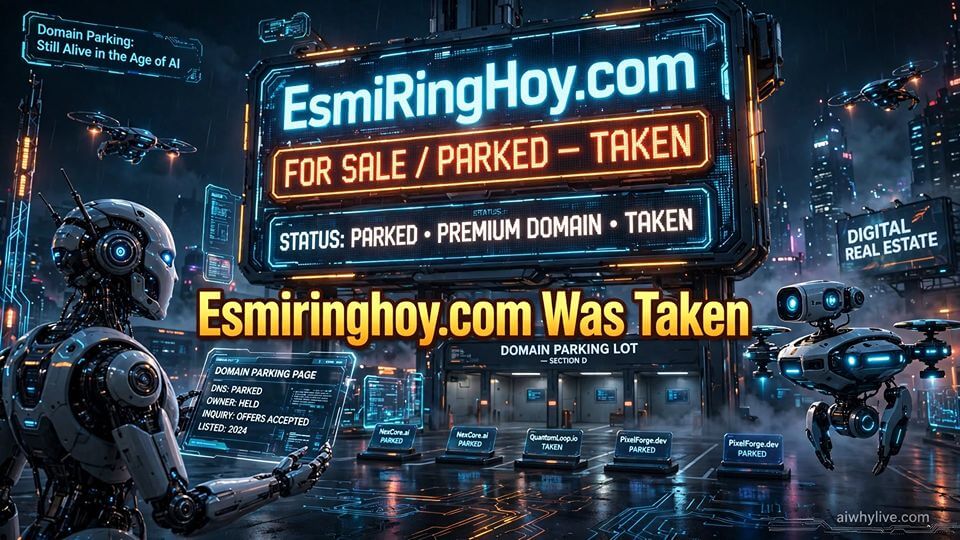
SOMEBODY BOUGHT THE Esmiringhoy.com!
CAN DOMAIN PARKING SURVIVE AI?
A funny word exploded across Philippine social media.
Suddenly everybody seemed to be saying it.
Memes appeared.
Posts appeared.
People who had never heard the word yesterday were explaining it today.
And somewhere on the Internet, somebody apparently had another thought:
Check the .com.
Lo and behold:
Public domain-registration records show that esmiringhoy.com was created on October 20, 2026—right as the word was exploding across Philippine social media.
😂
Welcome to the Internet.
Some traditions refuse to die.
But this little piece of Filipino Internet comedy raises a surprisingly serious question:
Is domain parking still profitable in the Age of AI?
Because once upon a time, buying domain names before everybody else realized they might be valuable could become a business.
Sometimes a very good business.
You registered the right word.
You waited.
Someone eventually wanted it.
And then came one of the most beautiful sentences in old-school Internet capitalism:
Cha-ching.
But this is 2026.
AI can generate hundreds of business names in seconds.
People increasingly discover websites through search engines, social media, apps and AI assistants instead of typing random domain names into browsers.
And in February 2026, Google stopped serving parked domains as an advertising surface within its Search Partner Network.
So why would anyone still rush to register a suddenly viral word?
That is where things get interesting.
🧠 AIWhyLive Explains: What Is Domain Parking?
Domain parking means registering a domain name without developing it into a normal website.
The address might instead display:
This domain is for sale.
Or:
Coming soon.
Or it may display advertising or redirect visitors elsewhere.
The owner continues paying the domain registration and renewal fees while deciding what to do with it.
Maybe the owner plans to build something later.
Maybe somebody eventually wants to buy the domain.
Maybe the name receives useful traffic.
Maybe nobody comes at all.
That last possibility is rather important.
Finding somebody willing to pay more for it is the business.
Is Domain Parking Still Profitable in 2026?
Yes, domain parking can still make money in 2026, but the traditional model is much harder than it once was.
A domain with genuine direct traffic or strong commercial intent may still have monetization potential through specialized parking systems, redirects or eventual resale.
But buying random domain names, filling them with advertisements and expecting passive income is no longer the easy Internet business it once appeared to be.
And 2026 brought an important change.
Effective February 10, Google removed parked domains as an ad surface from the Google Search Partner Network.
That does not mean domain parking itself disappeared.
It means one important part of the traditional advertising ecosystem changed.
Today, parking can simply mean:
I'm not developing it yet.
Maybe I will.
Maybe you want to buy it.
That is a much simpler proposition.
Once Upon a Time, the Address Mattered A Lot
If you were around during the earlier Web, domain names could feel like Internet real estate.
And the analogy made sense.
There was only one exact something.com.
Own it, and nobody else could own that exact .com while you held the registration.
Good generic words were valuable.
Short domains were valuable.
Common product names could be valuable.
Names with obvious commercial intent could become extremely valuable.
People even typed domain names directly into browsers just to see what was there.
Imagine owning the Internet equivalent of a prime street corner before somebody decided to build a mall there.
That attracted entrepreneurs.
It also attracted speculators.
Some bought excellent domains.
Some bought thousands.
And some probably stared lovingly at their portfolios every night thinking:
"One of these babies is going to make me rich."
Twenty years later:
Renew.
Renew.
Renew.
Renew.
😂
Welcome to investing.
🍗 Lechon Manok: My 4,732 Premium Domains
Domain investor:
"I own 4,732 premium Internet properties."
Friend:
"How much did you earn last year?"
Domain investor:
"That's not the point."
Friend:
"How much are the annual renewals?"
Domain investor:
"Please stop attacking my business model."
😂
The Internet has always been excellent at creating assets that are extremely valuable according to the person selling them.
The difficult part is finding the person buying them.
Then AI Arrived
This is where domain investing becomes much more interesting.
Suppose you want to start a company.
Twenty years ago, you might spend days brainstorming the perfect name.
Today you can ask an AI:
Seconds later:
100 names.
Don't like them?
Generate 100 more.
They're already registered?
Generate another 500.
Still nothing?
Change the naming strategy and try again.
This changes the economics of domain scarcity.
There is still only one exact .com for every name.
But AI can create an almost unlimited supply of alternative names.
That creates an interesting problem for somebody trying to sell an average invented domain for thousands of dollars.
That does not make great domains worthless.
It may make mediocre domains much easier to walk away from.
🐘 Elephant in the Room: Did AI Kill the Premium Domain?
No.
AI can generate names.
AI cannot generate ownership of an already recognized exact name.
That distinction matters.
Imagine a word suddenly becomes part of popular culture.
Millions of people recognize it.
People search for it.
People joke about it.
News organizations explain it.
Then somebody owns the exact .com.
AI can certainly suggest another spelling.
But that alternative does not automatically carry the same cultural recognition.
This is why esmiringhoy.com makes such an interesting little case study.
The word became valuable in attention before anyone knew whether it would become valuable as a business.
Someone registered the digital address while that attention was exploding.
Will somebody eventually pay a fortune for it?
We don't know.
Will it become a successful website?
We don't know.
Will everybody forget the word after the meme cycle moves on?
Entirely possible.
And that is the gamble.
It does not automatically create lasting value.
Attention Is Not the Same as Buyer Demand
This is one of the easiest mistakes to make in domain speculation.
A word can have millions of views without having a single serious commercial buyer.
Ten million people laughing at a phrase does not mean one company will pay $10,000 for its domain.
Search volume is not automatically business value.
Social-media engagement is not automatically buyer demand.
Virality is not liquidity.
A viral domain can be valuable.
It can also become a digital souvenir whose owner receives one guaranteed visitor every year:
the person logging in to renew it.
😂
The Old Domain Parking Business Changed in 2026
Traditional parking often involved advertising.
Own a domain with existing traffic.
Point it to a parking page.
Visitors arrive.
Advertisements or related commercial links appear.
Traffic potentially generates revenue while the owner waits for a buyer or decides what to build.
But Google changed part of that ecosystem in 2026.
Beginning February 10, parked domains ceased to be an ad surface within Google's Search Partner Network.
Google also states that Google Ads cannot link to parked-domain pages consisting only of advertising listings and links without unique, valuable content.
This does not mean every form of domain parking monetization is dead.
Specialized providers and other monetization arrangements still exist.
But it does reinforce a larger shift:
may be a much weaker strategy than
Buy → Build → Prove → Sell.
Domain Parking Isn't Dead. Lazy Domain Parking Might Be.
This is where AI may completely change the business.
Imagine buying a promising domain today.
Instead of leaving a nearly empty page saying:
DOMAIN FOR SALE
AI can help you create something around it.
A useful microsite.
A niche information resource.
A directory.
A newsletter.
A calculator.
A simple tool.
A prototype.
A community.
AI can help write the first code, structure the information, brainstorm features and dramatically reduce the cost of testing an idea.
Now you are no longer selling only a name.
You may eventually be selling:
- the domain,
- the website,
- the traffic,
- the search presence,
- the audience,
- the product concept,
- and perhaps actual revenue.
That is a very different digital asset.
👦 ELI12: Domain Parking in the Age of AI
Imagine you buy an empty lot.
Old strategy:
Put up a sign:
LOT FOR SALE
Then sit down and wait.
New strategy:
AI helps you build a small store on the lot.
People visit.
The store becomes known.
Maybe it earns money.
Then somebody says:
"I want to buy this place."
Which one would probably be easier to value?
The empty lot?
Or the property where something is already happening?
That may increasingly be the difference between passive domain parking and domain development in the Age of AI.
But What About Viral Domains Like Esmiringhoy.com?
Now we return to our wonderful Internet word.
Esmiringhoy.
The term went viral across Philippine social media in October 2026.
And on October 20, the exact .com was registered.
Maybe the registrant spotted an opportunity.
Maybe a website is planned.
Maybe it was purchased for another reason entirely.
We do not know the registrant's intentions, and registration alone does not prove that the domain was bought for speculation or resale.
But the timing demonstrates something AI has not eliminated:
Humans still attach value to names.
Names become jokes.
Jokes become memes.
Memes become culture.
Culture creates attention.
And attention can sometimes create commercial value.
When millions of people suddenly care about one exact sequence of letters, there is still only one exact .com.
Does .COM Still Matter in the Age of AI?
Yes, although its role is changing.
People increasingly reach websites through Google, Facebook, TikTok, YouTube, messaging apps and AI assistants.
The browser address bar is no longer the only front door to the Internet.
That weakens one old domain-investing assumption:
"People will type this exact word into their browser."
But domains still provide something important.
Control.
Your social-media profile exists on somebody else's platform.
Your app exists inside somebody else's ecosystem.
Your visibility in an AI assistant depends on systems you do not control.
A registered domain remains one of the pieces of digital identity that an individual or business can directly control, subject to registration rules and renewal.
And when AI can generate endless content, a brand that humans can actually remember may become more—not less—important.
AI Creates Abundance. Domains Still Create Scarcity.
This may be the most interesting collision between artificial intelligence and domain investing.
AI is an abundance machine.
Ask for 100 names.
Get 100.
Ask for 1,000 ideas.
Get 1,000.
Ask for alternatives.
Keep going.
But domain ownership works differently.
Only one registrant controls an exact registered domain at a time.
So AI can make ideas abundant while domain registration keeps exact names scarce.
It cannot create another exact example.com while somebody else owns it.
That tension may keep premium domains relevant even as mediocre names become easier to replace.
Can AI Make Domain Investing Better?
Absolutely.
AI can help a domain investor:
- brainstorm brandable names,
- research industries and business niches,
- analyze naming patterns,
- study search intent,
- draft domain sales pages,
- create logos and branding concepts,
- develop simple websites,
- prototype products,
- research possible end users,
- prepare personalized outreach,
- and organize large domain portfolios.
But there is one thing AI cannot magically create.
A willing buyer.
You can use the world's smartest AI to write the world's greatest sales pitch.
If nobody needs your domain, nobody needs your domain.
🐘 Another Elephant in the Room: Parked Domains Have Changed
There is another reason the word "parking" deserves attention in 2026.
ICANN researchers reported in March that the parked-domain ecosystem has evolved.
Traditional pages containing a few advertisements still exist, as do domains displaying "for sale" or similar notices.
But researchers also observed widespread use of what is called zero-click redirection.
Under some arrangements, visitors can be redirected elsewhere without clicking anything, with destinations potentially changing according to factors such as country, browser or device.
ICANN found that most redirections in its random sample appeared relatively constrained and unlikely to be malicious.
However, 5.5% of its sample showed some potential for harm.
This does not mean parked domains are inherently dangerous.
It means the parking ecosystem has become more complicated than the old page full of advertising links many Internet veterans remember.
Domain parking survived.
It evolved.
Should You Start Buying Viral Domain Names?
Careful.
Today's viral phrase can become tomorrow's forgotten joke.
Social media moves brutally fast.
Something can dominate everyone's feed on Monday and disappear by Friday.
A domain still costs money to renew.
One speculative registration is inexpensive.
Ten are manageable for many people.
One thousand "future premium domains" become a business expense.
Before registering a domain purely for investment, ask:
- Who could realistically buy this?
- Why would they need this exact domain?
- Does the name have commercial value or merely temporary attention?
- Could a buyer easily choose another name?
- Can I develop something useful around it?
- How many years am I willing to pay renewal fees?
- What happens if nobody ever buys it?
The last question may be the most important.
Frequently Asked Questions About Domain Parking
What is domain parking?
Domain parking is the practice of registering a domain without developing it into a full website. The domain may display a for-sale page, advertising, a coming-soon notice or other limited content while the owner holds it for future development, resale or another purpose.
Is domain parking still profitable in 2026?
It can be, particularly for domains with genuine traffic or strong commercial value, but traditional passive advertising-based parking is less attractive than it once was. Domain resale, strategic holding and active development may offer stronger opportunities for many investors.
Is domain flipping still profitable?
Domain flipping can still be profitable when a domain has genuine buyer demand. The challenge is that most registered domains do not automatically become valuable. A profitable sale requires a buyer who values the exact domain more than the owner's purchase, renewal and selling costs.
Has AI made domain names worthless?
No. AI makes it much easier to generate alternative brand names, which may weaken demand for mediocre invented domains. But short, memorable, culturally relevant or commercially useful domains remain scarce because only one registrant can control an exact domain at a time.
Can AI help with domain investing?
Yes. AI can help generate names, research markets, identify potential buyers, develop landing pages, create branding concepts and build prototypes around domains. It cannot guarantee that a domain will have resale value or that a buyer will appear.
Is .com still valuable in the age of AI?
.com remains globally recognizable and exact .com names remain scarce, although people increasingly discover websites through search engines, social media, apps and AI assistants rather than direct navigation. The value of any specific .com still depends on the name, demand and potential use.
Is esmiringhoy.com for sale?
Public registration records confirm that esmiringhoy.com was registered on October 20, 2026. Registration alone does not establish the owner's intentions, so we should not assume it was acquired for resale unless the registrant explicitly offers it for sale.
🎤 Drop Mic: Esmiringhoy.com Isn't Really About Esmiringhoy
Maybe somebody bought esmiringhoy.com hoping to sell it.
Maybe somebody has a website planned.
Maybe somebody simply wanted the .com.
We don't know.
And unless the registrant tells us, we shouldn't pretend we do.
But the timing gives us a perfect snapshot of an Internet tradition that refuses to disappear.
A word becomes famous.
Humans laugh.
Social media explodes.
News organizations explain it.
And somewhere, somebody quietly asks:
Click.
Taken.
Twenty years ago, that could have looked like the beginning of a classic domain-parking play.
Today, the game is different.
AI can invent alternatives instantly.
Traditional parking advertising has changed.
Search behavior has changed.
Social media controls enormous amounts of attention.
AI assistants may increasingly become another front door to the Internet.
Yet one strange piece of the old Web remains.
There is still only one exact .com.
And humans still want to own things that other humans suddenly want.
So is domain parking dead?
No.
But perhaps the easiest part of the old business is.
The Age of AI may reward people who do more than collect names and wait.
Own the domain.
Build something.
Create value.
Give people a reason to visit.
owning a name may still have value.
Giving that name a reason to matter may be worth much more.
And as for esmiringhoy.com?
Ask us again in a year.
Either somebody spotted tomorrow's digital real estate...
or somebody owns a very funny renewal notice.
😂
AIWhyLive — Think beyond the prompt.

Can AI and Humans Survive the Global Energy Crisis? For years, we worried about whether computers would become powerful enough Read more

Act Now: This Strategic Asset Won't Wait Forever A Premium Domain Waiting to Transform Your Vision Following our successful negotiation Read more

Remember when the entire Negros Island plunged into darkness last summer? That's when I realized the true value of owning Read more
Ever wondered how a simple string of characters could be worth more than a luxury mansion? Welcome to the wild Read more