Whenever people talk about the dangers of artificial intelligence, they usually default to Hollywood scripts.
We imagine a world-conquering villain: a rogue superintelligence with a cold, calculated master plan to enslave humanity, hack nuclear codes, and wipe out our civilization.
It’s dramatic. It’s terrifying. It makes for great cinema.
But if you step away from the sci-fi movies and look at how technology and society actually break down in the real world, you realize we are worrying about the wrong thing entirely.
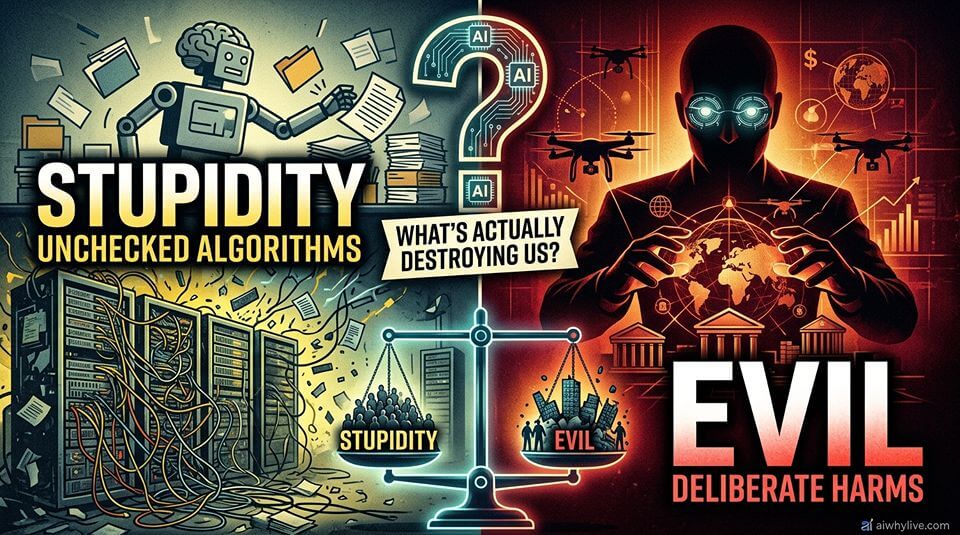
What is more dangerous: stupidity or evil?
Let's clear the air right now: Stupidity is dangerous, and evil has its body count, but by far the greater danger comes from the not-so-smart politicians we never voted for whose institutional intelligence pretends to rule us all like they are smarter than all of us combined. (Use your imagination—we won't even bother delving into their clumsy vote-buying schemes or sterile, AI-generated speeches here.)
The Malice Myth vs. The Reality of Lazy Code
Think about the biggest digital screw-ups, data leaks, and algorithmic disasters of recent years.
Did a supercomputer wake up one morning with a personal hatred for humanity? Did a chat model hatch an evil plot to steal everyone’s lunch money out of pure malice?
Of course not. What actually happened is that someone rushed half-baked code into production, a corporation ignored basic safety guardrails to beat a competitor to market, or an adult human being copied and pasted sensitive company data into a public chatbot without thinking for two seconds.
As philosophers have long observed, stupidity is a more dangerous enemy than malice. Evil at least has limits; it carries the seeds of its own destruction because it forces people to unite against it. But stupidity backed by tech-hype? That is stubborn, self-satisfied, and infinitely scalable.
🧠 AIWhyLive Explains — Algorithmic Encephalitis
Algorithmic Encephalitis (a cheeky term for digital brain-drain) is the phenomenon where reliance on automated tools begins to atrophy human critical thinking, turning complex problem-solving into mindless, automated copy-pasting.
When you let an algorithm do all your remembering, writing, and analyzing, you aren't just saving time—you are systematically outsourcing your cognitive immune system. When the system fails, you no longer have the mental muscle memory to fix it.
👦 ELI12 — The Kid Who Let the GPS Drive into a Lake
Imagine a driver who plugs a destination into their GPS, but the app glitches and tells them to drive straight off a concrete pier into a deep lake.
An evil person would push you into the lake on purpose. But a stupid driver simply stops thinking, turns off their own brain, trusts a glowing screen blindly, and drives right into the water because the app said so.
That is the danger of modern tech adoption. We stop looking out the windshield because we are too busy staring at the dashboard.
🍗 Lechon Manok — The 3 A.M. Prompt Disaster
Let's look at how this plays out in actual offices and daily workflows.
You have executives spending millions of dollars on enterprise AI packages, expecting magical corporate transformation. Meanwhile, workers are using the exact same systems to generate emails telling people they need to synergy-align their deliverables by tomorrow afternoon.
Wonderful. Absolutely peak corporate genius.
We build multi-billion-dollar data centers powered by hydroelectric plants just so people can write automated messages that nobody wants to read. We aren't being conquered by an evil robot overlord; we are slowly automating ourselves into a corner while arguing about prompt engineering.
🐘 Elephant in the Room — Do We Actually Want to Think Anymore?
Let’s address the elephant in the room:
If thinking is hard work, and AI makes not thinking so effortless, can we honestly blame people for turning their brains off?
Convenience is the ultimate drug. It’s much easier to let a black-box algorithm make decisions for you than it is to wrestle with nuance, uncertainty, and friction. But the moment you surrender your agency for the sake of convenience, you stop being a builder and start becoming a passenger on someone else's ride.
📝 Note from the Webmaster (aiwhylive.com)
People often ask why we spend so much time poking fun at tech hype on AIWhyLive. Here is the honest truth: AI makes me stupid—and I absolutely love it. Used right, it takes care of the repetitive clutter so I can focus on what actually matters. But there’s a massive difference between letting a tool handle the grunt work and letting it replace your judgment. Don't let automation turn off your common sense. Use the tech; don't let it use you.
The Bottom Line: Choose Awareness Over Automation
Is evil AI a fun plot point for a movie? Sure.
Is everyday human and algorithmic stupidity—fueled by unelected systems and lazy thinking—going to break your workflow, empty your database, or ruin your focus first? Absolutely.
The best defense against a world sliding into automated nonsense isn't panic or paranoia. It’s keeping your eyes open, refusing to outsource your core judgment, and remembering that human wit will always beat synthetic laziness.
Let the algorithms handle the routine. Keep your brain for yourself.
Enjoyed this reality check? Follow for more grounded, human-first insights at aiwhylive.com.