Open up TikTok, a school group chat, or LinkedIn today, and you’ll notice something kind of eerie.
Suddenly, everybody sounds like a certified genius.
Simple homework assignments or college application essays are reading like award-winning speeches. Thanks to artificial intelligence, anyone can type a sloppy idea into a chat box and instantly get back a perfectly polished, flawless essay in three seconds flat.
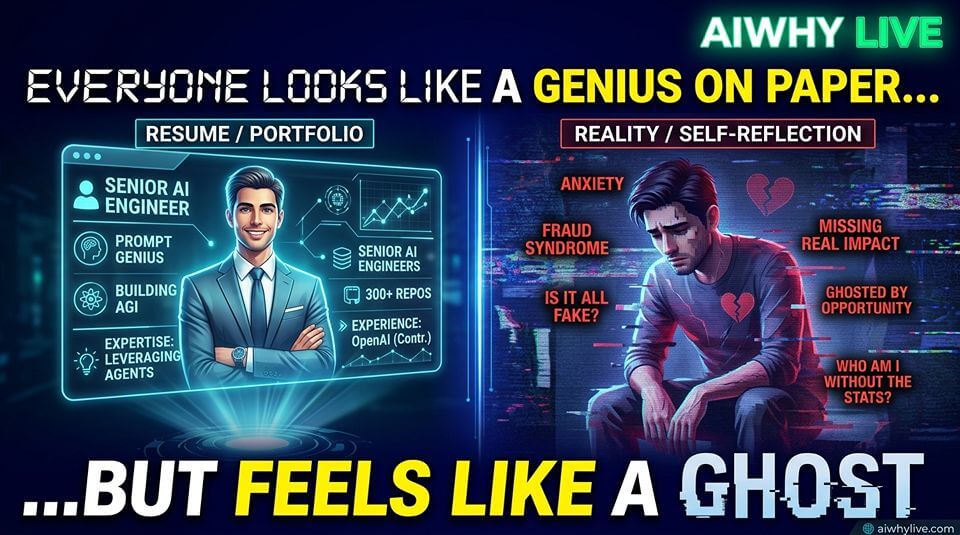
We’ve officially entered the era of the Resume Hologram: An optical illusion where everyone looks like a super-smart overachiever on paper, but half the time, they have no idea what they're actually talking about in real life.
The Inflation of Fake Perfection
Think about it this way: when everyone can easily sound like an absolute expert, sounding smart stops being special. It just becomes background noise.
Back in the day, a well-written paragraph or a clever essay proved you spent hours stressing over your notes, crossing out mistakes, and actually thinking through a problem. Today? It usually just means someone hit a "Make it sound professional" button.
We are drowning in an ocean of fake perfection. Teachers and bosses are getting flooded with endless streams of AI-generated work, which means they have to use *other* AI tools just to grade or read them. It’s a giant, silly loop of robots talking to robots, while real human effort gets buried in the digital dust.
🧠 AIWhyLive Explains — Linguistic Inflation
Linguistic Inflation is what happens when fancy vocabulary becomes so cheap and easy to generate that it loses all its value.
Imagine if your school printed a million-peso bill for every student. Suddenly, a million pesos wouldn't buy you a piece of candy because there's too much of it floating around. It's the exact same thing with words. When everyone's essay is packed with buzzwords like "paradigm-shifting" and "synergistic ecosystem," nobody actually sounds impressive anymore.
👦 ELI12 — The Kid with the Glittery Empty Box
Imagine a school project where one student spends all night baking real chocolate chip cookies from scratch, while another student just wraps an empty shoebox in shiny, sparkly gift wrap.
From across the room, everyone runs toward the shiny shoebox because it looks amazing. But the second you open it up? There’s nothing inside. Just empty air.
That’s what the internet is turning into. We are wrapping empty, half-baked ideas in so much fancy AI grammar that we're forgetting how to make anything real.
🍗 Lechon Manok — The 50-Page Group Project Essay
Let's look at how ridiculous this gets in the real world.
Imagine doing a group project, and one classmate drops a fifty-page report on everyone's desk. It looks like a masterpiece—gorgeous charts, flawless formatting, and sentences so complex they belong in a sci-fi movie.
Wonderful. Absolutely top-tier wizardry.
Then you ask them a simple, real-world question about how the project actually works or what any of those fancy words even mean, and they freeze up like a computer with a dead battery. We don't need fifty pages of AI fluff; we need someone who actually understands what they're doing when things get messy.
🐘 Elephant in the Room — How Do You Stand Out When Everyone Is Perfect?
Let’s address the elephant in the room:
If any random person can use AI to look like a genius, how is a real student, worker, or creator supposed to stand out?
The answer is pretty simple: **By being real, flawed, and specific.**
AI loves playing it safe. It hates taking risks, it smooths over all the interesting rough edges, and it just tells you what it thinks you want to hear. Real human value lives in the messy stuff—your actual weird experiences, your specific local context, and the courage to say, *"I built this ugly thing with my own hands, and it actually works."*
📝 Note from the Webmaster (aiwhylive.com)
At AIWhyLive, we use tools to code and structure our ideas, but we don't hide behind a fake holographic mask. We aren't here to shill for tech giants or impress people with robotic perfection. If your whole identity depends on how well an algorithm can rewrite your homework or your resume, you're building on rented land. Drop the buzzwords, keep your human grit, and build things that actually survive reality.
The Bottom Line: Drop the Hologram
The next time you feel pressured to sound like an untouchable corporate robot on your school papers or social media posts, take a deep breath.
The world is already flooded with algorithmic perfection. What it's actually starving for is realness, honest thinking, and genuine human presence.
Let the robots keep their holographic vocabulary. We’ll stick to reality.
Enjoyed this reality check? Follow for more grounded, human-first insights at aiwhylive.com.