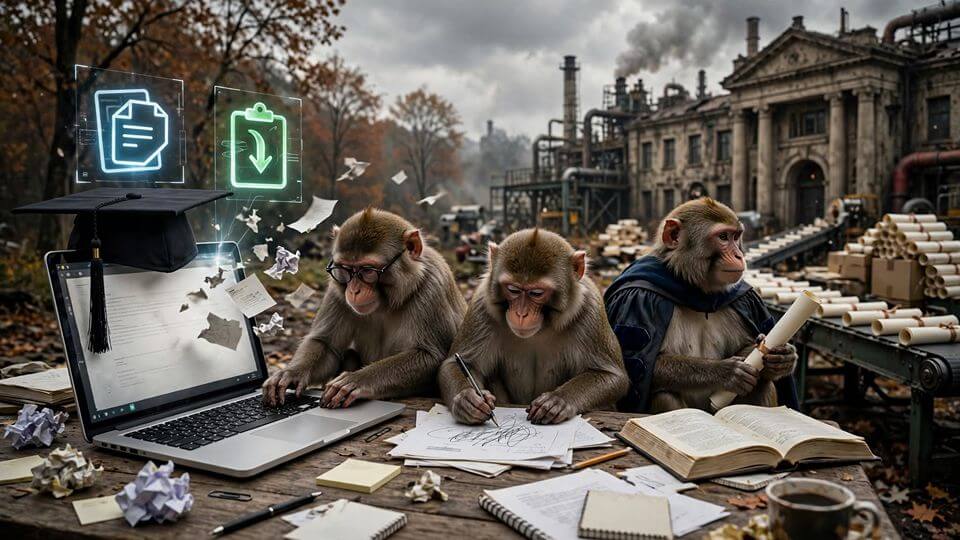
AI didn't invent human stupidity. It just gave it a faster internet connection.
There was a time when we joked about CPU:
Copy/Paste University.
You didn't understand the lesson.
You found somebody who did—or somebody who appeared to—and copied the answer.
Change a few words.
Submit.
Graduate.
Then came the prompt era.
Now you don't even have to find somebody else's answer.
You can ask a machine to produce one.
Copy.
Paste.
Polish.
Publish.
And now we may be entering the next academic achievement:
Monkey See, Monkey Do PhD.
Congratulations.
You have mastered the ancient human skill of watching somebody else do something and immediately doing the same thing—except now you have artificial intelligence helping you do it at industrial scale.
🧠 AIWhyLive Explains: AI Didn't Invent Stupidity
Let's get one thing straight.
This is not an anti-AI article.
AI is a tool.
A very powerful tool.
It can help us research.
It can explain complicated ideas.
It can help people write, code, design, analyze and create.
It can save hours of boring work.
I use AI myself.
I love what it can do.
But here's the uncomfortable part:
Humans were already perfectly capable of being stupid before AI arrived.
We copied homework before ChatGPT.
We repeated rumors before social media.
We followed stupid trends before TikTok.
We believed chain emails before algorithms.
We watched other people do something and copied them before there was a word called “influencer.”
AI didn't create the monkey.
It gave the monkey a keyboard.
From Copying Answers to Copying Thinking
The old Copy/Paste University had a simple problem:
You could copy somebody's answer without understanding it.
AI creates a more sophisticated version.
Now you can outsource the entire process.
Don't know the answer?
Ask AI.
Don't know what question to ask?
Ask AI.
Don't know how to explain your idea?
Ask AI.
Don't have an idea?
Ask AI for ten.
Don't like the ten?
Ask for fifty.
Don't know which one is good?
Ask AI.
Eventually something strange happens.
The machine isn't merely helping with the work.
It is becoming the starting point for the thinking.
That is where the problem begins.
🐘 Elephant in the Room: What If We Stop Asking “Why?”
There is a huge difference between:
“Help me think.”
and:
“Think for me.”
The first uses AI as a tool.
The second uses AI as a substitute.
And the difference may not be visible in the final product.
Two people can submit equally polished reports.
One person may understand every argument.
The other may not understand the subject at all.
The document won't tell you.
That's the scary part.
We can now manufacture the appearance of understanding.
🍗 Lechon Manok: The PhD in Monkey See, Monkey Do
Someone makes a viral video.
Everybody copies it.
Someone discovers a successful prompt.
Everybody copies it.
Someone creates a successful thumbnail.
Everybody copies it.
Someone finds a content formula.
Everybody copies it.
Someone discovers that outrage gets clicks.
Everybody gets angry.
Someone discovers that AI-generated animals get views.
Suddenly the internet has 14 million AI-generated animals doing exactly the same stupid thing.
Why?
Because it worked once.
And humans have always been very good at confusing:
“It worked.”
with:
“It is worth doing again.”
The AI Amplification Effect
Here's where AI becomes dangerous—not because it is evil, but because it is efficient.
Suppose one person has a dumb idea.
Before AI:
Maybe they write one dumb post.
Maybe ten people see it.
Maybe it disappears.
With AI:
They can produce 100 variations.
Rewrite them for Facebook.
Rewrite them for X.
Turn them into scripts.
Generate images.
Generate videos.
Translate them.
Schedule them.
Repeat.
Now the dumb idea has a distribution system.
AI did not make the idea dumb.
It made the dumb idea scalable.
The Exponential Stupidity Problem
Strictly speaking, we should be careful with the word “exponential.”
Not every increase in low-quality content is mathematically exponential.
But the underlying phenomenon is easy to understand:
The cost of producing and distributing low-effort material keeps falling.
When production becomes cheaper, more people can participate.
When distribution becomes easier, more material can circulate.
When algorithms reward attention, the material that gets attention gets copied.
Then it gets copied again.
And again.
And again.
That creates a feedback loop:
Something gets attention → people copy it → AI makes copying easier → more copies appear → the copies become the new reference → even more people copy them.
That isn't necessarily intelligence.
It's replication.
And Then Came Doomscrolling
This is where our earlier AIWhyLive article, “The Slop Output of Idle Minds in the Age of AI,” enters the picture.
We already have infinite feeds.
We already have automated summaries.
We already have recommendation algorithms.
We already have doomscrolling.
AI simply gives the machine another way to fill the pipeline.
More posts.
More videos.
More summaries.
More reactions.
More outrage.
More jokes.
More AI-generated pictures.
More AI-generated videos.
More AI-generated opinions about AI-generated opinions.
And eventually:
more content than human attention can meaningfully process.
Our previous article called this “cognitive slop accumulation”—the mental fatigue created by consuming and managing enormous quantities of low-value digital material.
The problem isn't simply that there is too much content.
The problem is that we keep consuming it.
👦 ELI12: Imagine a Factory That Makes Nothing Useful
Imagine a factory that can produce one million plastic toys every day.
But nobody wants the toys.
The factory doesn't care.
It keeps producing them.
Now imagine another factory that produces machines capable of making those toys even faster.
And another factory that distributes them.
And another system that watches which toys get attention and tells everyone which toys to make next.
Congratulations.
You have built an incredibly efficient system for producing things nobody really needs.
That's what happens when production becomes the goal instead of value.
AI Can Make Smart People Lazy—and Lazy People Productive
This is one of AI's strangest powers.
A smart person can use AI to move faster.
A curious person can use AI to explore further.
A skilled developer can use AI to eliminate boring work.
A student can use AI to understand a difficult concept.
A creator can use AI to test an idea.
But someone who doesn't want to think can also use AI to avoid thinking.
That is not an AI problem.
That is a human choice amplified by a powerful tool.
🧠 The Copy/Paste University Has Evolved
Let's look at the progression.
Generation 1:
Copy somebody's answer.
Generation 2:
Search Google for somebody's answer.
Generation 3:
Copy a prompt that gets somebody else's answer.
Generation 4:
Ask AI to generate the answer.
Generation 5:
Ask AI to generate the question, answer, explanation, summary and social-media post.
And now:
Generation 6:
Watch what everyone else is doing.
Ask AI to do something similar.
Publish it.
Repeat.
Welcome to:
🎓 Monkey See, Monkey Do PhD
No original research required.
No original thought required.
Just excellent imitation.
But Wait—Humans Were Doing This Long Before AI
This is the part where we should resist blaming the machine.
Fashion trends existed before algorithms.
Political slogans existed before generative AI.
Copycat businesses existed before ChatGPT.
Bad jokes were repeated before TikTok.
Rumors spread before Facebook.
People followed crowds before Twitter.
People bought things because celebrities used them before influencer marketing.
Humans are imitation machines.
It is part of how we learn.
Children learn by copying.
Students learn by observing.
Apprentices imitate masters.
Artists study other artists.
Scientists build on previous research.
Copying is not automatically stupid.
Mindless copying is.
The Difference Between Learning and Mimicking
If you copy a master chef's technique because you want to understand cooking, you're learning.
If you copy the recipe forever without understanding why it works, you're following instructions.
If you copy the recipe, remove half the ingredients, burn the kitchen and insist that the recipe is wrong...
Well.
That's another article.
The point is simple:
Imitation can be the beginning of learning.
But imitation without understanding can become the end of learning.
What Happens When Everyone Copies Everyone?
Something fascinating happens.
Originality becomes harder to find.
Not because original ideas disappear.
Because they get buried.
Imagine one million people producing content.
Now imagine most of them are copying the same successful patterns.
Suddenly the internet becomes incredibly busy and strangely repetitive.
Different accounts.
Different faces.
Different usernames.
Same ideas.
Same hooks.
Same jokes.
Same outrage.
Same AI voice.
Same thumbnail.
Same “10 things you need to know.”
Everybody is talking.
Fewer people are saying something new.
🍗 Lechon Manok: The Internet's Greatest Achievement
We have successfully invented technology capable of helping humanity solve incredibly difficult problems.
And what do we sometimes use it for?
Making 500 versions of a picture of a cat wearing sunglasses.
Then we scroll past them.
Then we ask AI to make another one.
Then we complain that we have no time.
Beautiful.
We automated the production of things we don't have time to consume.
🐘 The Bigger Problem Isn't Stupidity
Stupidity has always existed.
The bigger problem is stupidity with infrastructure.
A stupid thought used to require effort to become a stupid article.
Now it can become:
- an article
- a video
- a podcast
- a meme
- a slideshow
- a social post
- a newsletter
- a hundred variations
And all of them can be distributed simultaneously.
That's the real transformation.
AI lowers the friction between having an idea and broadcasting it.
That's wonderful when the idea is useful.
It's terrifying when the idea is garbage.
AI Isn't the Villain. Neither Are We.
Well...
Maybe sometimes we are.
But let's be fair.
AI doesn't force you to doomscroll.
AI doesn't force you to copy.
AI doesn't force you to publish garbage.
AI doesn't force you to believe the first answer.
AI doesn't force you to stop thinking.
It simply makes many of those behaviors easier.
And humans are very good at choosing the easy path.
Even before AI.
🎤 Drop Mic: The Machine Is Not the Problem
Maybe the uncomfortable lesson of the AI era is this:
Give humans a powerful tool and we will use it according to our character.
The curious will explore.
The lazy will shortcut.
The creative will create.
The imitator will imitate.
The thoughtful will question.
The attention addict will scroll.
The opportunist will monetize.
The spammer will spam.
The difference isn't the machine.
The difference is the person holding the machine.
🔥 The Bold AIWhyLive Conclusion
AI didn't make humanity stupid.
It made stupidity more efficient.
And that distinction matters.
Because if we blame AI for everything, we miss the uncomfortable truth:
Without AI, humans would eventually invent another way to copy, imitate, scroll, repeat and produce meaningless garbage.
We always have.
AI simply removed some of the friction.
So the real battle isn't:
Human vs. AI.
It is:
Thinking vs. copying.
Curiosity vs. convenience.
Creation vs. imitation.
Meaning vs. noise.
And perhaps the greatest intelligence test of the AI age isn't whether you know how to prompt a machine.
It's whether you can still look at the machine's answer and say:
“Wait. I don't agree.”
Because that tiny sentence might be one of the most important human skills left.
Frequently Asked Questions
Is AI making people less intelligent?
AI does not automatically make people less intelligent. It can amplify both good and bad habits. When people use AI to avoid questioning, learning and verification, intellectual shortcuts become easier. When they use it to explore and understand, it can become a powerful learning tool.
Did AI invent copying?
No. Humans have copied ideas, trends, behaviors and successful formulas throughout history. AI simply makes many forms of copying and distribution faster and cheaper.
What is AI slop?
AI slop generally refers to large quantities of low-value, repetitive or low-effort AI-generated material. The problem becomes particularly visible when production volume becomes more important than usefulness or originality.
What does doomscrolling have to do with AI?
Doomscrolling already existed before generative AI. AI can add to the volume of material competing for attention, making it easier for people to spend more time consuming low-value content.
Is using AI automatically bad for critical thinking?
No. The outcome depends on how AI is used. Asking AI to explain a difficult idea can support learning. Asking AI to think through every problem without understanding the reasoning can encourage dependence.

Rethinking credentials, creativity, and integrity when AI does the repeating Once, self-teaching meant endless copy/paste from textbooks, YouTube tutorials, or Read more

By Jein Pabalinas (Why Live), Webmaster Discovering the Lesson from Jack Ma I recently came across a quote from Jack Read more
Last time I checked, you're not a zombie. So why are you living like one? There is something I find Read more
Whenever people talk about the dangers of artificial intelligence, they usually default to Hollywood scripts. We imagine a world-conquering villain: Read more