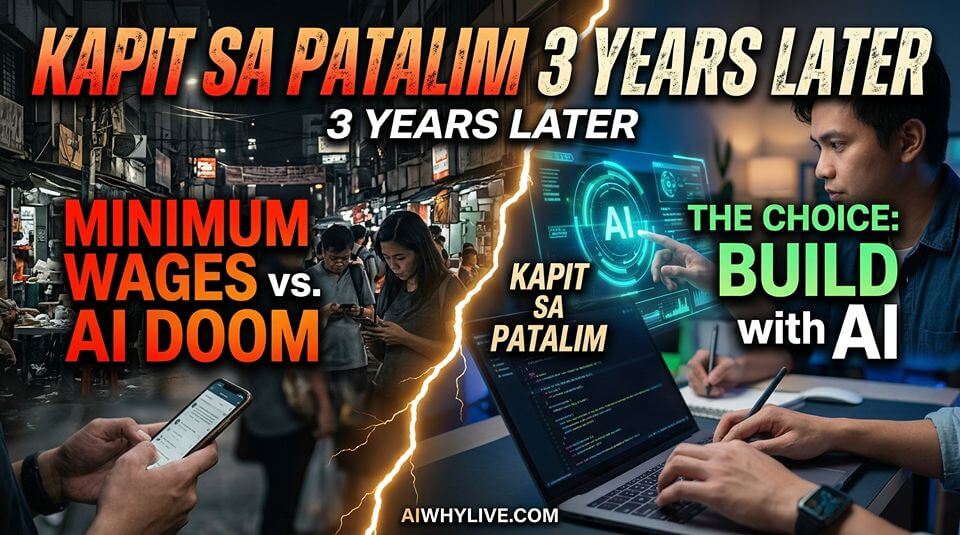
Three years ago, we looked at what it meant to "kapit sa patalim"—to cling to the sharp edge just to survive on a minimum wage in the Philippines. Back then, the daily grind felt heavy. Today, the ground beneath our feet has shifted entirely.
So, what happened after three years?
Did minimum wage earners finally level up?
Did the incremental wage orders across Metro Manila and the provinces pull families out of survival mode?
Or are we all just caught in a brand-new kind of trap—one where the physical struggle of a ₱755 daily minimum wage meets the silent, glowing pressure of an AI-driven economy while we stare blankly at our screens?
Let's talk about what changed, what didn't, and why the biggest danger today isn't just an empty wallet. It's an empty, distracted mind.
The Three-Year Mirage: Did Wages Actually Level Up?
Let’s look at the numbers. Over the past few years, regional wage boards have pushed out adjustment after adjustment. In the National Capital Region, non-agricultural workers have seen baseline rates climb toward ₱755 a day under recent wage orders, with provinces seeing incremental movement as well.
Sounds like progress, right?
On paper, yes. More pesos per day.
In reality? Inflation, the rising cost of rice, rent, transport, and utilities usually swallows those adjustments before the ink on the new wage order even dries. The cost of living didn't just match the wage increase; it sprinted ahead of it.
For millions of minimum wage earners, the math still doesn't breathe. You earn a little more, but everything costs a lot more. You aren't moving forward; you are treading water faster just to keep your chin above the surface.
And right when people are looking for a ladder out of this cycle, a new technological wave crashes onto the shore: Artificial Intelligence.
🧠 AIWhyLive Explains — Wage Compression
Wage compression occurs when the minimum wage rises faster or higher than the pay of mid-level or experienced workers, or when automation squeezes the middle tier of jobs entirely.
In an AI-infused economy, wage compression hits differently. When entry-level administrative tasks, basic content writing, data encoding, and customer support are automated, companies don't need a massive tier of junior workers. They need fewer people managing smarter tools.
This leaves workers caught in a dangerous split: either compete with algorithms that work for fractions of a cent, or stay trapped in low-wage physical and service jobs where automation can't reach yet.
Still Doom-Scrolling While the World Shifts?
When you work a grueling 8-to-5 shift, carry the mental weight of financial survival, and come home exhausted, what is the easiest escape hatch available?
Your phone.
Short-form videos, endless social media feeds, algorithmic outrage, and viral distractions. It feels like rest, but it's actually doom-scrolling.
Three years ago, the distraction was just entertainment. Today, it's a narcotic that keeps people passive while the rules of the global economy are being rewritten by AI.
While tech-literate workers are learning how to use AI to multiply their output, build side businesses, and pivot into higher-value digital roles, millions of everyday workers are kept in a loop of digital exhaustion. The phone feeds you comfort, but it starves your focus.
👦 ELI12 — The Video Game Level That Never Ends
Imagine playing a video game where every time you earn enough gold coins to buy a better sword, the shopkeeper instantly doubles the price of the sword.
That's what chasing inflation feels like.
Now imagine that while you're busy trying to figure out how to beat level one manually, someone next to you plugs a cheat code (that's AI) into the game and beats the whole thing in five seconds.
If you spent all your time watching videos of other people playing instead of learning how the cheat code works, you're going to stay stuck on level one forever. That's the choice between doom-scrolling and building.
🍗 Lechon Manok — The "Prompt Engineer" Fantasy
Ah, yes. Let's talk about the cultural pivot.
Three years ago, everyone wanted to be a crypto trader or an online seller overnight.
Today, everyone thinks they can escape minimum wage poverty by becoming a "certified global AI consultant" after watching a three-minute reel on TikTok.
Wonderful. Absolutely genius.
We think that just because AI exists in our pocket, our financial status will magically upgrade itself without actual skill-building, patience, or unglamorous execution. Typing a prompt into a chatbot doesn't make you an innovator if you don't actually understand how to solve human problems. The lechon-scented reality check? Magic apps don't fix structural economic struggles—only deep, practical competence does.
🐘 Elephant in the Room — AI on Minimum Wage: Problem or Solution?
Let's ask the question nobody wants to face head-on:
Is AI on minimum wage a job-destroying problem, or is it the ultimate equalizer?
The doom-and-gloom camp argues that AI is coming for the entry-level BPO jobs, the administrative assistants, the graphic designers, and the local customer service reps—the very stepping stones that allowed working-class families to enter the digital middle class.
If AI automates those roles away, what happens to the pipeline of upward mobility?
On the flip side, the optimist camp argues that AI is a leverage machine. It lowers the barrier to entry for solo creators, local entrepreneurs, and freelancers. A minimum wage worker in a province can theoretically use AI to learn coding, draft professional proposals, or build a digital service business that earns in dollars—something completely impossible a decade ago.
So which one is it? It's both.
AI is a ruthless problem for people who refuse to adapt, and a powerful solution for people who refuse to stay passive.
The technology itself is neutral. The human application of it is where the inequality deepens or dissolves.
The Bottom Line: Stop Scrolling, Start Building
Three years have passed, and the daily wage fight is still real. Prices are high, the economic pressure is heavy, and the technological landscape is moving at lightspeed.
You cannot control inflation overnight. You cannot rewrite national wage laws tomorrow.
But you can control where you direct your attention.
Stop letting the algorithm consume the hours you could be using to upskill, learn, and experiment. Put down the infinite scroll. Pick up a tool that builds your capacity.
The gap in the future won't just be between the rich and the poor. It will be between those who use AI to build their lives, and those who let AI—and their phones—use them.
Don't stay stuck in the loop. Follow for more grounded, human-first insights at aiwhylive.com.