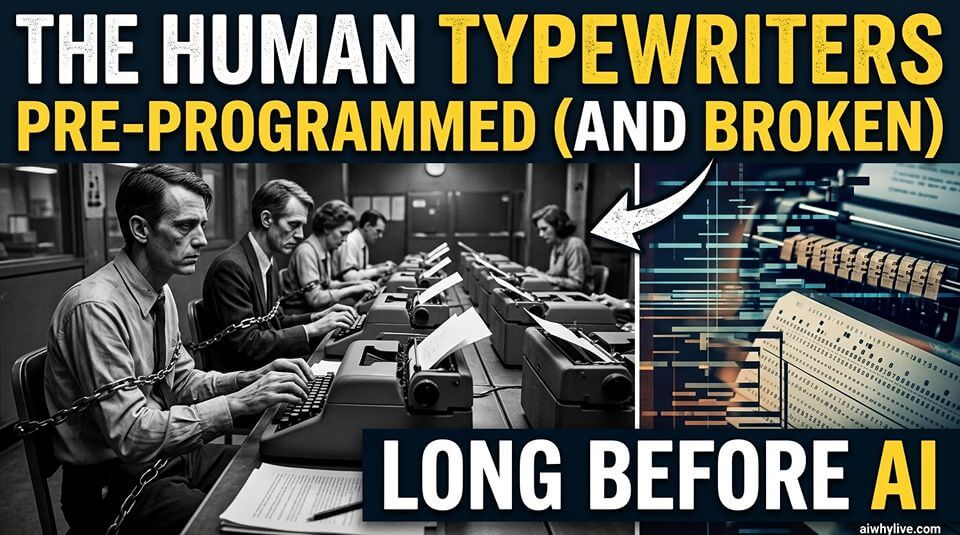
Long before artificial intelligence ever wrote a line of code or hallucinated a summary, millions of people were already operating like manual typewriters.
Think about how an old typewriter works.
It has no undo button. No backspace key that magically vaporizes a mistake. Every single keystroke strikes the paper with permanent, irreversible force. Hit the wrong letter, and you either live with the smudge, paste a piece of white-out correction tape over it, or rip the entire page out and start from scratch.
Now, look around your office, your corporate meetings, or your family group chat.
Long before generative AI entered the room, a lot of humans were already behaving exactly like that machine.
Rigid. Monotone. Terrified of making a typo. And utterly incapable of processing a single change without jamming.
The Pre-AI Mechanical Mind
We used to joke about technology turning us into robots. But the truth is much funnier and sadder: humans had already automated themselves into analog machines long before the algorithms arrived.
Meet the Human Typewriter:
- They operate strictly on fixed templates. Change one variable, and their internal gears grind to a grinding halt.
- They view any deviation from the script as a catastrophic system failure.
- They treat every error as a permanent stain on their character because they lack a mental
Ctrl+Z.
When you spend your entire life being conditioned to follow strict, unbending rules—memorize this script, fill out this form identically, never question the margins—you stop being a creator. You become a carbon-ribbon printer.
And when AI finally showed up, offering infinite flexibility, instant rewrites, and fluid adaptation, it didn't just shock the tech world. It terrified the people who had spent decades turning themselves into rigid machines.
🧠 AIWhyLive Explains — Mechanical Rigidity
Mechanical rigidity in human behavior is the psychological condition where a person relies entirely on rigid, pre-set routines, scripts, and rules to navigate life because they lack the tolerance for trial, error, and adaptation.
Just like a manual typewriter cannot adjust its font or autocorrect a misspelled word mid-line, a rigidly conditioned human treats minor adjustments as existential threats.
In the Age of AI, this rigidity is fatal. AI rewards iterative thinking, prompts that evolve, and the courage to make ugly first drafts. If your primary life strategy is "never make a typo," you are competing with a machine that types a thousand words a second without breaking a sweat.
👦 ELI12 — The Kid Who Refused to Erase
Imagine giving a kid a pen with permanent ink and telling them: “If you make a single spelling mistake on this drawing, the whole project goes in the trash.”
What happens? The kid gets so nervous, stiff, and paralyzed by the fear of a smudge that they barely move their hand. They stop experimenting. They stop drawing cool, wild things.
That's what happens when school and work teach us to act like typewriters instead of humans. We become so afraid of making an error that we stop thinking altogether. AI didn't break our creativity; it just exposed how stiff our joints already were.
🍗 Lechon Manok — The Office "Caps Lock" Survivor
Ah, yes. Let's talk about that one colleague or boss who treats every minor email update like a formal proclamation carved into stone tablets.
Everything is sent in aggressive ALL CAPS. Every deviation from SOP (Standard Operating Procedure) causes a minor emotional meltdown. They treat a misplaced comma like a direct assault on national security.
Wonderful. Absolutely pristine.
We spent decades building corporate environments that punish flexibility and reward mechanical obedience, and now we're shocked that people don't know how to prompt an AI or pivot in a crisis. Turns out, some people didn't need a software update—they needed an oil change and a hammer to loosen their stuck keys.
🐘 Elephant in the Room — Are We Becoming the Typewriters We Left Behind?
Let's ask the awkward question:
Are we complaining about AI taking over human work, or are we secretly mad that AI is exposing how mechanical our human work actually was?
If your entire daily output consists of copy-pasting spreadsheet rows, formatting identical reports, sending templated emails, and reciting corporate jargon without a single drop of original thought, you aren't doing human work.
You were just playing a very slow, low-paying typewriter.
AI didn't steal jobs from dynamic, creative, messy, unpredictable humans. It automated the tasks assigned to human typewriters. If you want to survive the shift, you have to stop guarding your repetitive mechanical routines and start leaning into the messy, unprogrammable magic of actual human judgment.
The Bottom Line: Grab the White-Out and Rewrite
Typewriters had a good run. They gave us clean manuscripts, dramatic cinematic sound effects, and a sense of historic permanence.
But humans were never meant to be locked inside a metal casing, striking a ribbon the exact same way every single day.
If you feel stuck, rigid, or terrified of making a mistake in this fast-moving digital era, remember: you are not a machine. You are allowed to backspace. You are allowed to change your mind, mess up a draft, throw away the page, and start over.
Don't be a relic. Keep your humanity fluid.
Enjoyed this satirical look at human machines? Follow for more grounded, witty insights at aiwhylive.com.