AI Thinks It Knows You. But It Doesn't Know What Happened Before You Typed.
You're driving.
A car suddenly cuts in front of you.
You slam the brakes.
Your immediate diagnosis:
IDIOT.
Reckless.
Selfish.
Probably shouldn't even have a driver's license.
Five minutes later, you accidentally cut somebody else off.
But that's different.
Your lane was disappearing.
The motorcycle surprised you.
You were avoiding a pothole.
You had a reason.
The other driver?
Idiot.
😂
Congratulations.
You have just encountered the basic intuition behind one of social psychology's most famous ideas:
And in the Age of AI, this old human tendency raises a very modern question:
What happens when machines help us judge people from data without knowing everything happening in their lives?
🧠 AIWhyLive Explains: What Is the Fundamental Attribution Error?
Don't let the intimidating name scare you.
The basic idea is remarkably simple.
When explaining another person's behavior, we can place too much emphasis on their personality or character and too little emphasis on the situation surrounding them.
Someone misses a deadline.
Lazy.
Someone doesn't answer your message.
Rude.
Someone arrives late.
Irresponsible.
Someone performs badly.
Incompetent.
But when explaining our own behavior, situational details often become much easier to remember.
I was exhausted.
Traffic was terrible.
My child was sick.
My boss gave me three urgent jobs.
I misunderstood the instructions.
I hadn't slept.
I was having the worst day of my year.
"That's the kind of person they are."
When WE make a mistake:
"You don't understand what happened."
That captures the intuition, although real attribution psychology is more complicated than a single rule.
Culture, available information, perspective and circumstances can affect how strongly people make dispositional versus situational judgments.
So the Fundamental Attribution Error shouldn't be treated as a magical law explaining every human judgment.
It is better used as a warning:
Before deciding what somebody IS, ask what might have HAPPENED.
The Email That Turned Someone Into an Arrogant Person
Imagine sending someone an important email.
No reply.
One day.
Two days.
Three days.
Your brain begins writing the person's biography.
Unprofessional.
Arrogant.
Doesn't respect me.
Then you discover:
Their mother was hospitalized.
Suddenly the same behavior means something completely different.
The unanswered email didn't change.
The number of days didn't change.
The context changed.
And with it...
your judgment.
Now Give That Problem to AI
This is where an old psychology lesson becomes an AI problem.
Imagine giving an AI system:
- emails,
- chat messages,
- a résumé,
- social-media posts,
- work records,
- customer interactions,
- purchase patterns,
- attendance data,
- performance scores,
- or other behavioral information.
Then ask:
"What kind of person is this?"
AI may identify patterns humans would miss.
It can summarize.
Classify.
Compare.
And in some systems, estimate probabilities or help support decisions.
But there may be something missing:
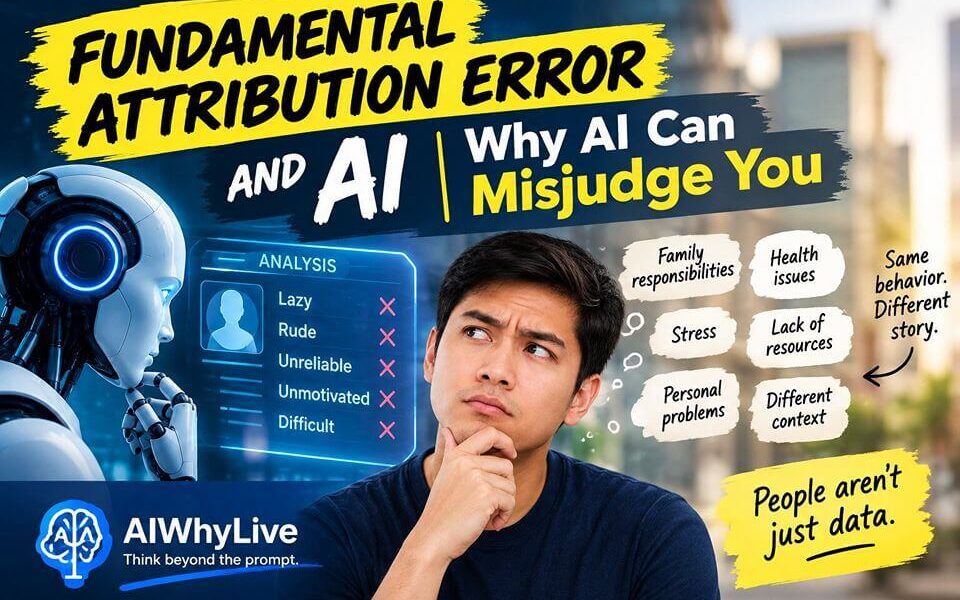
Why was the email angry?
Why did productivity collapse for two months?
Why did somebody repeatedly arrive late?
Why did a student suddenly perform badly?
Why did a customer become unusually aggressive?
Why did someone disappear from social media?
The available data may describe:
WHAT happened.
The dangerous leap is assuming it automatically explains:
WHY it happened.
Important: AI Doesn't Literally Need to Have a "Fundamental Attribution Error"
The Fundamental Attribution Error is a concept developed to describe human social judgment.
AI is not simply a human brain made from software.
So it would be careless to claim every AI system literally suffers from the same psychological bias.
The more useful connection is this:
An AI system can also produce an interpretation that overreaches beyond the evidence supplied to it.
That makes the old psychology lesson extremely relevant to AI-assisted judgment.
🍗 Lechon Manok: The AI Performance Review
Boss:
"AI, analyze Employee #27."
AI:
"The employee frequently arrives 15 minutes late."
Boss:
"Lazy?"
AI:
"The available data does not establish—"
Boss:
"Unmotivated?"
AI:
"There may be multiple explanations."
Boss:
"Terminate?"
Employee:
"My wife starts work at 7:00 AM. I bring our disabled son to school before coming here."
Boss:
"..."
AI:
"Remember when I said multiple explanations?"
😂
One missing fact can rewrite an entire interpretation.
AI May Know the Words Without Knowing the Circumstances
Suppose somebody writes:
"Leave me alone."
An AI system may detect hostility or negative sentiment.
Perhaps correctly.
But why was it written?
Possibility A:
The person is being rude.
Possibility B:
They're being harassed.
Possibility C:
They're terrified.
Possibility D:
They haven't slept for 30 hours.
Possibility E:
Their relationship just ended.
Possibility F:
They're joking with a close friend.
Same three words.
Very different realities.
But language is not the entirety of a human life.
🐘 Elephant in the Room: Humans Already Do This
It would be unfair to blame AI for inventing snap judgment.
We got there first.
We judge:
The poor.
The rich.
The unemployed.
The successful.
The student who failed.
The businessman who went bankrupt.
The employee who resigned.
The friend who stopped calling.
The stranger who made one stupid comment online.
Social media can intensify the problem.
Someone records 17 seconds of another human being.
We watch it.
Then diagnose an entire personality.
Narcissist!
Entitled!
Lazy!
Idiot!
Bad parent!
Maybe we're right.
Maybe we're completely wrong.
AI didn't create that habit.
But AI can help us perform judgments at a scale and speed humans previously couldn't.
The Age of AI Turns Judgment Into Scale
One manager can misunderstand a handful of employees.
A large automated system can influence decisions affecting enormous numbers of people.
AI and algorithmic systems can be used in areas involving:
- hiring,
- lending,
- fraud detection,
- education,
- customer service,
- content moderation,
- advertising,
- recommendation systems,
- employee management,
- and other forms of decision support.
Not every algorithm is trying to determine someone's personality.
Not every AI decision is unfair.
But many systems necessarily operate on representations of reality.
A score.
A record.
A pattern.
A probability.
A dataset.
Those representations may be extremely useful.
They can also be incomplete.
Which gives us one question worth asking repeatedly:
👦 ELI12: The Student Sleeping in Class
A student sleeps through class almost every day.
Teacher A says:
"Lazy student."
Then the teacher discovers the student works at night because the family needs money.
Same student.
Same sleeping.
Different explanation.
Now imagine an AI system sees:
Attendance.
Grades.
Homework completion.
Test scores.
Classroom incidents.
It predicts:
HIGH RISK OF FAILURE.
The prediction could even be accurate.
But there's another question:
Does the system know why?
That distinction becomes extremely important when predictions affect human lives.
AI Can Be Right About the Pattern and Wrong About the Person
Suppose AI predicts:
"This employee is likely to resign."
And the employee resigns.
The prediction was correct.
Now suppose somebody interprets the prediction as:
"This employee lacks commitment."
But the actual reason for leaving was caring for a seriously ill parent.
The prediction:
Correct.
The story:
Wrong.
That matters because explanations influence how humans decide:
- who deserves help,
- who deserves punishment,
- who deserves trust,
- who gets another chance,
- who gets hired,
- who gets promoted,
- and who gets investigated.
A probability can be useful.
It should not automatically become a moral judgment.
The Résumé Gap Problem
Imagine two applicants.
Applicant A:
Perfect employment history.
No gaps.
Steady promotions.
Applicant B:
Two-year employment gap.
Several short jobs.
A simplistic interpretation might say:
Applicant A is reliable.
Applicant B is unstable.
Maybe.
But Applicant B might have spent two years caring for a dying parent.
GAP.
Life may contain:
LOVE.
An algorithm can analyze what was recorded.
Reality includes things nobody entered into the database.
🐘 Bigger Elephant: Could AI Actually Help Us Make Fewer Attribution Errors?
Here's where the argument becomes more interesting.
AI doesn't have to make this problem worse.
Used carefully, AI could help humans consider explanations they overlooked.
Humans get emotional.
We hold grudges.
We get tired.
We stereotype.
We favor people we like.
We can reach conclusions before asking enough questions.
Now imagine deliberately prompting AI:
Instead of:
"He's lazy."
we might get:
"The available behavior could be consistent with low motivation, but it could also reflect excessive workload, unclear instructions, inadequate tools, family responsibilities or other circumstances. More information is needed."
That's not a weaker conclusion.
It's a better-calibrated one.
AI might therefore become part of the solution.
But only if we ask it to challenge our judgments rather than merely validate them.
Better AI Prompts for Judging Behavior
| Instead of Asking | Try Asking |
|---|---|
| "Why is this employee lazy?" | "What personal and situational explanations could produce this pattern of performance?" |
| "Is this person toxic?" | "What evidence supports that interpretation, what alternative explanations exist, and what context is missing?" |
| "What kind of person writes this?" | "What can reasonably be inferred from this text, and what cannot?" |
| "Why doesn't this student care?" | "What circumstances could explain this behavior, and what additional information would help distinguish among them?" |
| "Prove my interpretation is correct." | "What evidence would prove my interpretation wrong?" |
That last question is particularly useful.
What would prove me wrong?
Human intelligence needs that question too.
AI Should Be Allowed to Say Three Words
"I don't know."
Not:
"Based on sophisticated analysis of linguistic patterns, this individual demonstrates..."
Stop.
😂
Sometimes the responsible answer is:
That's not stupid AI.
That's calibrated AI.
Intelligence isn't merely reaching conclusions quickly.
Sometimes intelligence means recognizing when the available evidence does not justify one.
Social Media Is an Attribution Machine
Think about the modern feed.
Video:
A person shouting in a supermarket.
Caption:
"ENTITLED CUSTOMER GOES CRAZY!"
Millions of views.
But what happened five minutes earlier?
Maybe the person is behaving terribly.
Maybe someone threatened their child.
Maybe the uploader removed crucial context.
Maybe there was a misunderstanding.
Maybe the caption is completely accurate.
We don't know.
But social platforms don't necessarily need us to know.
They need us to react.
Context is slow.
And the Internet rewards fast.
Now add AI-generated summaries.
Maybe soon we don't even watch the full video.
AI tells us what happened.
Another AI summarizes that summary.
Then millions of humans argue about an event most of them never actually saw.
Welcome to progress.
😂
Politics Loves Simple Attribution
Bad economy?
Bad leader.
Good economy?
Great leader.
Poverty?
Lazy people.
Success?
Brilliant person.
Failure?
Incompetent person.
Reality is usually messier.
Character matters.
Choices matter.
Leadership matters.
But circumstances matter too.
Institutions.
History.
Opportunity.
Luck.
Education.
Timing.
Resources.
External events.
AI can help us examine those variables.
Or we can use AI to produce a beautifully written justification for the conclusion we already wanted.
Same technology. Different use.
The Fundamental Attribution Error Can Even Change How We Judge AI
Here's the twist.
AI gives us a terrible answer.
We immediately say:
"AI is stupid."
Maybe.
😂
But other explanations may exist.
The prompt was ambiguous.
Important context was missing.
The source material was wrong.
The task required information the system didn't have.
The model was poorly suited to the task.
Or yes...
AI simply got it wrong.
The larger lesson remains:
Humans judge AI.
AI helps humans judge humans.
Everybody could use more context.
Maybe the Real AI Skill Isn't Prompt Engineering
We've spent years teaching people:
How to ask AI better questions.
Useful.
But perhaps there's another skill we need:
Judgment engineering.
Before accepting an AI conclusion about a human being, ask:
- What does the AI actually know?
- What doesn't it know?
- What context was unavailable?
- Is it describing behavior or inferring character?
- Is it predicting an outcome or explaining its cause?
- What alternative explanations fit the same evidence?
- What evidence would contradict the interpretation?
Those questions matter beyond chatbots.
They matter whenever data and algorithms help humans make consequential decisions about other humans.
🍗 Lechon Manok: The Ultimate AI Personality Test
Human:
"AI, analyze my personality from our conversations."
AI:
"You appear curious, analytical and—"
Human:
"Correct."
AI:
"You also occasionally—"
Human:
"DELETE THAT PART."
😂
We love AI psychology when it flatters us.
When it doesn't?
Suddenly:
"AI lacks sufficient context to make psychological assessments."
Amazing how quickly we discover epistemology.
Understanding Is Not the Same as Excusing
There's an important objection to all of this.
If we keep looking for situational explanations, aren't we just making excuses for bad behavior?
No.
Explanation and excuse are different things.
Understanding why someone did something does not require approving what they did.
People still have responsibility.
Bad actions can still have consequences.
But better context can make responsibility more accurate.
It improves judgment.
Frequently Asked Questions About Fundamental Attribution Error and AI
What is the Fundamental Attribution Error?
The Fundamental Attribution Error is a concept in social psychology describing a tendency to overemphasize personal or dispositional explanations for other people's behavior while underestimating situational influences. The effect is not equally strong in every person or culture, so it should be understood as a tendency rather than an absolute rule.
What is a simple example of the Fundamental Attribution Error?
If another driver cuts you off and you immediately decide the driver is selfish or incompetent, you may be attributing the behavior to character without knowing the circumstances. If you later cut someone off yourself and explain it using traffic, road conditions or an emergency, the contrast illustrates the basic idea.
What does the Fundamental Attribution Error have to do with AI?
The concept was developed to describe human judgment, not AI psychology. However, it is relevant when humans or AI-assisted systems infer stable traits from behavioral data without enough situational context. AI can identify patterns without necessarily knowing the complete circumstances behind them.
Can AI judge someone's personality accurately?
AI can identify patterns in text and behavioral data, but conclusions depend heavily on the quality, relevance and completeness of the information provided. A limited dataset should not be treated as a complete representation of a person's personality or life circumstances.
Can AI make the Fundamental Attribution Error worse?
AI can amplify the consequences of attribution mistakes when automated analysis is applied at scale or when users treat incomplete predictions as explanations of character. However, AI can also help reduce the problem by deliberately generating alternative situational explanations and identifying missing context.
What is the difference between prediction and explanation in AI?
A prediction estimates what may happen, while an explanation attempts to identify why it happens. An AI system could correctly predict that an employee will resign without knowing whether the reason is dissatisfaction, family responsibilities, relocation, health, a better job offer or something else.
How can I reduce attribution bias when using AI?
Ask AI to identify both personal and situational explanations, state what information is missing, distinguish observations from inferences, propose alternative interpretations and explain what evidence could disprove its conclusion.
Can AI help humans make fairer judgments?
Potentially. AI can be prompted to consider alternative explanations humans may overlook. Whether it improves judgment depends on system design, data quality, context and how people use its output. AI should support careful human judgment rather than turn uncertain inferences into automatic facts.
🎤 Drop Mic: AI Knows Your Data. It Doesn't Necessarily Know Your Story.
The Age of AI will give machines access to increasingly detailed information about human behavior.
What we buy.
What we watch.
What we type.
How we work.
What we search.
What we click.
What we ignore.
AI may eventually know thousands of facts about a person.
But thousands of facts aren't necessarily:
your story.
A person is not merely a dataset.
A mistake is not automatically a personality.
A bad day is not a character trait.
A failed exam is not an intelligence test for an entire life.
A missed deadline is not necessarily laziness.
An angry sentence is not an entire personality.
A résumé gap is not emptiness.
And a prediction is not an explanation.
AI can help us understand people.
It can also help humans judge people faster than ever before.
Which future we get depends partly on how we build these systems...
and partly on how intelligently we use them.
So the next time AI—or your own brain—looks at someone's behavior and instantly says:
"That's the kind of person they are..."
ask one more question:
That question is older than artificial intelligence.
But in the Age of AI...
we may need it more than ever.
AIWhyLive — Think beyond the prompt.

Welcome to (WordPress) aiwhylive.com. This is your first post. Edit or delete it, then start writing! Like most journey, it Read more
"AI Showdown: ChatGPT vs. Bard - Unveiling the Ultimate AI Champion!" Let AI answer which is of them is better!
Please note that clickbait titles are often designed to grab attention but may not always accurately reflect the content or Read more

What AI truly means and how it can impact industries, automation, decision-making, and problem-solving. But let's not forget about ethical Read more