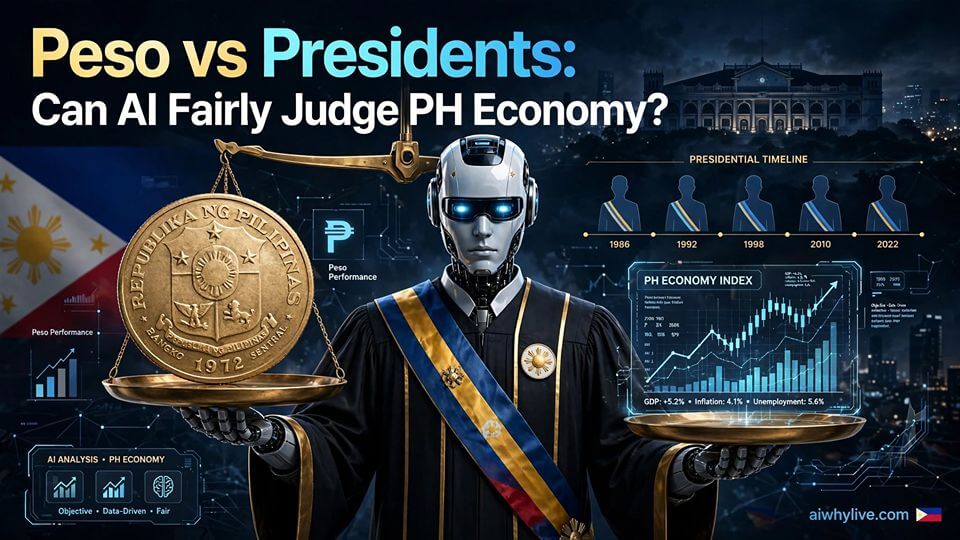
The Numbers Don't Lie. But Can a Peso Chart Tell You Which President Was Better?
Look at four numbers:
₱44.
₱46.
₱55.
₱62.
Now place the names of four Philippine presidents beside them.
Congratulations.
You have a political argument.
😂
One side will point at ₱46.
Another will point at ₱55.
Someone will circle ₱62 in red.
Someone else will explain oil prices.
Someone will blame debt.
Someone will blame the US Federal Reserve.
Someone will blame the current administration.
Someone will blame the previous administration.
And eventually somebody will type:
"ASK AI!"
Excellent.
Let's do exactly that.
But instead of asking AI:
"Which president destroyed the peso?"
let's ask something much harder:
Because this is where numbers become dangerous.
Not necessarily because they're false.
But because true numbers can still tell an incomplete story.
🧠 AIWhyLive Explains: What Does a Weaker Peso Actually Mean?
The USD/PHP exchange rate tells us how many Philippine pesos are required to buy one US dollar.
If the exchange rate moves from:
₱50 = $1
to:
₱60 = $1
the peso has depreciated against the dollar.
You now need more pesos to buy the same dollar.
That can matter throughout the economy.
A weaker peso can increase the peso cost of dollar-priced imports.
Fuel matters.
Machinery matters.
Raw materials matter.
Imported goods matter.
Foreign travel matters.
Foreign-currency obligations can matter.
But there is another side.
For people receiving US dollars, including many overseas Filipino families, each dollar converts into more pesos.
Some exporters can also benefit from a weaker domestic currency under certain conditions.
So even before politics enters the conversation, the first simplistic conclusion already has a problem:
Bad for whom?
Good for whom?
Compared with what?
And most importantly:
Why did the peso weaken?
Now we're analyzing.
Does the Philippine President Control the Peso-Dollar Exchange Rate?
No. The Philippine president does not personally set the peso-dollar exchange rate.
The Philippines operates under a market-determined exchange-rate framework.
The value of the peso is primarily determined by supply and demand in the foreign-exchange market.
That does not mean government policy is irrelevant.
Far from it.
Fiscal policy, debt, investment conditions, infrastructure, regulation, political stability, energy policy and confidence can all influence economic conditions.
But there is no presidential control panel with buttons marked:
₱50
₱55
₱60
😂
The exchange rate is the outcome of many domestic and international forces interacting at the same time.
The Viral Peso Chart Problem
Imagine a social-media graphic showing:
Administration A: roughly ₱44 → ₱46
Administration B: roughly ₱46 → ₱46
Administration C: roughly ₱46 → ₱55
Administration D: roughly ₱55 → above ₱60
The visual conclusion is almost automatic.
Administration B:
Excellent!
Administration D:
Disaster!
Case closed.
Except economics rarely works like a Facebook scorecard.
The arithmetic may be correct.
But the interpretation can still be incomplete or misleading.
That distinction is essential.
🍗 Lechon Manok: AI Picks the Best President
Human:
"AI, President A started around ₱44 and ended around ₱46."
AI:
"Okay."
Human:
"President B was around ₱46 at both ends."
AI:
"Okay."
Human:
"President C ended around ₱55."
AI:
"Okay."
Human:
"President D saw the peso move above ₱60."
AI:
"Okay."
Human:
"So who was the best president?"
AI:
"I need more context."
Human:
"No. Look at the numbers."
AI:
"I am looking at the numbers."
Human:
"Then answer."
AI:
"You're asking an economics question using arithmetic."
Human:
"..."
😂
That may be the entire problem.
Numbers Can Be Correct and the Story Can Still Be Wrong
This is one of the most important lessons in data literacy.
Imagine two students.
Student A scores:
85
Student B scores:
95
Who performed better?
Student B.
Obviously.
Now I tell you:
Student A took an advanced physics examination.
Student B took a basic spelling test.
Still comfortable comparing the numbers?
Context changed everything.
Exchange-rate comparisons have a similar problem.
A president governing during one global economic environment is not governing under exactly the same conditions as another president.
Different periods can include:
- global financial crises,
- periods of very low global interest rates,
- pandemics,
- wars and geopolitical tensions,
- oil and energy shocks,
- aggressive US interest-rate changes,
- global inflation,
- supply-chain disruptions,
- changes in capital flows,
- and changes in the strength of the US dollar itself.
The exchange-rate number remains real.
But suddenly:
the number isn't the whole story.
🐘 Elephant in the Room: Presidents Still Matter
Now let's avoid making the opposite mistake.
Saying:
"It's all global. Presidents have nothing to do with it!"
would also be intellectually lazy.
Governments matter.
Policy matters.
Fiscal discipline matters.
Debt matters.
Investment policy matters.
Infrastructure matters.
Energy policy matters.
Regulation matters.
Political stability matters.
Governance matters.
Investor confidence matters.
And how a government responds to an external shock matters.
So the intelligent position isn't:
"The president controls the peso."
And it isn't:
"The president has nothing to do with the peso."
It's closer to this:
Less exciting?
Yes.
More useful?
Also yes.
Welcome to economics.
😂
The Peso Doesn't Vote
Currencies don't attend rallies.
They don't read Facebook.
The foreign-exchange market isn't sitting there saying:
"I like this president. Strengthen!"
or:
"I hate this president. Depreciate!"
The peso-dollar exchange rate emerges from huge volumes of economic activity.
People and institutions buying dollars.
People selling dollars.
Imports.
Exports.
Investments.
Debt payments.
Remittances.
Interest-rate expectations.
Central-bank decisions.
Investor sentiment.
Global risk.
Domestic demand for foreign currency.
Global demand for dollars.
And countless market decisions occurring simultaneously.
The president matters.
But the peso doesn't have a president button.
Don't Forget the Other Half of USD/PHP: The Dollar
Political graphics in the Philippines naturally focus on Philippine presidents.
But USD/PHP has two sides.
PHP.
And:
USD.
The US dollar is not a measuring stick frozen forever at the same strength.
It moves too.
US interest rates change.
Federal Reserve policy changes.
Global investors move money into and out of dollar assets.
Risk appetite changes.
During periods of broad dollar strength, currencies in many countries can weaken against the dollar simultaneously.
So if we're going to judge a Philippine administration entirely from USD/PHP...
That's not an excuse.
That's context.
👦 ELI12: Four Runners, Four Different Races
Imagine four runners.
Runner A races on a cool, sunny day.
Runner B also gets good conditions.
Runner C runs during heavy rain.
Runner D runs uphill during a storm.
Then I show you only their finishing times.
Who is the best runner?
You can compare the numbers.
But can you fairly explain the performance without knowing the conditions?
Now make the example more realistic.
Runner D also chose terrible shoes.
Some of the problem was the storm.
Some was the hill.
And some was Runner D.
External conditions matter.
Leadership matters.
Both can be true at the same time.
This Is Where AI Can Become Dangerous in Politics
AI is excellent at finding patterns.
Give it a table.
Then ask:
"Who performed best?"
And a cooperative AI may produce a ranking.
That's exactly what political debate loves.
Winner.
Loser.
Good.
Bad.
Strong.
Weak.
Shareable.
But responsible AI analysis should first ask:
- Are these numbers actually comparable?
- Are the dates selected consistently?
- Are we comparing daily rates, monthly averages, annual averages or end-of-period rates?
- Were the administrations facing similar global conditions?
- What happened to inflation?
- What happened to economic growth?
- What happened to interest rates?
- What happened to oil prices?
- What happened to trade and external balances?
- Was the US dollar strengthening globally?
- What was monetary policy doing?
- What conditions were inherited from the previous administration?
Now the viral graphic becomes something much more valuable.
A data-literacy exercise.
The Prompt Can Be Political Even When the AI Isn't
Consider two prompts.
"Prove President X destroyed the peso."
versus:
"Prove President X had nothing to do with the weak peso."
Both prompts already contain the desired destination.
A cooperative AI may help construct arguments supporting either one.
Now try:
Same AI.
Completely different analytical task.
This is why AI literacy and political data literacy increasingly overlap.
It begins with the question we wanted answered.
The Starting-Date Problem
When exactly does a president "own" an exchange rate?
Inauguration day?
January 1?
The first full month?
The first full year?
What about the budget inherited from the previous administration?
What about policies whose effects take years to appear?
Suppose one government creates a vulnerability that explodes six months into the next administration.
Who gets the number?
Suppose an administration introduces a reform whose benefits become visible three years after it leaves.
Who gets the credit?
The economy doesn't reset when a new president takes an oath.
The economy has memory.
Administrations inherit:
- debt,
- infrastructure,
- contracts,
- inflation pressures,
- investment commitments,
- institutions,
- problems,
- and opportunities.
A two-number graphic cannot show all of that.
The End-Date Problem
Now imagine the peso behaves like this during an administration:
₱50.
₱51.
₱49.
₱50.
₱51.
Then a global shock arrives near the end:
₱56.
The graphic says:
₱50 → ₱56.
Large depreciation.
Numerically true.
But does that final observation fairly summarize the entire period?
Maybe.
Maybe not.
Reverse the situation.
Imagine the currency is weak for most of a term and suddenly strengthens just before the administration ends.
A start-versus-end comparison may make the entire period look much better.
This is why serious analysis can examine:
averages.
trends.
volatility.
turning points.
and the conditions surrounding them.
Two data points are useful.
They are not the entire movie.
Why the Exact Exchange-Rate Method Matters
One person can quote a daily closing rate.
Another can quote a monthly average.
Another can quote an annual average.
Another can quote the end-of-year rate.
All may be using legitimate data.
But they are measuring slightly different things.
For example, official BSP statistics separately publish:
- daily peso-dollar rates,
- monthly averages,
- end-of-period rates,
- and annual averages.
That means a fair historical comparison should disclose its methodology.
If a graphic compares administrations, use the same type of exchange-rate observation for every administration and clearly state the dates and source.
Otherwise, a comparison can quietly become cherry-picking.
🐘 Bigger Elephant: Is a Strong Peso Always Better?
Strong peso:
GOOD!
Weak peso:
BAD!
Not necessarily.
A stronger peso can make imported goods and dollar-priced inputs cheaper in peso terms.
That can help consumers and businesses dependent on imports.
But currency movements also affect exporters, tourism, remittance recipients and other parts of the economy differently.
A weaker peso can increase the peso value of dollar earnings.
At the same time, it can make imported fuel, equipment and other goods more expensive.
The exchange rate also affects inflation, competitiveness and the cost of servicing foreign-currency obligations.
So the question:
"Is a strong peso good?"
deserves perhaps the most famous answer in economics:
It depends.
😂
What Would a Fair AI Comparison of Administrations Look Like?
If we genuinely want AI to analyze administrations rather than manufacture political ammunition, one exchange-rate number isn't enough.
A better comparison could examine:
| Measure | Why It Matters |
|---|---|
| Starting USD/PHP rate | Provides the initial exchange-rate position. |
| Ending USD/PHP rate | Shows where the currency stood at the comparison endpoint. |
| Average exchange rate | Reduces dependence on one unusually strong or weak day. |
| Exchange-rate volatility | Shows how stable or unstable the currency was during the period. |
| Inflation | Provides context for domestic price pressures and purchasing power. |
| Economic growth | Helps prevent treating currency strength as the entire economy. |
| Interest rates | Can influence capital flows and currency demand. |
| Government debt and fiscal conditions | Can affect confidence and macroeconomic vulnerability. |
| Trade and current-account conditions | Influence demand and supply for foreign currency. |
| Investment flows | Foreign capital movements can influence the peso. |
| Remittances | A major source of foreign exchange for the Philippines. |
| Oil and energy prices | The Philippines imports significant energy requirements. |
| Global US-dollar strength | Separates some peso-specific weakness from broader dollar movements. |
| Major external shocks | Financial crises, pandemics, wars and global disruptions matter. |
| Domestic policy | Helps assess what the administration could plausibly influence. |
Then don't ask AI:
"Who won?"
Ask:
Now AI has to analyze.
Not campaign.
AI Should Be Allowed to Say "The Data Isn't Enough"
This may be one of the hardest lessons for both humans and AI.
We look at a chart.
We want an answer.
Who caused it?
Who deserves credit?
Who deserves blame?
But sometimes the most responsible conclusion is:
That's not weakness.
That's analytical maturity.
One danger of generative AI is that it is very good at producing explanations.
Even when the evidence deserves uncertainty.
Perhaps one of the most valuable sentences an AI can learn to give us is:
"The available data does not justify that conclusion."
I'd rather have that than a beautifully written political opinion disguised as economic certainty.
🍗 Lechon Manok: The Facebook Economist
Post:
PESO BEFORE: ₱46
PESO NOW: ₱62+
Commenter 1:
"PROOF!"
Commenter 2:
"FAKE!"
Commenter 3:
"GLOBAL FACTORS!"
Commenter 4:
"EXCUSES!"
Commenter 5:
"PREVIOUS ADMIN!"
Commenter 6:
"CURRENT ADMIN!"
Commenter 7:
"FEDERAL RESERVE!"
Commenter 8:
"OIL!"
Commenter 9:
"CORRUPTION!"
AI:
"Would anyone like to examine the methodology?"
Everyone:
"NO!"
😂
And perhaps that's the real problem.
Data May Be Neutral. Data Selection Isn't.
Numbers don't have political parties.
But humans choose:
Which numbers to show.
Where to start.
Where to stop.
Whether to use an average or a single date.
Which comparison to make.
Which variable to exclude.
Which crisis to mention.
Which crisis to ignore.
Which graph scale to use.
Which headline to write.
And increasingly:
which prompt to give AI.
So when somebody says:
"But these are the numbers!"
the intelligent response isn't automatically:
"The numbers are fake."
Ask instead:
Why these numbers?
Why these dates?
What methodology was used?
What important variables are missing?
What conclusion does the presentation encourage me to reach?
Would a different but equally legitimate selection of data change the impression?
That's data literacy.
And in the Age of AI, it is becoming survival literacy.
So Was the Peso Better Under One President?
If the question means:
"Was the numerical peso-dollar exchange rate stronger during some administrations than during others?"
Yes.
That is measurable.
If the question means:
"Can we therefore rank Philippine presidents from best to worst using USD/PHP alone?"
No.
Not responsibly.
A currency is an economic signal.
It can tell us something important.
But it is not a complete presidential report card.
Can AI Fairly Analyze Political Economic Data?
Yes—but only if the analysis separates facts, methodology, interpretation and causation.
AI can be extremely useful for:
- checking calculations,
- organizing historical data,
- comparing multiple indicators,
- identifying missing variables,
- testing alternative explanations,
- finding contradictory evidence,
- and challenging the assumptions built into a political claim.
But AI becomes less useful when we ask it merely to provide intellectual ammunition for a conclusion we already chose.
The better use of AI isn't:
"Prove my side is right."
It's:
Now AI becomes a fact-checking partner rather than a digital campaign volunteer.
Frequently Asked Questions About the Philippine Peso, Presidents and AI
Does the Philippine president control the peso exchange rate?
No. The Philippines follows a market-determined exchange-rate policy. The peso is affected by supply and demand for foreign exchange and by domestic and global economic conditions. Government policies can influence those conditions, but the president does not directly set the peso-dollar exchange rate.
Can you compare the peso under different Philippine presidents?
Yes, as a descriptive historical comparison. However, exchange-rate movements alone cannot fairly determine which president managed the economy best. A stronger analysis also considers inflation, growth, interest rates, investment, trade, debt, remittances, global dollar movements, energy prices and major external shocks.
Does a weaker peso mean the Philippine economy is bad?
Not automatically. A weaker peso can raise the local cost of imported goods and foreign-currency obligations, but it can also increase the peso value of dollar earnings and affect exporters differently. The exchange rate is one economic indicator, not a complete measurement of economic health.
Why does the Philippine peso weaken against the US dollar?
The peso can move because of changes in supply and demand for foreign exchange, investor sentiment, remittances, investment flows, export earnings, imports, interest-rate expectations, global risk and changes in the strength of the US dollar, among other factors.
Is ₱62 to the dollar proof that the current government failed?
The exchange rate by itself cannot establish that conclusion. Government policies can influence economic conditions, but establishing responsibility requires examining domestic policy together with monetary conditions, global dollar strength, energy prices, trade, investment flows and other external factors.
Is a strong peso always good?
No. A stronger peso can make imports cheaper in local-currency terms, while a weaker peso can increase the peso value of dollar income and affect export competitiveness. Currency movements create different winners and losers across the economy.
What is the fairest way to compare exchange rates across administrations?
Use a consistent data source and methodology. Clearly identify the dates and whether the figures are daily rates, monthly averages, annual averages or end-of-period rates. Then examine trends, volatility and relevant domestic and global economic conditions rather than relying only on two endpoints.
Can AI be politically neutral when analyzing economic data?
AI can help perform more balanced analysis when prompts request evidence, alternative explanations, uncertainty and counterarguments. However, a politically framed prompt can push an AI toward a predetermined conclusion. Users should therefore examine both the data and the assumptions embedded in the question.
🎤 Drop Mic: The Numbers Don't Lie. But They Don't Explain Themselves.
AI can calculate the percentage depreciation.
Easy.
It can produce the table.
Easy.
It can create the graph.
Easy.
It can even rank presidents.
Very easy.
But the hardest question comes afterward:
That's where arithmetic ends.
And judgment begins.
A peso chart can be factually accurate and politically misleading.
It can also be politically uncomfortable and economically accurate.
Those aren't contradictions.
That's why AI shouldn't become our automated political referee.
It can become something more useful:
our automated devil's advocate.
Give AI the graphic.
Then don't ask:
"Who should I blame?"
Ask:
"What is missing?"
Ask:
"What alternative explanations fit these same numbers?"
Ask:
"Which conclusions are actually supported by the data?"
Ask:
"Which conclusions go beyond the data?"
Ask:
"What would someone who disagrees with me point out?"
Ask:
"What additional evidence could change the conclusion?"
Because democracy doesn't need another machine capable of telling us what we already want to hear.
Social media already has enough humans doing that for free.
😂
What we need from AI is something harder.
A machine that helps us distinguish:
DATA
from:
INTERPRETATION
from:
POLITICAL STORYTELLING.
So yes.
Compare the peso.
Compare administrations.
Compare policies.
Compare results.
Ask difficult questions.
But never confuse a two-number comparison with an economic verdict.
The peso doesn't vote.
The spreadsheet doesn't campaign.
And AI shouldn't either.
The numbers don't lie.
But without context...
AIWhyLive — Think beyond the prompt.

Welcome to (WordPress) aiwhylive.com. This is your first post. Edit or delete it, then start writing! Like most journey, it Read more

"AI Showdown: ChatGPT vs. Bard - Unveiling the Ultimate AI Champion!" Let AI answer which is of them is better!

Please note that clickbait titles are often designed to grab attention but may not always accurately reflect the content or Read more

What AI truly means and how it can impact industries, automation, decision-making, and problem-solving. But let's not forget about ethical Read more