The Last Operating System: What Happens When AI Becomes the Computer?
For decades, one of technology's biggest wars was easy to understand.
Windows versus Mac.
Android versus iPhone.
Microsoft versus Apple.
Google versus everybody trying to get between Google and the internet.
We argued about operating systems because the operating system controlled how we used the computer.
Files.
Folders.
Windows.
Menus.
Applications.
Settings.
Permissions.
Then artificial intelligence arrived.
And suddenly there is a much bigger question:
What happens when we stop telling the computer which application to open—and simply tell the AI what we want done?
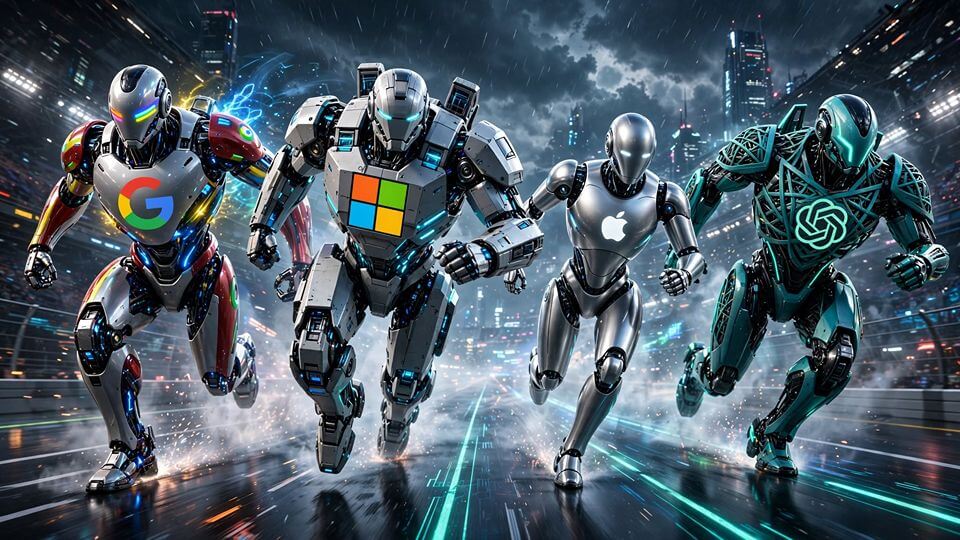
That's the emerging AI OS race of 2026.
Google has Gemini and Android.
Microsoft has Copilot and Windows.
Apple has Apple Intelligence, Siri and control over an extraordinary amount of its hardware and software stack.
And then there's OpenAI.
It doesn't own Windows.
It doesn't own Android.
It doesn't own macOS.
And strangely...
that may not disqualify it from the race.
Because the winner of the AI operating-system war may not be the company that builds the best traditional operating system.
It may be the company that makes us stop thinking about operating systems altogether.
What Is an AI Operating System?
An AI operating system is an emerging computing model in which artificial intelligence becomes a central interface between the user and applications, files, services, devices and digital actions.
That doesn't necessarily mean Windows, Android, macOS or iOS disappears.
Those systems still have to manage hardware, memory, security, networking, storage and applications.
The bigger change may happen above those technical layers.
A traditional operating system expects you to understand how the computer is organized.
You choose the application.
You find the file.
You navigate the menu.
You press the button.
An AI-native system increasingly starts with something different:
intent.
You tell it what you want.
The intelligence figures out which tools, applications, information and actions may be required.
In simplified form:
Traditional OS:
Human → App → Feature → ActionEmerging AI OS:
Human → Intent → AI → Tools / Apps / Data → Action
That small diagram may represent one of the biggest changes in personal computing since graphical interfaces replaced command lines.
🧠 AIWhyLive Explains: The Operating System Is Moving From Apps to Intent
Think about how we use computers today.
You want to edit a photo?
Open a photo editor.
You want to write a document?
Open a word processor.
You want to send an email?
Open email.
You want to research something?
Open a browser.
You want directions?
Open Maps.
We have spent decades learning which tool belongs to which task.
AI can reverse that relationship.
Instead of:
"Which application should I use?"
you say:
"Prepare everything I need for tomorrow's meeting."
The AI could potentially determine that it needs your calendar, email, documents, web research and other authorized services.
You don't necessarily care which application performed each step.
You care about the result.
The app used to be the destination.
In an AI OS, the app increasingly becomes a tool the intelligence can use.
Who Is Leading the AI OS Race in 2026?
There isn't one undisputed winner because Google, Microsoft, Apple and OpenAI are approaching the problem from different directions.
But if we define an AI OS as a system where AI increasingly understands context, coordinates applications and acts on behalf of the user, Google currently has one of the clearest claims to leadership in turning the traditional operating system itself into an AI-native environment.
Microsoft may have the strongest position in agentic desktop and enterprise computing.
Apple may have the strongest vertically integrated personal-computing position.
And OpenAI remains the wild card because it could make the AI interface more important than the operating system underneath it.
So this isn't one race.
It's at least four races happening on the same track.
🥇 Google: From Operating System to "Intelligence System"
Google may have given us the clearest description of where all this is heading.
In 2026, Google described Android's evolution as moving from an operating system toward an intelligence system.
That wording matters.
An operating system traditionally waits.
You open something.
You click something.
You tell it what to execute.
An intelligence system increasingly tries to understand:
What are you doing?
What do you need?
What context matters?
Which tool can help?
What should happen next?
Google's Gemini strategy increasingly connects AI with Android and Google's broader ecosystem.
That ecosystem includes enormous pieces of people's digital lives:
- Android
- Chrome
- Search
- Gmail
- Maps
- YouTube
- Calendar
- Drive
- Workspace
- Photos
- smart-home devices
Google doesn't have to invent an ecosystem for its AI.
It already has one.
The challenge is connecting those pieces intelligently, usefully and safely.
Google's Secret Weapon May Not Be Gemini
It's easy to turn the AI race into a model contest.
Which model scores highest?
Which reasons better?
Which answers faster?
Which generates better code?
Those things matter.
But operating systems have never succeeded solely because one component was technically superior.
Distribution matters.
Applications matter.
Developers matter.
Hardware matters.
Habits matter.
Google's enormous AI OS advantage may therefore be:
Gemini doesn't need to meet the user somewhere new.
Google can bring Gemini into places billions of people already are.
Phone.
Browser.
Email.
Search.
Maps.
Video.
Documents.
That's not merely an AI advantage.
That's a distribution advantage.
🥈 Microsoft: Windows Is Preparing for AI Agents
Microsoft may be doing something less obvious but potentially just as important.
It is preparing Windows for a world where software doesn't only run because a human clicked something.
AI agents can increasingly initiate and coordinate work.
That creates an entirely new operating-system problem.
Historically, the computer asks:
"Which user is running this process?"
An agentic operating system increasingly has to think about:
"Which human—or which AI agent acting for that human—is responsible for this process?"
That's a big difference.
Windows has been adding infrastructure relevant to this future, including isolation mechanisms for agentic workloads and ways for the system to identify agentic processes.
That sounds technical.
It is.
It is also potentially enormous.
Because useful AI agents require more than intelligence.
They need:
- identity
- permissions
- security boundaries
- auditing
- authentication
- controlled access to applications and data
- ways for humans and organizations to supervise what they do
The flashy part of the AI OS is the assistant.
The boring part is making sure the assistant doesn't destroy the company.
Microsoft understands boring enterprise infrastructure extremely well.
That could become a huge advantage.
Microsoft's Real Battlefield May Be Work
Google has extraordinary consumer reach.
But Microsoft owns a different kind of territory.
Work.
Windows.
Microsoft 365.
Teams.
Outlook.
Excel.
Word.
PowerPoint.
Azure.
GitHub.
Corporate identity and security systems.
If AI agents become digital workers, Microsoft already controls much of the digital office where those workers may operate.
The Windows AI OS may therefore evolve less like:
"Here's a smarter computer."
and more like:
"Here's a computer where humans and AI agents can work together under controlled permissions."
That may not produce the sexiest keynote demo.
It could produce something much more valuable.
Enterprise trust.
🍎 Apple: Don't Confuse Being Quiet With Being Out of the Race
For a while, the easiest AI criticism of Apple was simple:
"Apple is behind."
But the AI OS race is not only about who has the most impressive chatbot.
Apple has something its competitors would love to have.
Control of an unusually large portion of the computing stack.
Apple controls or tightly integrates:
- chips
- hardware
- operating systems
- system applications
- biometrics
- device security
- phones
- tablets
- computers
- watches
- headsets
- earbuds
That matters because a truly personal AI needs context.
Who are you?
What's on your screen?
Which application are you using?
What information are you allowed to access?
Which device are you holding?
Which actions should require authentication?
Apple can potentially connect those questions across hardware and software in ways few companies can match.
Apple's AI OS Bet Is Personal Context Plus Trust
Apple's AI architecture combines on-device intelligence with larger cloud-based processing through Private Cloud Compute for supported tasks.
Its broader Siri and Apple Intelligence direction centers on capabilities such as personal context, onscreen awareness and actions across applications.
That creates a different AI OS pitch.
Google can say:
"Look how much our AI can connect."
Microsoft can say:
"Look how much work our agents can perform."
Apple can potentially say:
"This intelligence knows your devices and personal context—and we designed the architecture around privacy."
Whether Apple executes that vision better than its competitors remains part of the race.
But structurally, Apple is far from irrelevant.
🐘 The Elephant in the Room: OpenAI Doesn't Have an Operating System
And then we reach the weird competitor.
OpenAI.
No Windows.
No Android.
No iOS.
No macOS.
No dominant smartphone platform.
So why include OpenAI in an AI OS race?
Because perhaps we're defining "operating system" too literally.
ChatGPT increasingly works with tools, connected services, files, web information and agentic workflows.
The important idea is not whether ChatGPT owns the kernel underneath your computer.
The important question is:
What interface do you increasingly use to tell the digital world what you want?
If the answer eventually becomes:
"I just tell the AI."
then something very strange happens.
Windows may still run underneath.
Android may still run underneath.
macOS may still run underneath.
But psychologically...
the AI has become your operating system.
What If the Winner Doesn't Own an OS?
This may be the most disruptive possibility.
Think about what an operating system traditionally does from the user's perspective.
It sits between you and the computer.
It gives you access to applications.
Files.
Services.
Devices.
Information.
Now imagine an AI sitting between:
you and your applications,
you and your files,
you and the web,
you and your email,
you and your calendar,
you and your work.
You stop thinking:
"Which app should I open?"
You simply say:
"Prepare everything I need for tomorrow."
The AI figures out which authorized tools are required.
At that point, the traditional operating system still matters enormously to engineers.
But to the ordinary human?
It may begin disappearing into the background.
🍗 Lechon Manok: Grandpa Still Opens Applications
2023:
Human:
"Open Photoshop."
Computer:
"Okay."
AI era:
Human:
"Fix this photo."
AI:
"Done."
Human:
"Open Photoshop."
AI:
"Why?"
Human:
"Because that's how computers work."
AI:
"Grandpa, please sit down."
😂
Or perhaps the conversation eventually becomes:
Human:
"Where did you save the file?"
AI:
"You don't need to know."
Human:
"Which application did you use?"
AI:
"You don't need to know."
Human:
"Which operating system am I using?"
AI:
"Exactly."
👦 ELI12: Your Computer Used to Be a Kitchen
Imagine your computer is a kitchen.
You want fried rice.
Today you do the work.
Find the rice.
Find the pan.
Find the oil.
Turn on the stove.
Cook.
That's traditional computing.
You know which tools you need and how to operate them.
An AI OS is more like telling someone:
"Make me fried rice."
They choose the pan.
Find the ingredients.
Cook it.
Maybe clean up afterward.
You don't care which drawer contained the spoon.
You care that dinner appears.
Sounds wonderful.
Except there's another part of the story.
For the cook to do everything, you have to give the cook the keys to the kitchen.
Welcome to the security problem of the AI operating system.
🐘 The Bigger Elephant: The Best AI OS May Need to Know the Most About You
A traditional operating system doesn't need to understand your life.
A truly useful personal AI increasingly benefits from context.
Your calendar.
Files.
Messages.
Contacts.
Applications.
Preferences.
Screen.
Location for relevant tasks.
Maybe your camera.
Maybe your microphone.
And increasingly...
permission to act.
This creates the central contradiction of the AI OS race:
The more useful your AI becomes, the more context it may need.
That means the AI OS war won't be decided only by intelligence.
It will also be decided by:
trust.
The New Password May Be Permission
For decades, computer security revolved around a simple question:
"Are you allowed in?"
AI agents create a more complicated one:
"What exactly is this intelligence allowed to do after it gets in?"
Read email?
Draft email?
Send email?
Open files?
Edit files?
Delete files?
Access financial information?
Make purchases?
Schedule appointments?
Install software?
Share documents?
Approve transactions?
Act without asking?
Act only after confirmation?
This may become one of the defining design problems of the AI operating system.
Permission may become the new password.
Why AI Agents Change the Operating System
A chatbot is relatively simple conceptually.
You ask.
It answers.
An agent changes the relationship.
You ask.
It plans.
It chooses tools.
It accesses authorized information.
It performs steps.
It checks results.
It may continue until the task is finished or human approval is required.
That means the operating system increasingly needs to understand not only applications and human users...
but delegated intelligence.
This is why the AI OS race isn't simply about putting a chatbot into Windows, Android or
“Last year, I asked whether data had become the new oil in the Age of AI. Today, I think I Read more

Every single day, a brand-new AI micro-app promises to revolutionize your workflow for just $14.99 a month. Let's separate the Read more

🛫 Create Your Own Runway, Not Clout, in the Age of AI — Because Likes Don't Pay the Bills Read more

AI can think faster. Work longer. Remember more. And increasingly, act with less human supervision. Is Human Still the Alpha Read more