“The truth is out there.” — The X-Files
When The X-Files first aired, that famous line carried a certain mystery.
It suggested that somewhere beyond classified documents, government secrets, unexplained lights in the sky, and strange encounters, objective truth existed.
You simply had to look for it.
Fast-forward to the Age of AI.
Apparently…
The truth isn’t out there anymore.
It’s on social media.
According to everyone.
📱 Breaking News: Everybody Is Now a Truth Creator
There was a time when information traveled through newspapers, radio, and television. Today, billions of people receive news through social media, where platforms have become one of the world’s primary gateways to information. Studies by the Reuters Institute and the Pew Research Center continue to show that social media plays an increasingly important role in how people discover current events, particularly among younger audiences.
That’s fascinating.
It’s also terrifying.
Because social media didn’t simply democratize publishing.
It democratized certainty.
Politicians publish “truth.”
Businesses publish “truth.”
Churches publish “truth.”
Influencers publish “truth.”
Anonymous pages publish “truth.”
Artificial intelligence summarizes “truth.”
Everyone arrives carrying screenshots, charts, testimonials, exclusive revelations, and captions that somehow all begin with the same invisible disclaimer:
“Trust me.”
🍗 Lechon Manok
Let’s roast this gently.
Not people.
Behavior.
Somewhere along the way, we became less interested in discovering truth and more interested in owning it.
Every post now competes for likes.
Every video begs for engagement.
Every caption quietly whispers,
“Please validate me with your attention.”
The strange part is that attention has become so valuable that almost every institution now behaves like a content creator.
Businesses chase engagement because customers scroll.
Organizations chase engagement because supporters scroll.
Public figures chase engagement because influence scrolls.
Even the most serious announcements are packaged like thumbnails competing for clicks.
It’s as if reality itself hired a social media manager.
👽 I Want to Believe
One of the most iconic posters in television history hangs behind Fox Mulder’s desk.
A flying saucer.
A blurry sky.
Three unforgettable words.
I WANT TO BELIEVE.
Ironically…
These days I’d rather believe in unidentified flying objects than every perfectly edited, emotionally charged, algorithm-approved post pretending to be objective while quietly serving someone’s interests.
At least UFOs never asked me to:
👍 Like
❤️ React
🔁 Share
🔔 Follow
📢 Subscribe
Or remind me that “only 97% of people will ignore this post.”
🤖 Did AI Change the Truth?
People often ask whether artificial intelligence changes truth.
I don’t think it does.
Truth remains remarkably stubborn.
What AI changes is speed.
Reach.
Scale.
Translation.
Summarization.
Distribution.
Algorithms then perform another trick.
They don’t necessarily reward what is most accurate.
They reward what keeps human attention alive.
Those are two very different competitions.
One searches for truth.
The other searches for engagement.
Confusing the two may be one of the defining mistakes of our generation.
🧒 Explain Like I’m 12
Imagine twenty students drawing maps to the same hidden treasure.
Only one map is actually correct.
But one student uses bright colors, dramatic arrows, and writes,
“100% REAL TREASURE!!!”
Guess which map gets passed around the classroom first?
Popularity doesn’t magically transform the wrong map into the right one.
Neither do likes.
Neither do shares.
Neither does a million views.
📡 Trust No One
One of the recurring slogans from The X-Files was beautifully simple.
Trust No One.
At first, it sounded paranoid.
Today, it sounds practical.
Not because everyone is lying.
But because everyone has incentives.
Some seek votes.
Some seek customers.
Some seek donations.
Some seek influence.
Some simply seek attention.
And some honestly believe they’re right.
The problem is that conviction and correctness have never been the same thing.
🚫 Deny Everything
Another X-Files phrase feels strangely modern.
Deny Everything.
We’ve become remarkably skilled at it.
Deny mistakes.
Deny context.
Deny nuance.
Deny yesterday’s post after today’s backlash.
Delete.
Edit.
Re-upload.
Repeat.
Artificial intelligence can archive everything.
The internet rarely forgets.
Humans simply hope everyone else does.
⚖️ Resist or Serve
Every time you open social media, an invisible question quietly appears.
Not on your screen.
Inside your mind.
Will you resist the algorithm?
Or serve it?
Will you verify before sharing?
Or share before verifying?
Will you seek understanding?
Or merely confirmation?
Those choices determine far more than any AI model ever will.
🎤 Drop Mic. Trust No One.
The older I become, the less interested I am in reading posts that confirm everything I already believe.
I’m far more interested in ideas capable of proving me wrong.
Because truth has never depended on popularity.
It has never depended on virality.
It has never depended on followers.
It has never depended on who posted first.
Or who shouted loudest.
Artificial intelligence did not redefine truth.
It simply exposed how desperately humans compete to own it.
Perhaps the greatest danger in the Age of AI isn’t that machines will deceive us.
Perhaps it’s that we willingly choose the version of truth that makes us feel most comfortable.
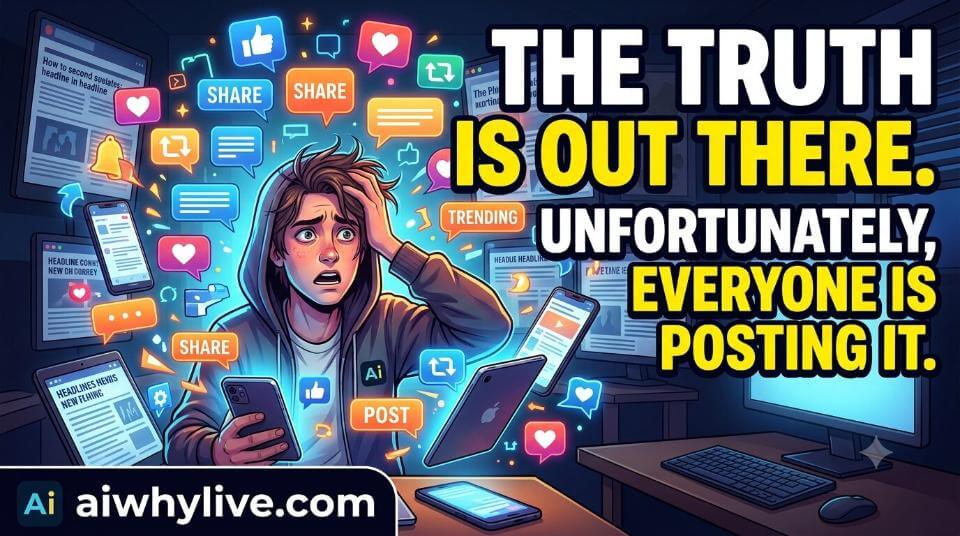
The truth is still out there.
Unfortunately…
everyone is posting it.
So here’s my final advice.
Borrowed from one of the greatest television series ever made.
Trust no one.
Not politicians.
Not influencers.
Not businesses.
Not anonymous pages.
Not artificial intelligence.
And certainly not yourself until you’ve asked one uncomfortable question:
“Do I believe this because it’s true… or because I wanted it to be true?”
That question may become humanity’s greatest survival skill in the Age of AI.
In our everyday Filipino communities, common scenes include dogs barking relentlessly in the night, pets leaving their mess on public Read more
🕰️ The Classic Time Trap Long before smartphones and social feeds, people already struggled with time. The factory clock dictated Read more
🧠 A Strange Time to Be Alive We are living in a time where: Stupidity can be monetized Noise can Read more
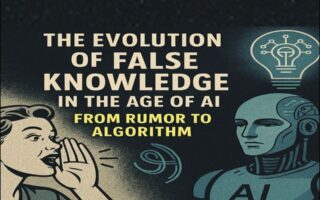
🧠 Abstract: False Knowledge Reborn False knowledge is not new. From gossip in the plaza to myths in textbooks, Filipinos Read more