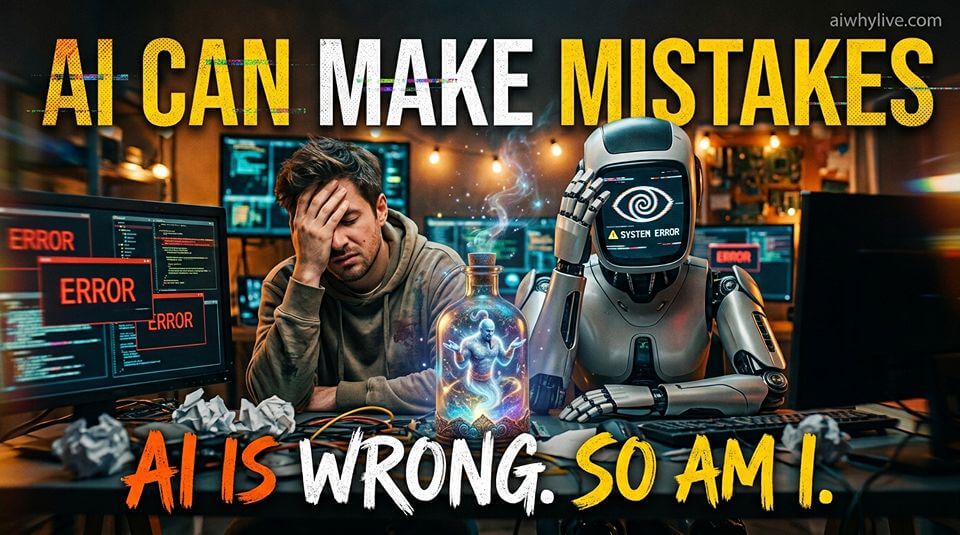
A genie gives you three wishes. AI gives you almost unlimited chances to ask. So what happens when the magic gets something wrong?
A man once found an old bottle.
He rubbed it.
POOF!
A genie appeared.
“I will grant you three wishes,” the genie said.
The man thought carefully.
“I want to be rich.”
POOF!
He became rich.
“I want to be famous.”
POOF!
He became famous.
The man smiled.
Then he had one final idea.
“I want three more wishes.”
The genie shook his head.
“No.”
“Why not?”
“Because I only give three wishes.”
“But you are a genie!”
“Yes.”
“So give me three more.”
“No.”
The man argued.
The genie refused.
Finally, the genie sighed.
“Even magic has limits.”
And that was the end of the man’s three wishes.
Now imagine something different.
Imagine the genie is AI.
You ask it something.
It answers.
You don’t like the answer?
Ask again.
You want it shorter?
Ask again.
You want it simpler?
Ask again.
You want it rewritten?
Ask again.
You want another idea?
Ask again.
Upload a document.
Show it a picture.
Give it more information.
Change the prompt.
Correct it.
Challenge it.
Ask it to explain itself.
Ask it to try again.
The old genie gave you three wishes.
AI can give you almost unlimited chances to ask.
Sounds amazing.
And it is.
But there is a small problem.
Sometimes the AI genie is wrong.
Very wrong.
And sometimes it is wrong while sounding like it knows exactly what it is talking about.
Welcome to the age of AI.
The Unlimited-Wish Problem
The amazing thing about AI isn’t simply that it can answer questions.
It’s that you can keep going.
You don’t have to accept the first answer.
You can say: “That’s not what I meant.”
And try again.
You can say: “Explain that like I’m 12.”
Try again. “Give me another approach.”
Try again. “Check your assumptions.”
Try again. “What could make this answer wrong?”
Try again.
This is something the old genie never gave us.
Iteration.
But there is an important lesson here:
Unlimited attempts don’t guarantee unlimited wisdom.
AI is not an all-knowing genie.
It doesn’t automatically know what you mean.
It doesn’t automatically know what is true.
It doesn’t automatically know what you need.
And it certainly doesn’t automatically know what you should do.
It can give you something brilliant.
It can give you something useless.
It can give you something that looks brilliant but is completely wrong.
That’s where things get interesting.
🧠 AIWhyLive Explains — Why Does the AI Genie Get Things Wrong?
AI works by generating responses based on patterns learned from huge amounts of information, combined with the instructions and context you give it.
That doesn’t make it a perfect database of truth.
Information can be incomplete.
It can be outdated.
Sources can disagree.
The question can be unclear.
Important context may be missing.
The AI can misunderstand what you’re asking.
It can make assumptions.
It can make calculation errors.
And sometimes it can generate information that sounds plausible but isn’t supported by reality.
This is often called an AI hallucination.
The important thing to understand is this:
AI doesn’t have to be stupid to be wrong.
It can be extremely useful and still make mistakes.
And sometimes…
it can make mistakes with remarkable confidence.
That’s one of the strangest things about AI.
You can ask:
“Are you sure?”
And it might say:
“Absolutely.”
And then proceed to be absolutely wrong.
Confidence is not proof.
A polished answer is not proof.
A long answer is not proof.
A confident tone is not proof.
Even something that looks like a citation deserves checking when the information matters.
So What If the Genie Makes a Mistake?
Let’s return to our genie.
You say:
“I want to be rich.”
The genie disappears.
A few seconds later, a giant truck arrives.
It’s filled with…
rice.
You stare at the truck.
“What is this?”
“Your wish.”
“I said I want to be rich!”
“Yes.”
“Rich!”
“Yes.”
“R-I-C-H!”
The genie looks confused.
“You said rice.”
“I SAID RICH!”
The genie shrugs.
“Rice. Rich. Close enough.”
Obviously, that’s a joke.
But the lesson isn’t.
When something goes wrong, there are usually two possibilities:
The question was unclear.
Or:
The answer was wrong.
Sometimes both.
And that means the first answer doesn’t always have to be the end of the conversation.
It can be the beginning.
Sometimes Your Wish Is the Problem
Imagine telling the genie:
“Give me something good.”
The genie gives you broccoli.
You complain.
“I don’t like broccoli!”
The genie raises an eyebrow.
“You said something good.”
“But I wanted pizza!”
“You didn’t say pizza.”
That’s prompting in a nutshell.
People sometimes ask AI: “Write me a business plan.”
Okay.
For what business?
Who are the customers?
Where is the business?
What’s the budget?
What’s the product?
What’s the goal?
What’s the competition?
How big is the team?
What’s the timeline?
What are the limitations?
Without context, AI has to fill in the blanks.
And when AI fills in the blanks…
it guesses.
A vague question can produce a vague answer.
A confused question can produce a confused answer.
A missing detail can send the whole answer in the wrong direction.
Sometimes the problem isn’t the AI.
Sometimes the wish is the problem.
But Even the Perfect Wish Can Go Wrong
This part matters.
Don’t blame everything on the prompt.
You can write a detailed prompt.
You can give the AI plenty of context.
You can explain exactly what you want.
And the answer can still be wrong.
That’s because better instructions reduce some mistakes.
They don’t magically eliminate all mistakes.
AI is a tool.
Not an oracle.
Not a crystal ball.
Not a divine truth machine.
And not a genie with perfect knowledge.
That’s why good AI use requires something that sounds surprisingly old-fashioned:
Judgment.
Know when to trust.
Know when to check.
Know when to question.
Know when to ask again.
Know when to stop and verify the important stuff yourself.
The Human Version Is Not Much Better
Now let’s talk about us.
Humans.
The original error-generating machines.
We misremember.
We misunderstand.
We guess.
We assume.
We exaggerate.
We repeat things we heard from somebody who heard it from somebody else.
We read half a headline and think we understand the entire story.
We confidently give directions to places we’ve never visited.
We sometimes calculate something incorrectly and then defend the calculation because admitting the mistake is embarrassing.
We forget names.
We forget dates.
We mix up facts.
We make decisions with incomplete information.
We’ve been doing this for thousands of years.
And unlike AI…
we don’t even need a software update to make a mistake.
We can do it before breakfast.
AI Doesn’t Invent Human Mistakes
AI is sometimes criticized because it makes mistakes.
Fair enough.
But humans have a long history of making mistakes without any help from AI.
The difference is speed.
A human makes a bad assumption.
Maybe ten people hear it.
AI makes a bad assumption.
A person copies the answer into a report.
Another person copies it into a presentation.
Someone posts it online.
Another website republishes it.
A thousand people see it.
Someone makes a video about it.
Now thousands more believe it.
The mistake has legs.
AI can make mistakes faster than humans can spread them manually.
That’s why AI literacy matters.
Not because AI is useless.
Quite the opposite.
Because AI is powerful.
And powerful tools require people who know how to use them.
Human × AI = A Different Kind of Mistake
Here’s where things get dangerous.
AI makes a mistake.
That’s one problem.
A human makes a mistake.
That’s another.
But:
AI makes a mistake + human blindly trusts it = something much bigger.
Imagine asking AI for a medical explanation and never checking an important detail.
Or asking for a legal interpretation and treating the answer as legal advice.
Or asking for financial calculations and never checking the numbers.
Or asking for historical facts and publishing them immediately.
Or asking AI to generate code and assuming it must work because the code looks professional.
The problem isn’t simply:
“AI made a mistake.”
The bigger problem can be:
“Nobody noticed.”
Use AI to accelerate your thinking.
Don’t use it as an excuse to stop thinking.
So Why Use AI Anyway?
This is the obvious question.
If AI can make mistakes…
Why bother?
Because imperfect doesn’t mean useless.
Your car can break.
You still drive.
A calculator can be given the wrong number.
You still use calculators.
Google Maps can occasionally send you somewhere you didn’t expect.
You still use maps.
A human employee can make mistakes.
You don’t fire the entire human race.
You correct the mistake.
Then continue.
AI can help with:
- brainstorming
- writing
- coding
- explaining difficult ideas
- translation
- summarizing
- research
- organizing information
- creating prototypes
- analyzing data
- learning new subjects
- generating images and presentations
- finding different ways to approach a problem
The question isn’t:
“Is AI perfect?”
It isn’t.
The better question is:
“Is AI useful enough to be worth using while I remain responsible for checking important things?”
For many tasks, the answer can be yes.
The First Draft Is Supposed to Be Wrong
Here’s something writers, programmers, designers, entrepreneurs, and basically every human being needs to remember:
The first attempt doesn’t have to be good.
You write a bad paragraph.
Fix it.
Write ugly code.
Debug it.
Build a terrible prototype.
Improve it.
Create a business idea nobody wants.
Learn why.
Make a presentation that feels boring.
Rewrite it.
Ask AI a terrible question.
Improve the prompt.
This is how almost everything gets better.
We sometimes have a strange expectation that our first attempt should already look like someone’s tenth attempt.
It won’t.
And that’s okay.
👦 ELI12 — What If Mistakes Are Part of Learning?
Imagine a child learning to ride a bicycle.
The child gets on.
The bicycle moves.
Wobble.
The child falls.
Would you say:
“You have failed. You are not a bicycle person.”
Of course not.
You say:
“Try again.”
The child tries again.
Wobble.
Try again.
A little better.
Try again.
Eventually, balance.
That’s learning.
Nobody expects perfection before practice.
So why do adults sometimes expect it from themselves?
Why do we treat one bad decision like a permanent identity?
Why do we treat one failed business idea like proof that we’re failures?
Why do we treat one embarrassing mistake like the end of our story?
We learned to walk by falling.
We learned to talk by saying things incorrectly.
We learned to write by writing badly.
We learned almost everything through some combination of:
Try.
Fail.
Correct.
Try again.
Life Is Not School
School often teaches us to look for the correct answer.
There is a question.
There are choices.
There is an answer sheet.
You get a grade.
But life doesn’t work like that.
There is no answer sheet for:
“What career should I choose?”
“What business should I build?”
“Who should I trust?”
“How should I raise my children?”
“When should I change direction?”
“What should I do after I fail?”
“How do I repair something I broke?”
“What kind of person do I want to become?”
You don’t get a multiple-choice test.
Sometimes you simply have to make the best decision you can with the information you have.
And sometimes…
you get it wrong.
Then what?
That’s the real test.
Not whether you got everything right.
But what you do after discovering that you didn’t.
Life is not school.
Stop Treating Every Mistake Like a Failing Grade
The internet doesn’t help.
Social media shows us everyone’s polished version.
Successful business.
Beautiful vacation.
Perfect family.
Amazing meal.
New car.
Promotion.
Happy relationship.
Big achievement.
Nobody posts:
“I have no idea what I’m doing today.”
Or:
“I made a terrible decision.”
Or:
“I misunderstood the situation.”
Or:
“I thought I was right. I wasn’t.”
But those moments exist.
For everyone.
AI actually gives us an interesting mirror here.
We expect a machine to make perfect answers.
Then it makes a mistake.
And we’re shocked.
Maybe the shock comes from something deeper.
We know machines are supposed to be precise.
But humans?
We’ve always been messy.
You made a mistake. You are not automatically a mistake.
That’s an important difference.
AI Makes the Mess Visible
One of the great things about AI is that it makes experimentation cheap.
You can ask for ten ideas.
Nine might be terrible.
One might be useful.
You can ask for five headlines.
Four might sound ridiculous.
One might work.
You can generate different designs.
Some will be ugly.
Some will be strange.
Some will be surprisingly good.
You can try different code approaches.
Some fail.
Some almost work.
One finally works.
That isn’t necessarily wasted effort.
That’s iteration.
AI makes it easier to produce attempts.
And attempts give you something to react to.
Sometimes you don’t know what you want until you see what you don’t want.
The Builder Has an Advantage
Imagine two people with the same business idea.
Person A spends three months planning.
Market research.
Color schemes.
Logo.
Business cards.
Perfect website.
Perfect pitch.
Everything looks ready.
Person B builds a rough version in three days.
It isn’t beautiful.
But they show it to ten potential customers.
Nine don’t care.
One does.
Person B just learned something important.
Maybe the idea needs to change.
That information is valuable.
AI can make this kind of experimentation much faster.
Not because AI guarantees success.
Because it can lower the cost of trying.
And when trying becomes cheaper…
learning can become faster.
The Mistake Is Not Always the Enemy
A mistake can be painful.
Sometimes very painful.
But a mistake can also contain information.
You trusted the wrong assumption.
Now you know.
Your code failed.
Now you know where it broke.
Your business idea didn’t work.
Now you know what customers didn’t want.
Your prompt produced nonsense.
Now you know what information was missing.
You misunderstood someone.
Now you know you need to listen more carefully.
The mistake itself isn’t automatically the lesson.
Correction is what turns a mistake into learning.
Without correction, we simply repeat the mistake.
With correction, something changes.
🍗 Lechon Manok — The Perfection Police Have Arrived
Breaking news:
Humans have discovered that AI makes mistakes.
The same humans who:
- forward fake news without reading it
- believe headlines without opening the article
- confidently share rumors
- misquote people
- forget where they got information
- argue about things they haven’t checked
- and sometimes say “trust me” immediately before being completely wrong
…are now demanding perfection from artificial intelligence.
Beautiful.
Absolutely beautiful.
We want the machine to say: “I may be wrong.”
But when we are wrong?
Suddenly we become constitutional lawyers defending our original Facebook comment from 2019.
Maybe AI isn’t the only thing that needs fact-checking.
Maybe our ego needs it too.
Don’t Let AI Make You Afraid to Try
Some people see AI mistakes and conclude:
“Then I shouldn’t use AI.”
That’s one possible reaction.
But there’s another.
Learn how to use it better.
Understand that AI can be wrong.
Learn how to write clearer prompts.
Give it context.
Ask it to identify assumptions.
Ask it to challenge its own answer.
Verify important information.
Use reliable sources.
Test code.
Check calculations.
And when something doesn’t look right…
don’t be afraid to say:
“That’s wrong.”
Then try again.
You are not fighting the AI.
You’re working with a tool.
And Don’t Let AI Make You Lazy
There is another danger.
AI can make difficult things easier.
That’s wonderful.
Until easier becomes automatic.
If AI writes everything you write…
If AI solves every problem you face…
If AI makes every decision…
If AI does all your thinking…
Eventually you may become very efficient at not thinking.
That’s not the goal.
Use AI as:
a teacher.
a collaborator.
a critic.
a brainstorming partner.
a coding assistant.
a research helper.
But keep your brain in the room.
Don’t outsource your judgment.
Human × AI: Maybe We’re Supposed to Make Different Mistakes
Maybe the future isn’t:
Humans versus AI.
Maybe it’s:
Human + AI.
AI can process information quickly.
Humans understand context differently.
AI can generate possibilities.
Humans decide which possibilities matter.
AI can spot patterns.
Humans deal with consequences.
AI can help produce the first draft.
Humans decide whether the draft is actually worth keeping.
AI can make mistakes.
Humans can catch them.
Humans can make mistakes.
AI can sometimes help us catch those too.
That’s a much more interesting relationship than simply asking whether AI will replace humans.
Maybe the real goal is to create a partnership where each side helps reduce the other’s mistakes.
🧠 AIWhyLive Explains — The Real Superpower Isn’t Being Right
Think about the smartest person you know.
Would you describe them as someone who is never wrong?
Probably not.
You might describe them as someone who:
- listens
- learns
- checks
- changes their mind when evidence changes
- admits mistakes
- asks better questions
- keeps learning
That’s a different kind of intelligence.
The real superpower isn’t being right.
It’s being correctable.
Ask AI: “What could make your answer wrong?”
Ask yourself the same question.
Ask: “What assumption am I making?”
Ask: “What information am I missing?”
Ask: “What would change my mind?”
That is how learning stays alive.
What Now?
AI made a mistake?
Fix it.
You made a mistake?
Fix it.
The prompt was bad?
Rewrite it.
The code broke?
Debug it.
The business idea failed?
Study what happened.
The article isn’t good enough?
Write another one.
You said something stupid?
Own it.
You hurt someone?
Apologize.
You made the wrong decision?
Learn.
You trusted the wrong information?
Check better next time.
You failed?
Figure out what the failure is trying to teach you.
Then…
keep moving.
🧠 AIWhyLive Explains — Error Is Not the Same as Failure
An error means something went wrong.
But what happens next matters.
An error followed by correction can become learning.
A failure followed by reflection can become experience.
A mistake followed by humility can become character.
And sometimes the terrible thing you did not want to happen becomes the thing that forces you to become a better version of yourself.
Not always.
Some mistakes have serious consequences.
Some damage cannot simply be undone.
Some apologies don’t immediately repair what happened.
That’s why mistakes shouldn’t be romanticized.
But neither should they automatically become a life sentence.
When possible:
Recognize it.
Take responsibility.
Repair what you can.
Learn.
Change.
Continue.
AI Can Be Wrong. So Can I.
This might be the most useful sentence you can carry into the AI era:
AI can be wrong. So can I.
Check important information.
Question confident answers.
Verify things that matter.
Don’t blindly trust AI.
But don’t blindly trust yourself either.
Your memory can be wrong.
Your assumptions can be wrong.
Your first impression can be wrong.
Your favorite person can be wrong.
Your favorite website can be wrong.
And yes…
I can be wrong too.
The smartest response isn’t always:
“I know.”
Sometimes it’s:
“I don’t know.”
Sometimes:
“Let me check.”
Sometimes:
“I was wrong.”
Sometimes:
“Let’s try another approach.”
That’s not weakness.
That’s how improvement works.
🎤 Drop Mic — Maybe Mistakes Are the Point
Remember the genie?
Three wishes.
Three chances.
And then…
No more.
AI changed the story.
You can ask again.
And again.
And again.
But maybe the most valuable thing AI gives us isn’t unlimited answers.
Maybe it’s unlimited opportunities to try another way.
And perhaps that’s why AI’s mistakes are so interesting.
We expected the machine to be perfect.
But it isn’t.
Neither are we.
School taught many of us to search for the correct answer.
But life doesn’t come with an answer sheet.
You will get things wrong.
You will misunderstand.
You will trust the wrong person.
You will choose the wrong path.
You will build something that doesn’t work.
You will say something you wish you hadn’t said.
You will make decisions you later wish you could undo.
And sometimes you will simply look back and think:
“What was I thinking?”
Congratulations.
You’re human.
The goal isn’t to become a person who never makes mistakes.
That’s impossible.
The goal is to become someone who gets better at:
making mistakes,
recognizing mistakes,
correcting mistakes,
learning from mistakes,
and becoming better because of them.
AI can help with that.
But AI cannot do the growing for you.
It can give you another answer.
It can give you another idea.
It can show you another way.
It can even tell you:
“You might be wrong.”
Listen.
Check.
Think.
Then decide.
Because the genie isn’t the point.
The wishes aren’t the point.
Even the mistakes aren’t the point.
What you become after the mistake is the point.
You made a mistake.
You are not automatically a mistake.
You got something wrong.
You are not finished.
The answer didn’t work.
Ask again.
The prompt failed.
Rewrite it.
The plan failed.
Learn.
Life didn’t go according to plan.
Welcome to life.
Life is not school.
There is no final grade.
No perfect score.
No gold star for never falling.
There is only the strange, messy, beautiful business of being human.
So yes…
Use AI.
Let it help.
Let it challenge you.
Let it surprise you.
Let it occasionally get things hilariously wrong.
Then correct it.
And when you get something wrong?
Correct yourself.
Learn.
Grow.
Try again.
Not for a grade.
Not for applause.
Not for an algorithm.
For yourself.
AI can be wrong.
So can I.
And maybe that’s okay.
The internet gave everyone a microphone. AI gave everyone an argument. Maybe the smartest move is knowing when not to Read more
If value is the new currency in the Age of AI, then what happened to time? Last week, I argued Read more
🌅 The Morning Transition No One Prepares You For I shut down my IDE. I close my browser tabs after Read more
🌑 The Most Human Thing Left? AI can now: write articles generate images summarize meetings answer questions build code automate Read more