Yahoo Is Back in the AI Search Game. But Is It Too Late?
In June 2025, we published an article calling Yahoo an "AI-less search engine." At the time, the criticism was straightforward: while Google and Microsoft were pushing artificial intelligence into search, Yahoo appeared to be standing still.
That story needs an update.
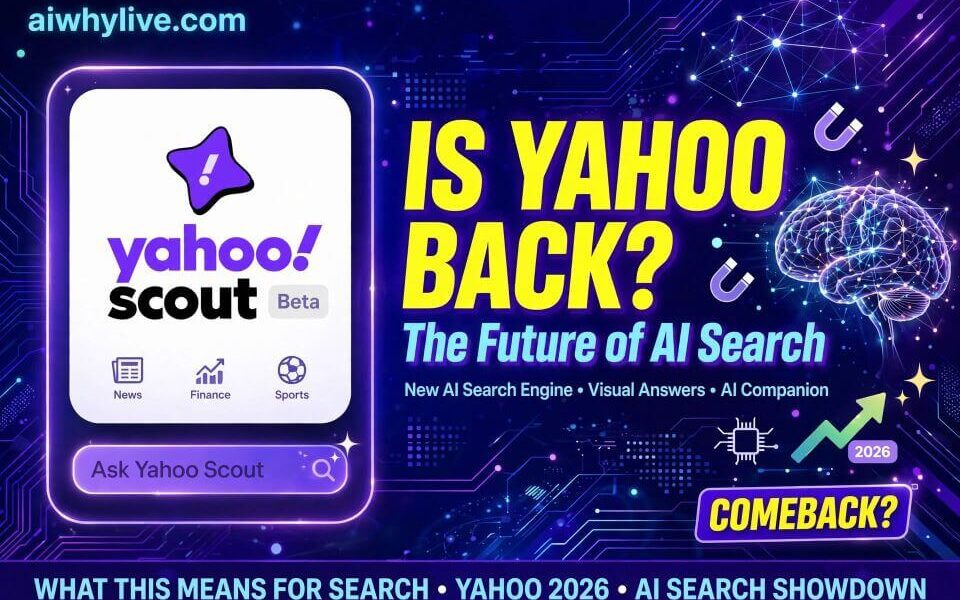
Yahoo has since introduced Yahoo Scout, its own AI-powered answer engine. It has rebuilt its search experience, introduced a new approach called Pivot Search, and begun bringing AI assistance into other Yahoo products.
In other words, the company we once described as lagging behind is now making a serious attempt to compete in the AI-search era.
From "AI-less" to AI-powered: What happened to Yahoo?
Let's rewind.
Our June 15, 2025 article, Yahoo! An AI-less Search Engine To Date, argued that Yahoo's search experience looked increasingly outdated in a world moving toward conversational AI and direct answers.
We compared the direction of Google and Microsoft Bing with Yahoo's relatively conventional search experience. The concern was not that Yahoo had disappeared. It was that a recognizable internet brand risked becoming less relevant as people's expectations changed.
Yahoo eventually responded with something much more substantial than a cosmetic update.
Meet Yahoo Scout: The new AI answer engine
On January 27, 2026, Yahoo announced Yahoo Scout, a proprietary AI-powered answer engine initially released in beta.
Yahoo describes Scout as a system that combines information from the open web with Yahoo's own content, data, and user insights. Instead of simply returning a page of links, it can synthesize information into answers, summaries, lists, tables, and other structured responses.
There is an important detail behind the technology: Yahoo announced that Anthropic's Claude would serve as Scout's primary foundational AI model. It also said Scout would use Microsoft Bing's grounding API to help connect answers to information from across the web.
That combination is interesting. Yahoo is not necessarily trying to build every component of an AI search engine from scratch. It is combining an established AI model, web-search infrastructure, and its own data and content ecosystem.
Yahoo's January announcement also described a much broader AI strategy involving Mail, News, Finance, Sports, and Shopping.
Source: Yahoo's announcement of Yahoo Scout, January 27, 2026.
November 2026: Scout exits beta
The next major development arrived on November 10, 2026.
Yahoo announced that Scout had exited beta and was becoming a central part of a rebuilt Yahoo Search experience.
Yahoo reported that Scout had delivered more than 3 billion answers since its launch in the first quarter of 2026.
That is a substantial company-reported usage figure. But let's be careful about what it means. Three billion answers does not automatically mean three billion different people, three billion successful searches, or three billion satisfied users. Yahoo has not presented that figure as an independently audited measure of user satisfaction.
Still, the announcement signals that Yahoo is moving beyond experimentation. It is positioning Scout as a major part of its search strategy.
Pivot Search: Yahoo's answer to the answer-engine problem
One of the most interesting parts of Yahoo's November announcement is Pivot Search.
Rather than forcing every query into a traditional list of links or an AI-generated response, Yahoo says its rebuilt search experience can adapt to the type of question being asked.
Users can move between conventional search results and a Yahoo Scout answer.
Think about the difference:
- Traditional search: You enter a query and receive a list of websites to explore.
- AI answer search: You ask a question and receive a synthesized response, ideally with sources.
- Pivot Search: You can use either experience and move between them depending on what you need.
This is a practical recognition that not every search has the same purpose.
If you want a particular website, a traditional result may be exactly what you need. If you want to understand a complicated subject, an AI-generated explanation may save time. If you want to verify a claim, access to the original sources remains essential.
Scout is no longer just about search
Yahoo's strategy extends beyond its search homepage.
Its November announcement described Yahoo Scout integrations across several major parts of its ecosystem:
1. Yahoo Finance
Users can ask questions about stock movements, company news, and portfolio-related information while using Yahoo Finance. The idea is to bring explanations closer to the financial information being viewed.
2. Yahoo Sports
Sports fans can explore game results, player statistics, and the implications of a team's performance without having to leave the article or page they are reading.
3. Yahoo News
Readers can use Scout to explore the context behind major news stories, understand complicated developments, and examine different perspectives.
4. Yahoo Shopping
Yahoo has also described Scout-powered shopping research that compares products and summarizes information from expert articles and user discussions. The company says this capability is part of its expanding product direction.
5. A mobile app and Firefox integration
Yahoo announced a standalone Scout mobile app with voice and image-search capabilities for U.S. users. It also announced a Firefox integration that lets U.S. desktop users access Scout through the browser's AI sidebar.
The bigger idea is clear: Yahoo wants AI to be available where people already read, watch, research, invest, and shop.
Yahoo's real advantage may not be AI alone
It is tempting to compare Yahoo Scout with ChatGPT, Gemini, Claude, or Microsoft Copilot and focus only on which AI model produces the best answer.
But Yahoo's potential advantage may be something else: its existing ecosystem.
Yahoo already operates recognizable destinations for news, finance, sports, mail, and other online activities. These properties give it opportunities to place AI assistance inside experiences that users already understand.
That is different from asking people to abandon their existing habits and adopt an entirely new AI destination.
Yahoo's January announcement also highlighted its extensive history of user insights, content, and search activity. These are company-described assets, not independent proof that Scout is more accurate or more useful than competing services.
But the strategic logic makes sense: AI becomes more valuable when it is connected to relevant information and useful tasks.
The elephant in the room: Will AI search hurt publishers?
This is where the story becomes bigger than Yahoo.
For years, publishers built websites around a familiar arrangement: search engines helped people discover content, users clicked through, and publishers had an opportunity to earn advertising revenue, subscriptions, or customer relationships.
AI answer engines complicate that arrangement.
If a search engine summarizes an article and gives the user enough information to move on, the publisher may receive less traffic. The original writer or website may have supplied the information, but the platform may capture much of the user's attention.
Yahoo appears to recognize this tension. In its November announcement, the company emphasized prominent links and sources, saying it wants to help users reach the open web and send traffic back to publishers.
That is encouraging as a stated design goal. But the real test will be measurable referral traffic, publisher visibility, and the quality of the links users actually click.
For independent websites, including AIWhyLive.com, this is not a minor issue.
We need to be discoverable in traditional search, understandable to AI systems, and valuable enough that people still have a reason to visit the original source.
What does this mean for SEO and AEO?
Yahoo's evolution reinforces a lesson that website owners should already be considering: search is no longer just about matching keywords to pages.
People increasingly ask complete questions, expect context, and want useful answers. Search platforms are responding by combining conventional results with generative AI.
For website owners and publishers, this means paying attention to several fundamentals:
- Original information: Publish something useful, specific, and worth citing—not just another rewritten summary.
- Clear structure: Use descriptive headings, concise explanations, and logically organized sections.
- Credibility: Identify authors, link to reliable sources, and distinguish facts from opinion.
- Search fundamentals: Keep pages accessible, technically sound, fast, and properly indexed.
- Answer Engine Optimization: Write clearly enough that search systems can identify the question being answered and the evidence supporting it.
- Human value: Give readers analysis, experience, judgment, and perspective that a generic AI summary cannot replace.
SEO is not dead. AEO is not a magic shortcut. The practical challenge is to build content that works for people first and can also be understood by search and AI systems.
For more on this shift, read our earlier discussion: AI Makes Me Stupid, and I Love It.
Is Yahoo too late to the AI search competition?
Let's not declare a comeback just because a familiar brand has launched an AI product.
Yahoo is competing in a crowded environment. Google has integrated AI into search. Microsoft has developed Copilot and AI-powered Bing experiences. ChatGPT, Claude, and other assistants have changed how people research and ask questions.
Yahoo has a long road ahead if it wants to change user habits and become a major destination for AI-assisted discovery.
But "too late" is not the same as "no opportunity."
Yahoo still has a recognizable brand, established products, content relationships, and an existing audience. Its strategy of placing AI inside products people already use may be more practical than trying to convince everyone to start their digital lives over again.
Whether that strategy succeeds will depend on product quality, trust, usefulness, distribution, and whether users actually return.
AIWhyLive Explains: What should we learn from Yahoo?
Yahoo's story offers a lesson that applies to more than search engines.
A company does not necessarily become irrelevant because it is old. It becomes vulnerable when it assumes that yesterday's success will automatically protect tomorrow's business.
In June 2025, we questioned Yahoo's apparent absence from the AI search race. By November 2026, Yahoo had introduced Scout, rebuilt Search, and expanded its AI ambitions across its product ecosystem.
That does not prove Yahoo has won. It proves that the story was not finished.
For businesses, professionals, creators, and website owners, the lesson is simple: keep watching how customer expectations change. Do not confuse a familiar brand with a permanent competitive advantage. And do not mistake a new AI feature for a successful business strategy.
ELI12: Explain Yahoo Scout like I'm 12
Imagine asking a librarian a question.
A traditional search engine gives you a list of books and websites where you might find the answer.
An AI answer engine reads information from different sources and tries to explain the answer to you.
Yahoo Scout is Yahoo's attempt to offer that AI-powered explanation while still letting you access regular search results and original websites.
Pivot Search is like having both the librarian's list of books and the librarian's explanation in one place.
The important part? You should still check the original books. An AI answer can be helpful, but it can also be incomplete or wrong.
Frequently asked questions
What is Yahoo Scout?
Yahoo Scout is Yahoo's AI-powered answer engine. It generates responses using information from the web and Yahoo's own content and data. Yahoo announced it in January 2026.
Is Yahoo Scout powered by ChatGPT?
Yahoo announced Anthropic's Claude as Scout's primary foundational AI model. It also announced the use of Microsoft Bing's grounding API. Yahoo did not describe Scout as being powered by ChatGPT.
What is Yahoo Pivot Search?
Pivot Search is Yahoo's rebuilt search experience, announced in November 2026. It combines traditional search results with AI-generated Scout answers and lets users move between the two.
Has Yahoo Scout left beta?
Yes. Yahoo announced on November 10, 2026, that Scout had exited beta and was being integrated into its rebuilt Yahoo Search experience.
Has Yahoo Scout delivered 3 billion answers?
Yahoo reported more than 3 billion answers since Scout's Q1 2026 launch. This is a company-reported figure and should not be confused with 3 billion unique users or independently verified successful answers.
Can people in the Philippines use Yahoo Scout?
Yahoo's November 2026 announcement listed the rebuilt Yahoo Search experience as available in the U.S., UK, Europe, and Switzerland. It listed the standalone Scout app as available in the U.S. The announcement does not establish availability of every feature in the Philippines. Check Yahoo's official Scout website for current access.
Will AI search replace traditional search engines?
Not necessarily. Yahoo's Pivot Search approach illustrates that traditional links and AI-generated answers can coexist. Different searches require different kinds of results.
What does Yahoo's AI strategy mean for website owners?
Website owners should continue investing in technical SEO, original content, clear structure, credibility, and useful information. They should also monitor how AI answer engines cite sources and send referral traffic.
The bottom line: Yahoo is not the same search engine we criticized in 2025
In June 2025, Yahoo looked like a search engine that had not fully embraced the AI transformation.
In November 2026, it is a company trying to combine its established internet properties with generative AI, traditional search, and a new answer engine.
That is a meaningful change. Whether it becomes a lasting comeback remains to be seen.
Yahoo does not need to become the next Google overnight. It needs to give people a compelling reason to use it again.
Today, it wants AI to help us understand it.
The question is whether people are ready to come back.
Now, let's hear from you
Would you use Yahoo again if its AI search experience gave you useful answers, transparent sources, and access to the original websites?
Or have Google, ChatGPT, Gemini, and other AI tools already become too deeply embedded in your daily routine?
And if you own a website, would you welcome AI search engines that summarize your content—as long as they send visitors back to you?
Join the conversation. The future of search affects more than search engines. It affects everyone who creates, publishes, discovers, and earns online.
About AIWhyLive.com
AIWhyLive.com explores how artificial intelligence changes work, business, technology, digital life, and the choices people make. Founded by Jein T. Pabalinas, the platform approaches AI not simply as a technology trend, but as a practical tool whose value depends on how people use it.
Sources and further reading
-
Yahoo Inc. — January 27, 2026
Introducing Yahoo Scout, a New AI Answer Engine
Yahoo's announcement of Scout, its Claude partnership, Bing grounding API, and its AI platform strategy. -
Yahoo Inc. — November 10, 2026
After Delivering More Than 3 Billion Answers, Yahoo Scout Exits Beta to Underpin All of Yahoo Search
Yahoo's announcement of Pivot Search, Scout's beta exit, product integrations, and availability. -
AIWhyLive.com — June 15, 2025
Yahoo! An AI-less Search Engine To Date
The original article that prompted this follow-up.
Editorial transparency: Product features, launch dates, availability, and usage figures in this article are based primarily on Yahoo's public announcements. Company-reported metrics are identified as such. Product availability and features may change by region.

In an era when search engines are evolving into intelligent, conversation-like “answer engines,” Yahoo! remains a relic—a search tool largely Read more

We Filipinos are known for being madiskarte (resourceful). From finding side hustles online to navigating endless group chats, we’ve learned Read more

A recent Yahoo! Finance report spotlighted a controversy in U.S. higher education—a college student demanded a tuition refund after discovering Read more
Embark on a hilarious journey through the chat program hall of fame as we explore the rise and fall of Read more