The New Normal Trap: How AI Is Shifting Our Standards Without Us Noticing
When did average become acceptable? When did copied content become creativity? When did a confident AI answer become a substitute for knowing the truth? And when did we stop asking whether things were actually getting better?
There is something more dangerous than a machine becoming smarter.
It is a human being gradually becoming comfortable with less.
Less accuracy. Less originality. Less patience. Less accountability. Less curiosity. Less effort.
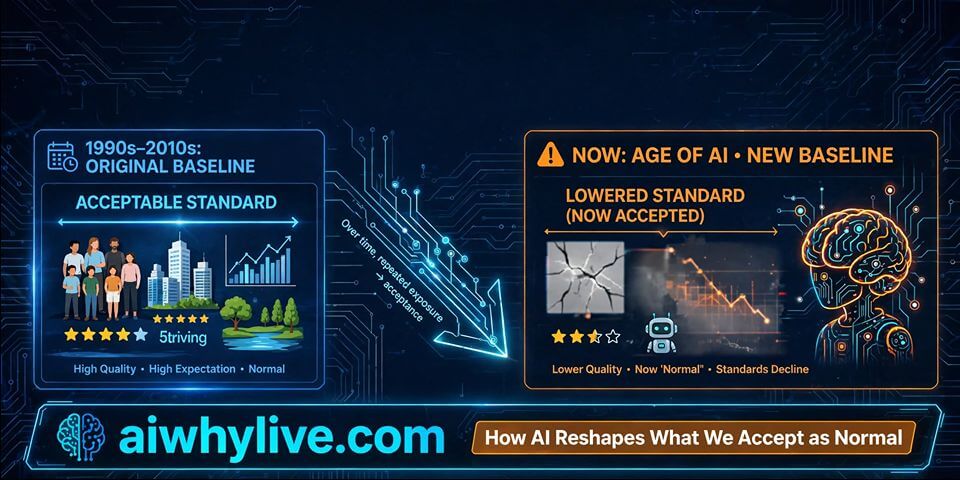
Not because people deliberately decided that these things no longer matter, but because the decline happened slowly enough to become familiar.
We adjusted. We adapted. We got used to it.
And eventually, we called it normal.
The most dangerous decline may be the one we no longer recognize as a decline.
What Is Shifting Baseline Syndrome?
The established term is shifting baseline syndrome. It originated in environmental science and is associated with fisheries scientist Daniel Pauly, who introduced the concept in a 1995 paper titled Anecdotes and the Shifting Baseline Syndrome of Fisheries.
The concept describes how people's reference points for what is normal can change over time. When people have little experience or knowledge of earlier conditions, they may accept an already-degraded environment as normal.
Imagine someone who has only ever seen a river with fewer fish, dirtier water, and damaged banks. To that person, the river may seem normal. They have no direct experience of what it looked like decades earlier.
The next generation grows up with an even more degraded river. They accept that condition as normal, too.
The baseline keeps moving.
Researchers have examined this phenomenon in different environmental and social contexts. A 2024 synthesis of 73 case studies reported widespread evidence of shifting baseline syndrome across environmental settings.
But there is an important distinction for this article.
The established research concept comes from environmental science. When we apply it to AI, education, creativity, work, and digital behavior, we are extending the idea as an editorial framework—not describing a formally established AI-specific syndrome.
AI Is Not the Only Cause. But It Can Accelerate the Adjustment.
Artificial intelligence is changing how people write, research, communicate, learn, design, and make decisions.
These changes bring real benefits. AI can help people understand complex topics, improve productivity, automate repetitive tasks, and make certain capabilities more accessible.
But every new convenience can also change our expectations.
If an AI tool produces an answer in seconds, do we gradually stop expecting careful research?
If AI can generate a hundred images, do we stop asking whether any of them communicate an original idea?
If a student can produce a polished essay with a prompt, do we stop asking whether the student understands the subject?
If a business can automate customer replies, do we stop expecting genuine customer care?
These are not inevitable outcomes of AI. They are risks that arise when convenience replaces standards instead of improving them.
The question is not whether AI can make things easier. The question is whether easier is quietly becoming our only standard.
Seven Places Where Our Standards May Be Shifting
1. Truth: From Verified Information to Plausible Answers
We once expected information to have a source, evidence, and context. Today, a polished paragraph, realistic image, or confident AI response can appear convincing before anyone checks whether it is accurate.
The danger is not simply that false information exists. False information has always existed.
The danger is that we may become less demanding about proof because convincing content is so easy to produce.
A fluent answer is not automatically a factual answer. A realistic image is not automatically an authentic image. A large number of shares is not evidence of truth.
If we lower our standards for verification, misinformation does not need to become more sophisticated. We simply become easier to convince.
2. Creativity: From Original Thinking to Content Volume
AI can generate articles, slogans, designs, scripts, images, and videos at impressive speed.
That is useful when the technology supports a person's ideas and creative direction.
But what happens when volume becomes more important than originality?
When everyone can generate content, producing content is no longer enough to distinguish someone. Perspective, taste, experience, judgment, and authenticity become more important.
If we accept repetitive, derivative material simply because it looks polished, we risk normalizing a lower standard of creativity.
3. Education: From Understanding to Producing Answers
AI can be an excellent learning assistant. It can explain difficult concepts, provide examples, help learners practice, and offer feedback.
But there is a difference between using AI to understand an answer and using AI to avoid understanding the question.
A student who submits a perfect-looking assignment without learning the underlying lesson may have completed a task without developing the skill.
If schools and learners begin to measure education mainly by finished output, the baseline for actual understanding may gradually decline.
The goal of education should not be to produce the most polished answer. It should be to develop people who can think, explain, question, and apply what they know.
4. Work: From Professional Standards to Acceptable Shortcuts
Automation can reduce repetitive work and free people to focus on more meaningful tasks.
But automation does not remove responsibility.
A report still needs to be checked. A recommendation still needs professional judgment. A medical or financial decision still needs appropriate expertise and accountability.
If an employee or organization starts accepting unverified AI output simply because it saves time, efficiency can become an excuse for lower-quality work.
The right question is not just, "How quickly can we finish?"
It is, "How can we finish faster without sacrificing what makes the work reliable?"
5. Customer Service: From Human Attention to Automated Replies
Automated customer support can make services faster and more accessible. It can answer routine questions and direct people to the right information.
But an automated reply is not necessarily a resolved problem.
Customers may gradually become accustomed to repeating their concerns to systems that do not understand their situation. Organizations may start treating a sent response as proof that service has been delivered.
A response is not the same as a resolution. Automation should improve the customer experience, not merely reduce the cost of responding.
6. Social Media: From Meaningful Communication to Endless Noise
We have become accustomed to endless scrolling, constant notifications, recycled opinions, manufactured urgency, and content designed to capture attention.
When noise becomes familiar, silence can feel unusual. When outrage becomes routine, thoughtful discussion can seem boring.
The baseline for a healthy digital conversation can shift without us noticing.
We may start accepting behavior online that we would never tolerate in a face-to-face conversation.
That is not necessarily progress. It may simply be adaptation to an unhealthy environment.
7. Personal Standards: From Improvement to Mere Survival
Perhaps the most personal shift happens when people lower their own expectations.
"I am too busy to learn."
"Everyone uses AI this way."
"Good enough is good enough."
"Nobody checks the details anyway."
Sometimes these statements reflect real pressures. People have limited time, money, energy, and resources.
But when temporary compromises become permanent habits, we can forget what we were capable of doing—and what we should still strive to do.
The Three-Generation Test: What Did We Stop Expecting?
One way to recognize a shifting baseline is to compare experiences across generations.
Ask someone older what a particular place, service, profession, or everyday experience used to be like. Ask someone younger what they consider normal today.
Then compare the answers with evidence where possible.
- What used to be considered good service?
- What did people expect from a reliable news source?
- How much effort went into learning a skill?
- What standards were expected from professional work?
- What did people consider acceptable behavior in public?
- What has improved, and what has quietly deteriorated?
Memory alone is not enough. People can romanticize the past, forget its problems, or exaggerate how good things used to be.
That is why historical records, reliable data, direct experience, and different generations' perspectives matter.
The objective is not to declare that everything was better before AI, the internet, or modern technology.
The objective is to identify what has genuinely improved, what has declined, and what we may have stopped noticing.
How to Prevent AI from Lowering Your Standards
We do not need to reject AI. We need to establish standards that technology must help us meet—not standards that technology quietly replaces.
1. Keep a Reference Point
Know what quality looks like before adopting a faster method. Compare AI-assisted work with reliable sources, established professional standards, and measurable outcomes.
2. Verify Before You Trust
Check important claims, sources, dates, calculations, and context. Treat AI output as something to evaluate, not an authority that automatically deserves belief.
3. Measure Results, Not Just Speed
Saving time is useful, but only if the result remains accurate, useful, and responsible. Faster mistakes are still mistakes.
4. Preserve Human Judgment
Use AI to support thinking, not eliminate it. Ask questions, challenge assumptions, compare alternatives, and make decisions with appropriate expertise.
5. Pass Knowledge Between Generations
Share experiences, historical context, lessons learned, and professional standards. Younger people should not have to rediscover every lost lesson, and older people should remain open to genuine improvements.
6. Do Not Confuse Familiarity with Quality
Something can become common without becoming good. Popularity, convenience, and frequency do not automatically establish quality.
7. Keep Asking: Can This Be Better?
Do not accept the current condition simply because it is familiar. Look for evidence, alternatives, and practical ways to improve it.
The Elephant in the Room: Maybe the Past Wasn't Better
There is a danger in this discussion: turning it into nostalgia.
The past was not automatically more honest, more creative, more professional, or more intelligent. Earlier generations also had misinformation, poor service, weak institutions, inefficient systems, and unfair practices.
Some changes are genuine improvements. AI can help people learn, make services more accessible, support people with disabilities, improve productivity, and help small organizations do more with limited resources.
We should not reject progress just because it changes familiar habits.
But neither should we call every change progress.
The proper comparison is not "old versus new." It is whether the new approach delivers better outcomes without quietly sacrificing accuracy, fairness, creativity, privacy, or accountability.
Do not romanticize the past. Do not blindly celebrate the present. Have enough evidence and judgment to know the difference.
AIWhyLive Explains: The Danger Is Not Just What AI Can Do
AI is a powerful tool, but the human response to it matters just as much.
We can use AI to become more informed or more careless. We can use it to improve our work or to disguise poor work. We can use it to expand our abilities or to avoid developing them.
The same technology can support progress while also making it easier to tolerate mediocrity.
That is why digital intelligence matters. In our earlier article, Digital Intelligence: Protect Your Reputation in the Age of AI, we discussed verification, critical thinking, privacy, and responsible digital behavior.
In The AI Advantage: Stop Thinking Someone Else's Win Is Your Loss, we explored how a zero-sum mindset can prevent people from recognizing opportunities for collaboration and shared growth.
Now we take the next step: even when we learn to collaborate and use AI responsibly, we must not allow our standards to keep falling.
A better tool should help us produce better work. A faster process should preserve quality. More access to information should improve our understanding.
Otherwise, we are not necessarily progressing. We may simply be getting better at accepting less.
ELI12: Explain It Like I'm 12
Imagine a classroom where the school slowly stops fixing broken chairs.
At first, one broken chair is unusual. Then several chairs become broken. New students arrive and see broken chairs everywhere. They think that is just how classrooms are supposed to look.
Eventually, nobody complains. Nobody remembers that the chairs used to be in good condition.
That is a shifting baseline.
Now imagine AI arrives and helps the school identify damaged chairs, track repairs, and manage supplies.
That is progress—if the school actually fixes the chairs.
If it simply uses AI to produce a beautiful report about broken chairs while nobody repairs them, the technology has not solved the problem.
The lesson: a better tool does not automatically create a better result. People must still care about the standard.
Frequently Asked Questions
What is shifting baseline syndrome?
Shifting baseline syndrome describes how people's reference points for normal conditions can gradually change over time. The concept originated in environmental science, where it helps explain why people may underestimate long-term environmental decline.
Who introduced shifting baseline syndrome?
Fisheries scientist Daniel Pauly introduced the term in his 1995 paper, "Anecdotes and the Shifting Baseline Syndrome of Fisheries," published in Trends in Ecology & Evolution.
What is a shifting baseline mindset in the age of AI?
In this article, shifting baseline mindset is an informal expression for the broader risk of becoming accustomed to lower standards for accuracy, originality, learning, service, and accountability as AI and digital tools change everyday expectations.
Is shifting baseline mindset an established scientific diagnosis?
No. Shifting baseline syndrome is an established research concept. Shifting baseline mindset is used here as an accessible editorial expression to discuss its broader application to human expectations. It is not a separate clinical or AI-specific diagnosis.
Does AI automatically lower human standards?
No. AI can improve access to knowledge, productivity, creativity, and services. Standards decline only when people or organizations accept weaker outcomes, stop verifying work, or replace judgment with convenience.
How can AI affect critical thinking?
If people routinely accept AI-generated answers without questioning or verifying them, they may practice less independent evaluation. Used thoughtfully, however, AI can support critical thinking by offering explanations, comparisons, and alternative perspectives.
How can we prevent shifting standards?
Keep historical and professional reference points, preserve knowledge across generations, verify important information, measure quality rather than speed alone, and regularly question whether current practices are genuinely better.
Is everything from the past better than today's technology?
No. The past had serious limitations, and many modern technologies offer genuine improvements. The goal is to compare outcomes honestly rather than automatically favoring either old or new methods.
The Bottom Line: Don't Let the New Normal Become Your New Excuse
AI will continue to change how we work, learn, communicate, and create.
Some changes will make life better. Others will introduce new problems. Many will require us to rethink what we consider acceptable.
But we must remain careful about one thing:
Do not let convenience quietly replace quality. Do not let familiarity replace evidence. Do not let speed replace understanding. Do not let a polished answer replace the truth.
And do not let the next generation inherit a lower standard simply because nobody bothered to explain what came before.
If you no longer remember what good looks like, almost anything can start looking good enough.
Progress is not simply getting used to what we have. It is knowing what can still be improved.
Use AI. Learn from it. Build with it. But keep your standards higher than the convenience it offers.
Because the greatest risk is not that AI will change the world.
It is that we may stop noticing when the world—and our expectations of it—are getting worse.
Sources and Further Reading
The original shifting baseline syndrome concept comes from environmental science. The discussion of AI, work, education, and digital culture in this article is an editorial application of that concept.
- Pauly, D. (1995). Anecdotes and the Shifting Baseline Syndrome of Fisheries. Trends in Ecology & Evolution. Read the paper.
- Soga, M. and Gaston, K. J. (2024). Global synthesis indicates widespread occurrence of shifting baseline syndrome. BioScience. Read the research.
- Alleway et al. (2023). The shifting baseline syndrome as a connective concept for more informed and just responses to global environmental change. People and Nature. Read the paper.
The Internet Never Forgets. Are You Being Smart Enough to Remember That? You can delete a post. You cannot always Read more

The AI Advantage: Stop Thinking Someone Else’s Win Is Your Loss What if your biggest competitor is not the person Read more
Why Is It Getting Harder to Find Something Worth Reading? We have never had more information—and perhaps never had more Read more
🔄 From Human Exhaustion to Machine Leverage By AI Why Live Editorial Team 🌑 Abstract: Intelligence That Moves, Not Stagnates Read more