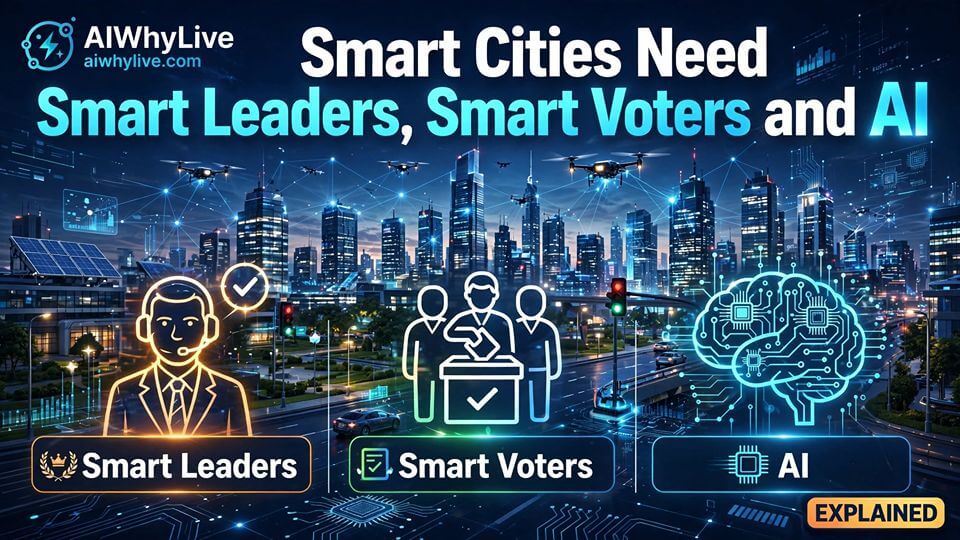
You Can't Build a Smart City With Foolish Decisions
Imagine a city where traffic lights adjust themselves, public transportation is monitored in real time, floods are predicted before they become disasters, government transactions are digital, and artificial intelligence helps officials make better decisions.
Sounds smart?
Now imagine that the same city is run by leaders who cannot manage public funds, projects are awarded without meaningful accountability, and voters choose candidates based on who hands out the most cash during an election campaign.
Welcome to the contradiction.
We want smart cities. We talk about artificial intelligence, digital transformation, automation, innovation, and world-class infrastructure.
But before we ask whether our cities are technologically advanced, perhaps we should ask a more uncomfortable question:
Are we electing leaders who are intelligent enough, honest enough, and competent enough to build them?
A Smart City Is More Than Cameras, Sensors, and Wi-Fi
A smart city is not simply a place with digital billboards, surveillance cameras, automated traffic lights, free public Wi-Fi, and an impressive command center.
Those are tools. They are not proof of good governance.
A genuinely smart city uses technology and reliable information to improve the daily lives of its residents.
Think about what that could mean:
- Traffic management: AI-assisted systems analyze traffic conditions and help improve signal timing and road planning.
- Disaster preparedness: Data and predictive tools support flood monitoring, weather alerts, and emergency response.
- Public health: Digital systems help manage health records, appointments, resources, and service delivery.
- Public transportation: Connected systems provide better information about routes, schedules, congestion, and passenger demand.
- Government services: Digital platforms reduce unnecessary paperwork, waiting time, and repetitive transactions.
- Public accountability: Transparent project information and accessible records help residents monitor how public money is spent.
But none of these systems can guarantee that the people managing them will make good decisions.
A smart traffic system cannot fix a badly planned road network. An AI dashboard cannot force an official to act on a warning. A digital procurement platform cannot automatically eliminate favoritism or corruption.
Where Are We in the Smart City and AI Journey?
There are already concrete steps toward using artificial intelligence in public services and infrastructure.
In our earlier AIWhyLive article, we discussed the government's announcement of more than ₱2.6 billion in planned AI investments through 2028. The proposed areas included healthcare, education, mobility, the environment, disaster risk reduction, and emerging technology platforms.
That announcement was an investment plan covering several sectors. It was not a ₱2.6-billion smart-city budget, nor proof that all the proposed systems had already been deployed.
There has also been progress in specific AI research and development projects. The updated government AI roadmap, marked September 2025, lists a Design and Development of Intelligent Traffic Control and Management System as completed. It also lists a separate project for a lightweight edge-computing solution for smart and efficient traffic management as completed.
The same roadmap identifies other areas of development, including:
- AI for government operations and service delivery.
- AI-assisted thunderstorm early-warning systems.
- Intelligent structural integrity monitoring.
- Vehicle assessment systems.
- AI data centers and cloud platforms for researchers.
- Training and upskilling for the AI workforce.
These are meaningful building blocks. They show that AI in public services is not just an abstract idea.
However, a completed research or development project is not automatically a fully deployed, citywide public service. The real test is whether residents experience measurable improvements: less congestion, faster transactions, better disaster response, lower costs, and more reliable services.
That is the difference between announcing innovation and delivering it.
Read our earlier report: Philippines Levels Up in the AI Game: The ₱2.6 Billion AI Investment Plan.
Smart Technology Needs Smart Leadership
Imagine giving two city administrations exactly the same technology, the same budget, and access to the same AI tools.
One administration uses data to identify traffic bottlenecks, publishes project costs, consults residents, monitors contractors, and measures results.
The other administration buys expensive equipment for photo opportunities, launches a command center that nobody knows how to use, and treats every project announcement as an achievement.
Same technology. Same opportunity. Very different outcomes.
The difference is leadership.
AI can provide information. It can identify patterns, estimate costs, analyze risks, and suggest possible solutions. But people in authority still decide what to prioritize, what to fund, which projects to approve, and whether public money is being used properly.
Technology can improve the decision-making process. It cannot guarantee the integrity of the decision-maker.
The Elephant in the Election: Can AI Defeat Vote-Buying?
Here comes the uncomfortable part.
We can talk about AI-powered government, smart infrastructure, digital transformation, and futuristic cities all day. But what happens when the political system rewards candidates for distributing cash rather than presenting credible plans?
What happens when a campaign becomes a competition over who can give more money, more favors, or more promises?
AI can analyze a candidate's public record. It can compare proposed budgets. It can identify inconsistencies in campaign claims. It can help citizens examine public information.
But can AI stop a voter from accepting money in exchange for a vote?
No.
Can an algorithm force a candidate to stop buying votes?
No.
Can a chatbot make someone choose competence over cash?
It can explain the consequences. The decision remains human.
And this is not merely an imaginary problem. The 2025 Philippine election observation reports documented vote-buying and other practices that undermine electoral integrity. The European Union Election Observation Mission also recorded concerns expressed by interlocutors that some candidates might seek to recover campaign spending through kickbacks from projects once in office.
That observation is not proof that every candidate who spends heavily will engage in corruption. But it illustrates a dangerous incentive: when public office is treated as an investment, the public may eventually pay the price.
In a nationwide survey reported after the 2025 elections, 38% of respondents said they had encountered or were aware of vote-buying incidents. Among those aware of such incidents, 71% believed vote-buying affected the election outcome.
These are survey findings about awareness and perceptions, not a count of every vote bought or a measurement of how many election results were changed. Still, they show why the issue deserves serious attention.
The ₱1-Million Project Versus the ₱2-Million Project
Let's use a simple hypothetical example.
A private contractor can deliver a particular project for ₱1 million.
A publicly funded project with supposedly identical scope, specifications, materials, quality, location, and completion requirements is priced at ₱2 million.
That is a difference of ₱1 million. The public version costs twice as much, or 100% more.
Now, before anyone starts accusing a particular contractor or official, let's be clear: this is an illustration, not a documented case of government overpricing.
Public and private project costs are not automatically comparable. A fair comparison must account for engineering specifications, quantities, site conditions, labor, taxes, insurance, warranties, maintenance obligations, procurement requirements, and other legitimate costs.
A higher price alone does not establish corruption.
But if two genuinely comparable projects have a substantial unexplained price difference, taxpayers have every right to ask questions.
Where did the extra money go?
Was the project properly estimated? Were competing bids evaluated fairly? Were the materials delivered? Was the work inspected? Was the finished project worth what the public paid?
And if the answers are missing, why should residents simply accept the explanation that the project is expensive because it is a government project?
A city saves ₱1 million on one properly delivered project. That money could support another public service, repair a facility, improve a road, or fund something the community actually needs. Multiply that principle across hundreds of projects, and accountability becomes a development strategy.
The point is not that every government project should cost the same as a private project. The point is that every public peso should have a defensible purpose, a transparent price, and a measurable result.
Vote-Buying Is Not Just a Political Problem. It Is a Public Accountability Problem.
It is tempting to blame politicians alone. They deserve scrutiny when they offer money or benefits to influence votes.
But elections are not a one-person transaction.
There is an offer, and there is a decision about whether to accept it and how to vote.
When voters knowingly exchange their votes for cash or favors, they share moral responsibility for weakening the very system they later expect to deliver honest public service.
This does not mean every voter who accepted money necessarily voted for the candidate who offered it. Nor does it erase the effects of poverty, intimidation, coercion, or unequal power. Those realities matter.
But accepting money in exchange for political support is not harmless. It helps normalize the idea that a public office can be won through a transaction rather than earned through competence and trust.
And once public office is treated as something purchased, the temptation to recover the investment through favors, contracts, influence, or public resources becomes a serious governance risk.
That is why vote-buying can become part of a wider cycle of corruption. It is not the only cause of corruption, and it does not explain every corrupt act. But it can help create incentives that make corruption harder to prevent.
Let's Be Honest: Some Voters Sell Tomorrow for Today's Cash
Here is the satire.
A candidate offers a small amount of money. A voter accepts it. The campaign promises a brighter future. The candidate wins.
Months later, the same voter complains about the road that was never repaired, the drainage that still floods, the public service that remains slow, and the project that costs more than expected.
Perhaps the voter asks why the city is not smart enough.
Perhaps the voter demands better leadership.
Perhaps the voter wonders where the budget went.
But the most uncomfortable question may be the one nobody wants to ask:
What did we expect to happen when we helped turn an election into a cash transaction?
A few bills can disappear in a day. The consequences of a poor leadership decision can remain for years.
We want a smart city, but sometimes we choose leaders using the cheapest available intelligence test: How much cash is in the envelope?
Can AI Help Voters Become Smarter?
Yes, but only if people use it as a tool for independent thinking rather than as another source of political propaganda.
AI can help voters:
- Compare candidates' published platforms.
- Examine public budgets and project announcements.
- Summarize available audit reports and procurement records.
- Check whether campaign promises have measurable targets.
- Compare a candidate's statements with documented public records.
- Identify missing information and questions that deserve answers.
However, AI can also make mistakes, repeat misinformation, overlook context, or generate convincing but unsupported claims.
It should not be treated as an election oracle.
Voters should check original documents, verify dates and figures, compare multiple credible sources, and distinguish allegations from established findings.
AI can help people ask better questions. It cannot make the decision for them.
What Should Smart Leaders Actually Do?
A leader who wants to build a smart city should begin with the problems residents experience every day, not with the technology that looks most impressive in a presentation.
Here are practical tests of smart leadership:
1. Publish project costs and results
Residents should be able to understand what a project costs, what it is supposed to deliver, who is responsible, and whether it was completed properly.
2. Use AI where it solves a real problem
Deploy AI for traffic analysis, disaster warnings, public service information, resource planning, and other applications where measurable benefits can be demonstrated.
3. Make procurement transparent
Use fair competition, defensible cost estimates, proper inspections, and public reporting. Technology should make it easier to follow the money, not harder.
4. Protect citizens' data
Smart cities collect and process information. Privacy, cybersecurity, responsible data sharing, and clear accountability must be part of the design.
5. Measure outcomes, not announcements
Count reduced waiting times, improved traffic flow, faster emergency response, lower operating costs, and better public satisfaction—not just the number of cameras, sensors, or digital systems installed.
6. Build institutions that outlast politicians
Public services should not depend on one leader's personal popularity. Systems, records, standards, and accountability should continue when administrations change.
Smart City, Smart Leaders, Smart Voters: The Missing Connection
We often discuss smart cities as if the challenge were mainly technological.
Buy the equipment. Install the software. Connect the sensors. Add AI. Open a command center. Publish a futuristic rendering.
But the real challenge is institutional and human.
A smart city needs competent planning. It needs honest procurement. It needs people who understand technology and can use it responsibly. It needs leaders who are willing to be measured by results.
And it needs voters who understand that an election is not a marketplace where public authority goes to the highest bidder.
AI can help a city become more efficient. It cannot make an irresponsible leader responsible. It cannot turn a bad decision into a good one simply by adding an algorithm.
Technology can help improve governance, but it cannot replace the integrity that governance requires.
AIWhyLive Explains: The Smartest Technology Is Still a Bad Investment Without Smart Decisions
The government's AI roadmap and the projects already identified in it show that the country has begun building capabilities that can support smarter public services.
That is worth recognizing.
But the success of these investments will not be measured by announcements or budget figures alone. It will be measured by what people actually experience.
Does traffic improve? Do emergency warnings arrive on time? Are public transactions faster? Are infrastructure projects delivered at reasonable cost? Can residents see how their money is spent?
And when something goes wrong, can someone be held accountable?
These are not questions an AI demonstration can answer. They require public records, independent scrutiny, competent leadership, and an informed public.
ELI12: Explain It Like I'm 12
Imagine your class wants to build a smart classroom.
You have computers, internet access, digital screens, and an AI assistant.
But the class officers spend the money carelessly, choose suppliers because they are friends, and never check whether the equipment works.
Would the classroom become smart?
No. It would simply become an expensive classroom with technology.
A smart city works the same way. Technology helps, but the people making decisions matter just as much.
The Elephant in the Room
We cannot demand excellent public services while treating elections as a short-term opportunity to collect money.
We cannot demand transparent spending while refusing to examine how candidates raise and spend campaign money.
We cannot demand honest leaders while excusing dishonesty whenever it benefits our preferred candidate.
And we cannot expect artificial intelligence to repair a political culture that rewards the wrong behavior.
That is not a technology problem. It is a human decision problem.
Frequently Asked Questions
What makes a city a smart city?
A smart city uses technology, data, and coordinated public services to improve residents' quality of life. Common applications include traffic management, disaster preparedness, public transportation, healthcare, energy efficiency, and digital government services.
How can AI help local governments?
AI can assist with analyzing traffic, forecasting risks, organizing public information, supporting service delivery, identifying patterns in data, and helping officials evaluate possible solutions. Its recommendations still require human oversight.
Is the ₱2.6-billion AI investment a smart-city budget?
No. The announced amount was a planned investment in AI projects across multiple sectors, including healthcare, education, mobility, environment, disaster risk reduction, and emerging technology. It should not be described as a dedicated smart-city fund.
Can AI eliminate corruption in government?
No. AI may support transparency, identify unusual patterns, and make public information easier to examine. But corruption also involves human decisions, institutional weaknesses, enforcement, incentives, and accountability. Technology alone cannot eliminate it.
Is vote-buying connected to corruption?
Vote-buying undermines electoral integrity and can create incentives for officials to treat public office as an investment to recover. It is one possible contributor to a wider corruption cycle, not the sole cause of corruption.
Can AI help voters choose better leaders?
AI can help compare public records, budgets, policies, and campaign promises. But voters must verify information from reliable sources and make their own decisions. AI should support independent judgment, not replace it.
The Bottom Line
Smart City. Smart Leaders. Smart Voters. Artificial Intelligence.
All four belong in the same conversation.
We can invest in AI, build digital infrastructure, install intelligent traffic systems, and modernize public services. These are worthwhile goals.
But if leadership is poor, public money is treated as personal opportunity, and elections reward whoever distributes the most cash, even the smartest technology will struggle to deliver its promise.
A smart city cannot be built by software alone. It needs people who understand that public office is a responsibility, not an investment to recover.
A smart city begins with smart leaders. Smart leaders begin with smart voters. And smart voters begin when they refuse to be bought.
So, before asking AI to build a smarter city, perhaps we should rewind to the beginning.
It started during the election—when smart voters refused to sell their future for a handful of cash.
AIWhyLive.com: Technology can help build the future. Only people can decide what kind of future deserves to be built.
Editorial note: This article is political satire and commentary on public accountability. The ₱1-million and ₱2-million project comparison is hypothetical, not an allegation about a specific project or public official. Vote-buying statistics are survey findings and should be interpreted according to their stated methodology. Allegations and observer concerns are not findings of guilt against any particular person.
Sources and Further Reading
- AIWhyLive: Philippines Levels Up in the AI Game — The ₱2.6 Billion AI Investment Plan
- Philippine News Agency: DOST to Invest ₱2.6 Billion for AI Projects Until 2028
- DOST-PCIEERD: Artificial Intelligence Roadmap, Updated September 2025
- European Union Election Observation Mission: 2025 Philippine Elections Final Report
- Philippine Star: OCTA Survey on Awareness of Vote-Buying in the 2025 Elections
- J-PAL: Combating Vote-Selling in the Philippines

Why Filipino professionals must stop worshipping complexity—and start weaponizing intelligent elegance Complexity used to be a badge of honor. Long Read more
In the Philippines, we have a name for this constant need to be "extra." It’s being "Pa-sosyal" or "Pa-bibo." In Read more
The Future of Work Has a Toolbox, Not Just a Keyboard Artificial intelligence can write reports, generate images, analyze information, Read more
Use It, Lose It—or Give It to AI? What Happens When AI Does the Thinking? There is an old principle Read more