The Future of Work Has a Toolbox, Not Just a Keyboard
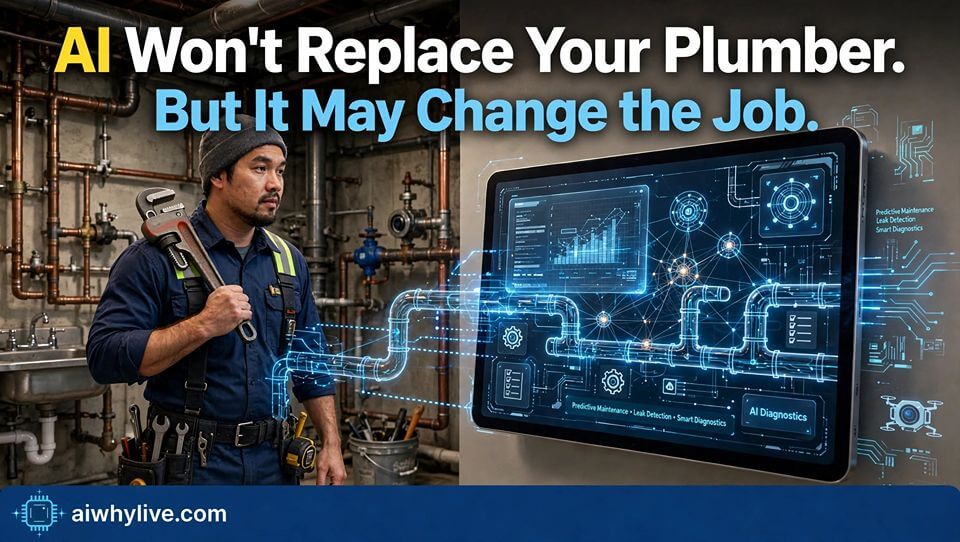
Artificial intelligence can write reports, generate images, analyze information, answer questions, and automate many routine office tasks. But can it repair a leaking pipe, install electrical wiring, lay concrete blocks, or fix a broken water pump?
Not reliably on its own in the ordinary environments where these jobs happen today.
That is an important distinction. While much of the conversation about artificial intelligence focuses on office workers, programmers, designers, writers, and customer service representatives, millions of people earn a living doing something very different: working with their hands.
Plumbers. Electricians. Carpenters. Mechanics. Welders. Masons. Appliance technicians. Construction workers.
These professions are not automatically protected from technological change. But their future may look very different from the future of jobs that are performed almost entirely on a computer.
And here is the bigger point: AI does not have to replace a skilled worker to change the value of that worker.
AI Doesn't Need to Become a Plumber to Change Plumbing
Imagine two plumbers with similar experience.
One relies entirely on traditional methods. The other uses digital tools and AI assistance to prepare estimates, organize appointments, identify possible causes of common problems, calculate materials, and communicate with customers.
Both still need to inspect the pipes, understand the building, choose the correct materials, and perform the actual repair.
But the second plumber may spend less time on administrative work and more time doing paid jobs.
The difference is not necessarily physical strength or technical knowledge. It may be how effectively each person uses available tools.
The same principle applies to other trades:
- Electricians: Digital diagnostic tools and AI-assisted information can help organize troubleshooting and technical documentation. Actual inspection, testing, installation, and safety decisions still require qualified people.
- Masons and tile setters: Digital measurements, layout planning, and material calculations can help reduce errors and waste. The physical installation still requires skill and judgment.
- Mechanics: Diagnostic software can help interpret vehicle data and identify possible faults. Someone still needs to inspect the vehicle, verify the diagnosis, and perform the repair.
- Carpenters: Design software and AI-assisted planning can help with measurements, cutting lists, estimates, and project preparation. Accurate construction remains a hands-on job.
- Appliance technicians: AI-assisted troubleshooting can help narrow down possible causes, but the technician must test components and confirm what is actually wrong.
These tools do not make expertise unnecessary. Used properly, they can help skilled people apply their expertise more efficiently.
The Real Competition May Be Between Two Skilled Workers
We often ask whether AI will replace workers.
Perhaps a more practical question is this: What happens when two people have similar skills, but one knows how to use technology to work more efficiently?
Consider a small repair business.
Worker A spends time writing quotations, calculating materials manually, answering every customer inquiry individually, and organizing appointments through scattered messages.
Worker B uses AI-assisted tools to prepare quotation drafts, organize customer inquiries, create job summaries, maintain records, and plan schedules.
Neither worker has replaced the other with a robot. Both still need the knowledge and ability to do the work.
However, Worker B may have more time for customers, more organized records, and fewer repetitive administrative tasks.
That can become a business advantage.
It does not guarantee higher income. Customers, pricing, competition, reliability, and the quality of the actual work still matter. But it creates an opportunity that should not be ignored.
One Worker Could Eventually Do What Used to Require Several
This is where the discussion becomes more complicated.
Technology can increase productivity. A skilled technician who uses better diagnostic tools, digital planning, and automated administrative processes may be able to handle more jobs than before.
That is good news for some workers and businesses. It may also create pressure on others.
If one person can complete more work in the same amount of time, a business may need fewer people for certain tasks. Some administrative responsibilities may disappear. Some services may become faster and cheaper.
So it would be misleading to say that physical occupations are completely safe from automation.
The actual work may remain physical, but parts of the process surrounding it can still be automated or reorganized.
That is why the future of work is not simply a contest between humans and machines. It is also a contest between different ways of organizing work.
The Question Nobody Should Ignore: Who Benefits From Higher Productivity?
Suppose an electrician uses AI-assisted tools and better digital processes to complete more jobs in a week.
Who receives the benefit?
- The worker, through higher wages or more completed jobs?
- The business owner, through increased profit?
- The customer, through lower prices or faster service?
- Or all three, if the business shares the benefits fairly?
There is no automatic answer.
Technology can make a worker more productive without guaranteeing that the worker will receive a larger share of the value created.
This is why upskilling should go beyond learning how to operate an AI application.
Workers should also learn how to price their services, communicate their value, negotiate fairly, manage customers, and understand the business side of their profession.
Being more productive is useful. Knowing how to benefit from that productivity is equally important.
AI Literacy Should Not Be Limited to Office Workers
AI education is often presented as something for people who work in technology, business, marketing, or office environments.
That is too narrow.
A vocational graduate does not need to become a programmer or an AI engineer to benefit from artificial intelligence.
A practical starting point could be learning how to:
- Prepare estimates and quotations with AI assistance.
- Organize customer records and job histories.
- Draft clear explanations of technical problems.
- Plan materials and project schedules.
- Create a digital portfolio of completed work.
- Respond to customer inquiries more efficiently.
- Promote services through websites and social media.
- Use AI to research unfamiliar problems while verifying important technical information.
These are not futuristic abilities. They are practical business skills that can be developed gradually.
Start with one repetitive task. Learn how to improve it. Check whether the result is accurate. Keep using the tool only if it genuinely saves time or improves the quality of the work.
But Don't Trust AI With Your Safety
There is an important limitation.
AI can produce convincing answers that are incomplete, inaccurate, or simply wrong. In technical occupations, an incorrect recommendation can have serious consequences.
Electrical installations, structural work, plumbing systems, machinery, and repairs involve real-world risks. An AI-generated suggestion is not a substitute for professional training, inspection, applicable standards, or safety procedures.
A qualified worker must know when to use an AI suggestion, when to verify it, and when to reject it.
In fact, the ability to question AI may become one of the most valuable skills of all.
Human Skills Still Have Economic Value
There is another reason skilled trades matter: people do not buy technical work alone. They also buy trust.
Customers invite plumbers into their homes. They depend on electricians to work safely. They expect mechanics to explain what is wrong with their vehicles. They rely on construction workers to build something that will last.
Communication, honesty, reliability, patience, and accountability matter in these situations.
But let's be realistic. Being friendly is not enough. A kind technician who repeatedly delivers poor work will eventually lose customers.
Human qualities become valuable when they are supported by competence.
The strongest combination is not simply human versus artificial intelligence. It is:
- Technical knowledge.
- Practical experience.
- AI literacy.
- Critical thinking and verification.
- Communication and customer service.
- Reliability and accountability.
That combination can help a worker remain useful even as the tools and expectations of the profession change.
The Opportunity for Vocational Graduates and Small Business Owners
Imagine a newly qualified plumber who does more than look for employment.
That person builds a small service business, uses digital tools to organize customers, prepares professional quotations, documents completed jobs, and builds a reputation through reliable work.
AI can assist with some of the planning, writing, and administrative tasks. The plumber still provides the technical service.
Over time, that worker may develop a customer base, employ an assistant, train another technician, or expand into a specialized service.
This is not a promise of easy money. Starting a business involves expenses, competition, responsibility, and risk.
But it demonstrates something important: AI is not only a tool for people who sit in front of computers. It can also be useful to people whose work happens in homes, workshops, construction sites, farms, and small businesses.
What Should Skilled Workers Do Now?
You do not need to learn every AI application available. You do not need to abandon your profession. And you certainly do not need to believe every prediction about robots taking over the world.
Start with a more practical approach:
1. Protect the skill you already have
Build strong technical foundations. Learn the correct procedures, standards, tools, and safety practices. AI cannot compensate for poor workmanship.
2. Learn one useful AI application
Choose a task that consumes time, such as quotations, customer communication, documentation, or scheduling. Experiment with AI assistance and check the results.
3. Improve your business skills
Understand pricing, expenses, customer service, marketing, and record-keeping. Technical ability is valuable, but managing work professionally creates additional opportunities.
4. Verify before you act
Never accept AI-generated technical instructions without checking them against reliable professional knowledge, relevant standards, and safety requirements.
5. Keep learning as the tools change
The applications available today will not be the same forever. Focus on learning how to solve problems, not memorizing the features of one particular tool.
AIWhyLive Explains: The Future Belongs to People Who Can Combine Skills
The discussion about AI and employment often gets trapped between two extreme predictions.
One side says AI will take everyone's jobs. The other says certain professions are completely safe because machines cannot perform every physical task.
Neither view tells the whole story.
Some tasks will be automated. Some jobs will change. New tools will create opportunities, while increased productivity may also put pressure on wages and staffing. The effects will differ from one profession, business, and location to another.
For skilled trades, the physical work may remain important. But the surrounding activities—planning, estimating, diagnosing, scheduling, documenting, and finding customers—can increasingly benefit from digital technology.
That is the opportunity worth preparing for.
ELI12: Explain It Like I'm 12
Imagine two people who repair bicycles.
Both know how to fix a flat tire, adjust brakes, and replace a chain.
One person does everything manually, including writing receipts and remembering customer appointments.
The other uses a phone and AI tools to organize customers, calculate costs, prepare messages, and keep track of repairs.
Both still need to know how to repair bicycles. But the second person may spend less time doing paperwork and more time fixing bicycles.
That is the point: AI does not always need to do your job. Sometimes it only needs to help you do your job better.
The Elephant in the Room
There is no guarantee that every worker who learns AI will earn more. There is no guarantee that every traditional occupation will remain unchanged. And there is no guarantee that employers will automatically share productivity gains with workers.
Some people will benefit more than others. Some businesses will adapt faster. Some workers will need retraining. Others may face difficult transitions.
That is why practical AI education should be accessible beyond universities and corporate offices. It should reach vocational schools, small businesses, independent workers, and communities where people earn a living through skilled labor.
The goal should not be to turn every worker into a technology expert.
The goal should be to make technology useful to people who already have valuable skills.
Frequently Asked Questions
Will AI replace plumbers, electricians, and masons?
AI does not currently perform the full range of physical tasks involved in these professions independently in ordinary real-world settings. However, automation and AI-assisted tools can change parts of their work, including planning, diagnostics, estimates, and administration. The level of impact will vary by task and technology.
Are skilled trades safe from AI automation?
No occupation should be considered completely immune to technological change. Physical trades may be harder to automate fully because they involve unpredictable environments, practical judgment, and hands-on work. But some tasks surrounding those jobs can still be automated.
How can vocational graduates use AI?
They can start with practical tasks such as preparing quotations, organizing customer records, creating marketing materials, planning schedules, and documenting completed work. Technical decisions and safety-critical work must still be verified by qualified people.
Do plumbers and electricians need to learn programming?
Not necessarily. Basic AI literacy and the ability to use relevant digital tools may be more immediately useful. Programming can be an additional skill, but it is not a requirement for every skilled trade.
Will AI increase wages for skilled workers?
Not automatically. AI may improve productivity, but wages depend on factors such as demand, competition, bargaining power, business decisions, and how productivity gains are distributed.
What is the most important skill in the age of AI?
There is no single skill that guarantees success. A strong combination includes technical competence, critical thinking, adaptability, communication, and the ability to use technology responsibly.
The Bottom Line
AI may not be able to walk into your house, inspect a leaking pipe, understand every complication behind a wall, and complete a safe repair on its own.
But it may help a plumber prepare a better quotation, organize a business, communicate with customers, and complete more work efficiently.
That difference matters.
We should not tell young people that traditional trades are guaranteed safe from AI. We should not tell them that every job will disappear either.
We should teach them to develop skills that are useful in the real world—and learn how technology can make those skills more valuable.
AI doesn't need to hold a wrench to change the plumbing business. It only needs to help one plumber work smarter than the competition.
AIWhyLive.com: The future is not only about who can use AI. It is also about who knows how to combine AI with something real, useful, and difficult to replace.
Editorial note: This article discusses possible applications and implications of AI in skilled trades. Specific capabilities vary by tool, occupation, workplace, and local safety requirements. AI-generated technical advice should always be independently verified.
Imagine waking up to an email from a job applicant who introduces themselves by saying: "Hi Henry, I'm Pip, an Read more

From Ghost Shift to BUGNA: Reclaiming Your Time with Intelligent Surveys The Shift Nobody Officially Announced For years, people imagined Read more

Career Advice for Filipinos Who Were Outsourced, Ghosted, and Radicalized Before the Robots Even Arrived 🔪 The Original Sin: Why Read more
When OpenAI announced its vision of “expanding economic opportunity with AI,” it sounded like a global salvation story. AI, they Read more