Why Being Small Can Be a Big Business Advantage
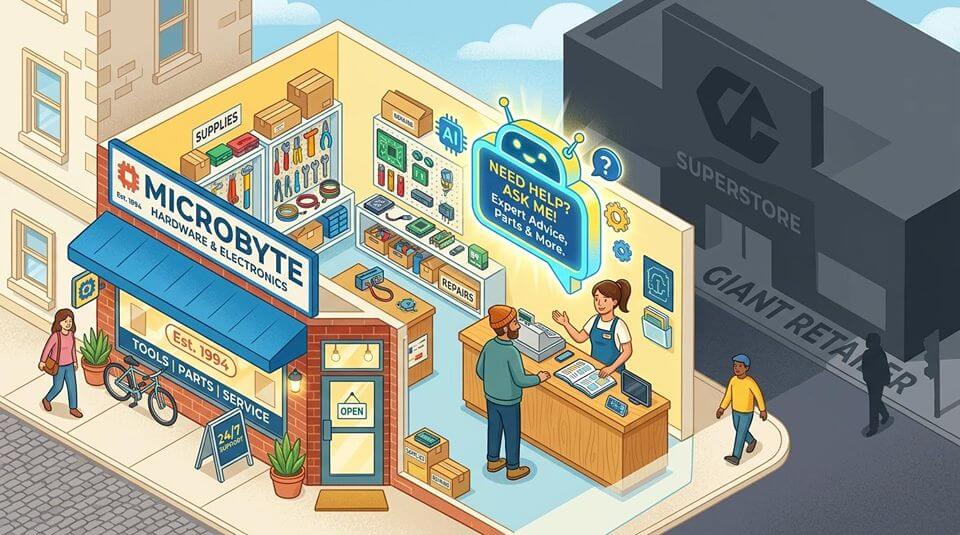
You don't need to defeat a giant company. You need to serve a customer it overlooks. In the age of AI, small businesses have an opportunity to compete differently—not by matching corporate budgets, but by combining technology with local knowledge, specialization, flexibility, and personal service.
Stop Trying to Beat the Giants at Their Own Game
Imagine owning a small neighborhood business.
Across the street, or somewhere just a few clicks away, is a much larger competitor.
It has a bigger advertising budget, more employees, a sophisticated website, established suppliers, and perhaps an entire department dedicated to marketing.
You cannot easily match its prices. You cannot match its advertising reach. You probably cannot afford its technology infrastructure.
So what do you do?
Many small business owners make the mistake of trying to imitate the giant.
They copy its promotions, compete on price, attempt to serve everybody, and spend money trying to look bigger than they really are.
But what if that is the wrong strategy?
You don't need to defeat a giant company. You need to serve a customer it overlooks.
That may be one of the most important opportunities for small businesses in the age of artificial intelligence.
The Big Company Has Resources. The Small Business Has Other Advantages.
Large companies have genuine advantages. They can benefit from economies of scale, extensive distribution networks, established brands, large marketing teams, and significant purchasing power.
Small businesses should not pretend those advantages do not exist.
But size can also create distance between a company and its customers.
A large organization may have standardized procedures, multiple approval layers, broad customer segments, and systems designed to serve thousands or millions of people.
A small business may be able to make decisions faster, recognize individual customers, adapt its offerings, and respond to a specific local need.
These advantages are not automatic. A poorly managed small business can be slow, inconsistent, and difficult to deal with, too.
But when a small business deliberately builds around its strengths, it can compete on dimensions that are not determined by company size.
AI Changes the Equation for Small Businesses
For years, advanced digital capabilities were expensive.
A business might need a marketing team to produce regular content, a developer to build digital tools, an analyst to organize information, or administrative staff to handle repetitive work.
AI is making some of these capabilities more accessible.
A small business owner can now use AI to help draft marketing content, prepare customer communications, organize business information, analyze feedback, plan promotions, and automate selected routine tasks.
This does not mean AI can replace every employee or guarantee better business results.
AI-generated content still needs checking. Automated systems need monitoring. Customer information needs protection. Business decisions still require human judgment.
But the important change is this:
A small business can access capabilities that once required much more time, money, or specialized support.
That creates room to compete more intelligently.
Five Small Business Advantages Worth Building
1. Local Knowledge: Understand What Your Community Actually Needs
A large company may understand national or regional market trends.
But a local business may understand the specific needs of its immediate community.
It may know which products customers regularly request, which delivery arrangements work, which local events affect demand, what customers can afford, and what problems people experience in the area.
That knowledge can influence product selection, service hours, promotions, pricing decisions, and customer communication.
AI can help organize sales records, summarize customer feedback, identify recurring questions, and prepare marketing messages.
But the business owner still needs to understand the community and verify what the information actually means.
The opportunity: Use AI to organize local knowledge—not to replace it.
2. Niche Markets: Stop Trying to Sell to Everybody
Trying to serve everyone can make a small business forgettable.
A more focused business can become known for serving a particular customer group or solving a specific problem.
Consider the difference between a general online store and a store specializing in products for a particular hobby, profession, lifestyle, or community.
The specialized store may have a smaller potential audience, but it can develop deeper knowledge of that audience's needs.
AI can help research customer questions, organize product information, create targeted content, and analyze customer feedback.
It can also help a business test whether a niche has enough demand before investing heavily.
The opportunity: Be especially useful to a clearly defined group instead of being vaguely relevant to everybody.
3. Personalized Service: Make Customers Feel Recognized
Customers are not just transaction numbers.
They have preferences, questions, schedules, budgets, and individual circumstances.
A small business can build an advantage by being attentive, remembering preferences appropriately, following up, and making the buying experience easier.
AI can help prepare personalized messages, organize service requests, draft follow-up communications, and support customer service workflows.
However, personalization should respect privacy. Businesses should obtain appropriate consent, protect customer information, and avoid using sensitive details carelessly.
The opportunity: Use technology to make service more personal, not more intrusive.
4. Flexibility: Adapt Without Waiting for a Corporate Decision
Large organizations often need coordination across departments and approval processes.
A small business may be able to test a new product, adjust an offer, change a delivery arrangement, or respond to customer feedback more quickly.
That flexibility can be valuable when customer needs change.
AI can support faster planning, comparison, communication, and analysis, helping the owner consider options before making a decision.
But speed should not replace careful thinking. An inexpensive mistake can still be expensive for a small business.
The opportunity: Use your ability to adapt, while keeping decisions grounded in evidence.
5. Relationships: Build Trust Beyond the Transaction
People may choose a business because of price or convenience.
They may return because they trust the people behind it.
Reliability, honest communication, fair treatment, and consistent service can turn a first-time customer into a long-term customer.
AI can help a business communicate consistently and respond to routine questions, but it cannot replace the responsibility to honor promises and resolve problems.
The opportunity: Let AI handle selected repetitive work so people can spend more attention on customers.
What AI Can Help a Small Business Do Today
You do not need an expensive AI transformation project to begin.
Start with practical tasks that take time away from serving customers or managing the business.
| Business Need | Possible AI Application | Human Responsibility |
|---|---|---|
| Marketing | Draft social posts, product descriptions, and campaign ideas | Check accuracy, tone, and relevance |
| Customer service | Prepare FAQs and draft routine responses | Handle sensitive or complicated concerns |
| Sales analysis | Summarize sales information and identify patterns | Verify data and make business decisions |
| Administration | Organize documents and draft reports | Review records and protect confidential information |
| Planning | Compare options and develop possible scenarios | Evaluate risks, costs, and feasibility |
| Online presence | Assist with website content and search optimization | Ensure useful, original, accurate information |
The goal is not to automate everything.
The goal is to identify tasks where AI can save time or improve the quality of work without creating unnecessary risks.
A Practical Example: The Neighborhood Business That Knows Its Customers
Imagine two businesses selling similar everyday products.
The first tries to compete with a large retailer by offering the lowest possible price.
The second studies what nearby customers actually need. It keeps useful products available, communicates clearly, offers convenient ordering, remembers common requests appropriately, and responds when customers have a problem.
It also uses AI to help prepare product announcements, organize customer inquiries, and review sales patterns.
It may not have the same purchasing power or advertising budget as the large retailer.
But it is competing on convenience, familiarity, relevance, and service.
That does not guarantee success. Its prices, inventory, costs, and execution still matter.
However, it has stopped trying to win every possible customer.
It is concentrating on the people it can serve particularly well.
The best customer for a small business may be the one a large competitor does not consider important enough to serve personally.
How to Find the Customer Bigger Businesses Overlook
Finding a niche is not about inventing a customer who does not exist. It is about discovering a real group of people whose needs are not being served well.
Step 1: Listen to Existing Customers
Ask what they find inconvenient, expensive, confusing, or difficult about the products and services available to them.
Step 2: Look for Repeated Problems
One complaint may be an isolated incident. Repeated complaints may reveal an opportunity.
Step 3: Identify a Specific Customer Group
Think about a particular profession, neighborhood, business type, hobby, age group, or recurring need. Avoid defining your audience so narrowly that there is not enough demand.
Step 4: Test a Small Solution
Before spending heavily, offer a limited service, trial product, pilot promotion, or simple improvement. Observe whether people actually use it.
Step 5: Use AI to Improve What Works
Once you have evidence of demand, use AI to help improve communication, operations, research, and delivery.
Let customer needs guide your technology choices.
The Elephant in the Room: AI Does Not Fix a Bad Business
There is a danger in treating AI as a shortcut to business success.
A business with poor customer service can use AI to send more messages. That does not make the service better.
A business with weak products can use AI to produce attractive advertisements. That does not make the products worth buying.
A business with bad financial management can use AI to generate impressive reports. That does not fix its cash flow.
Technology can improve a process, but it cannot automatically repair a broken business model.
Small business owners should also consider subscription costs, staff training, data privacy, inaccurate outputs, security, and the time required to maintain automated systems.
Sometimes the best decision is not to buy another AI tool.
It is to fix the underlying business problem first.
AI can amplify a good business process. It can also amplify a bad one.
ELI12: Explain It Like You're 12
Imagine two stores selling snacks.
One store is a huge supermarket with thousands of products.
The other is a small neighborhood shop.
The small shop cannot stock everything or offer every possible discount.
But it may know what people nearby usually buy. It may be closer, more convenient, and easier to talk to.
Now imagine the small shop uses AI to organize its products, prepare announcements, and answer common questions.
It still cannot become a giant supermarket overnight.
But it can become a better neighborhood shop.
That is the idea: you do not have to be the biggest. You have to be useful to the people you serve.
AIWhyLive Explains: The Advantage Is Not Being Small. It Is Knowing Where Size Matters Less.
Let's be realistic.
Being small is not automatically an advantage. Large companies can offer lower prices, wider selection, faster distribution, and stronger brand recognition.
Small businesses should not romanticize their limitations.
Instead, they should identify areas where scale is less important than understanding, responsiveness, specialization, and customer relationships.
AI can help small businesses become more organized and capable. It can help one person perform selected tasks that previously required additional support.
But the strategy must come first.
Know your customer. Understand the problem. Choose a useful solution. Use AI where it makes a measurable difference.
Do not automate just because automation is fashionable.
Do not imitate a corporation when your opportunity is to serve a market segment it overlooks.
The Bottom Line: Serve Better, Not Just Bigger
The age of AI does not mean every small business will survive or every large company will fail.
Competition remains real. Costs matter. Quality matters. Cash flow matters. Execution matters.
But AI is making certain digital capabilities more accessible, giving small businesses new ways to improve how they operate and serve customers.
The opportunity is not to look like a giant company.
It is to build a business that understands a particular customer so well that the customer has a good reason to choose it.
Drop Mic
You don't need to defeat a giant company.
You need to serve a customer it overlooks.
Don't try to become the biggest. Become the business that matters to the right people.
AIWhyLive.com — Think beyond the prompt.
Frequently Asked Questions
How can small businesses compete with large companies using AI?
Small businesses can use AI to support marketing, customer communication, research, administration, and selected automation. They can combine these capabilities with local knowledge, specialization, flexibility, and personal service. Success still depends on demand, quality, pricing, and execution.
What is the biggest advantage of a small business?
There is no single advantage that applies to every small business. Potential strengths include closer customer relationships, specialized knowledge, faster decision-making, flexibility, and a better understanding of a specific market.
What AI tools should a small business use?
The right tools depend on the business problem. A business may need AI assistance for writing, research, customer communication, data analysis, or workflow automation. Start with a clear need and evaluate tools based on cost, reliability, privacy, and measurable usefulness.
Can AI help a small business with marketing?
Yes. AI can assist with campaign ideas, social media drafts, product descriptions, customer research, and content planning. Business owners should review the output to ensure that it is accurate, relevant, original, and consistent with their brand.
What is a niche market in small business?
A niche market is a focused segment of customers with particular needs, interests, or problems. Serving a well-defined group can help a small business specialize, develop relevant products, and build stronger customer relationships.
Can a small business use AI without hiring an AI expert?
Many basic AI applications can be learned by business owners and staff. However, more complex automation, software integration, sensitive data handling, and security requirements may need qualified professional assistance.

Ignore the Noise. Build Real Leverage. 🧠 The Noise vs. The Reality Across the Philippines, a strange pattern is emerging. Read more

In the age of AI, your words are no longer just yours. Every time you type a prompt into a Read more
In today’s business landscape, embracing AI is crucial for success. Discover the game-changing potential of AI and its impact on Read more

What Happens When AI Tells You What You Want to Hear? What if the most dangerous AI answer isn't necessarily Read more