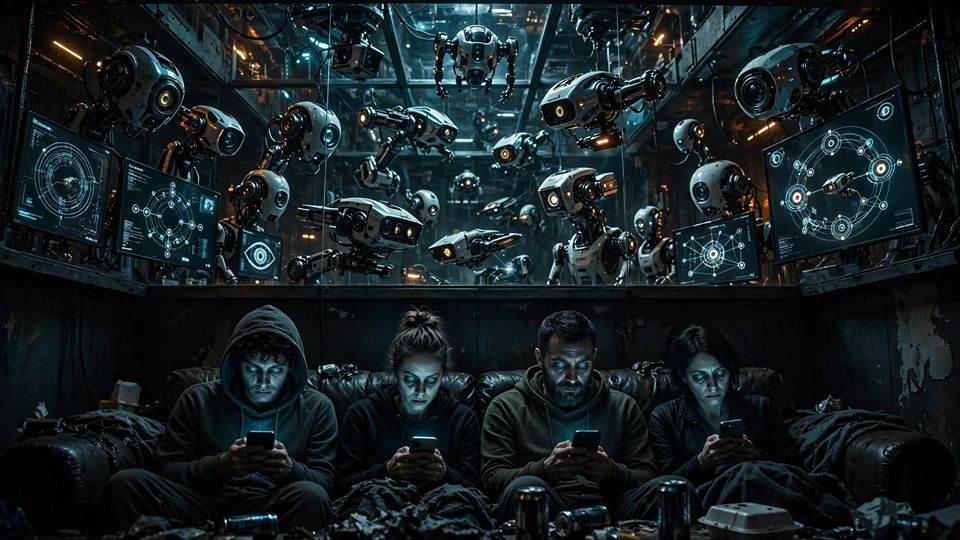
We built the algorithms, trained the machines, and then volunteered to become their easiest audience.
There is something deeply ridiculous happening in the Age of AI.
Humans are worried that AI is watching us.
Meanwhile, AI is watching AI while humans are busy doomscrolling.
Think about that for a moment.
We built recommendation algorithms to figure out what people want.
We built social platforms to keep people engaged.
We built generative AI to create content faster.
We built systems that can translate, summarize, remix, imitate, personalize, optimize and distribute information at almost zero marginal effort.
Then we handed all of it to ourselves.
And what did we do?
We scrolled.
Swipe.
Watch.
React.
Share.
Prompt.
Generate.
Scroll again.
Perhaps the most uncomfortable question about artificial intelligence isn't whether machines will become smarter than humans.
Perhaps it is this:
What happens when increasingly intelligent machines are connected to increasingly distracted humans?
🧠 AIWhyLive Explains: The Machine Isn't the Weakest Link
Let's make something clear.
AI is not the problem.
At least, not by itself.
A hammer doesn't decide what to hit.
A camera doesn't decide what is worth photographing.
A spreadsheet doesn't decide what business deserves your money.
And an AI model doesn't automatically decide whether an idea is intelligent, stupid, useful, harmful, profound or completely pointless.
Humans provide the direction.
Humans provide the incentives.
Humans provide the prompts.
And increasingly, humans provide the attention.
That's where things get interesting.
A powerful machine can produce an extraordinary answer.
But give it a terrible objective and it can become extraordinarily efficient at producing terrible things.
The machine may be intelligent.
The mission can still be stupid.
The Algorithm Didn't Make Us Stupid
This is where we have been asking the wrong question.
Did AI make humans stupid?
Probably not.
Humans were already perfectly capable of being stupid long before ChatGPT existed.
We had television.
We had tabloids.
We had chain emails.
We had clickbait.
We had conspiracy theories.
We had gossip.
We had reality television.
We had comment sections.
We had Facebook.
We had TikTok.
We had X.
The human appetite for nonsense is not new.
AI simply removes another layer of friction.
Before, somebody had to create the nonsense.
Now the machine can help create it.
Before, somebody had to translate it.
Now the machine can translate it.
Before, somebody had to rewrite it.
Now the machine can rewrite it.
Before, somebody had to produce ten versions.
Now the machine can produce a hundred.
Before, stupidity had a production cost.
Now stupidity can have an API.
And that changes the economics of nonsense.
🌍 A Few Prompts Can Give Stupidity a Passport
Here is the part that fascinates me.
Imagine someone creates a terrible idea.
One person sees it.
Then another person copies it.
Then someone asks AI to rewrite it.
Someone else asks another AI to translate it into another language.
Another person asks AI to make it shorter.
Another asks for a more emotional version.
Another asks for a viral headline.
Another creates a video from it.
Another creates a voice-over.
Another adds subtitles.
Another posts it on another platform.
Suddenly, one mediocre idea has become hundreds of pieces of content.
Different language.
Different format.
Different thumbnail.
Different personality.
Same stupidity.
We didn't create intelligence at scale.
Sometimes we simply created stupidity at scale.
That may be one of the strangest side effects of generative AI.
The machine doesn't need to believe something is intelligent before helping you distribute it.
It only needs a prompt.
🌐 The Global Stupidity Machine
Language used to be a barrier.
Geography was a barrier.
Production cost was a barrier.
Skill was a barrier.
Distribution was a barrier.
AI is quietly attacking many of those barriers.
That is wonderful when the underlying idea is useful.
A Filipino student can ask for an explanation in simpler English.
A small business owner can translate a product description.
A developer can understand documentation.
A teacher can create learning material.
A creator can reach another country.
A researcher can explore a complicated subject.
The same machinery that multiplies useful ideas can multiply useless ones.
That's the uncomfortable symmetry.
AI doesn't have a built-in stupidity filter.
Neither does the internet.
Neither do we.
👦 ELI12: Imagine a Photocopier That Can Think
Imagine you have a photocopier.
You put one stupid poster into it.
It makes ten copies.
Not very impressive.
Now imagine the photocopier can:
- translate the poster;
- change the wording;
- make it funny;
- make it angry;
- make it scary;
- create a video;
- create a voice;
- make ten thumbnails;
- target different audiences;
- and produce another hundred versions.
You haven't necessarily created a better idea.
You've created a better distribution system for the original idea.
That's the difference.
AI can multiply intelligence.
But it can also multiply whatever else we give it.
Including nonsense.
Including outrage.
Including misinformation.
Including boredom.
Including our worst habits.
🍗 Lechon Manok: Congratulations, Your Stupidity Is Now Multilingual
Humanity spent thousands of years trying to overcome language barriers.
AI finally helps us do it.
And naturally...
we may use it to translate arguments nobody needed to have.
Wonderful.
Progress.
Now your bad opinion can travel internationally.
Your recycled motivational quote can reach three continents.
Your outrage can be translated into six languages.
Your 14-second video about something you don't understand can receive subtitles.
Your AI-generated opinion about an AI-generated opinion can become content.
And somewhere in the background, an algorithm quietly whispers:
"This seems to be working."
So it gives you more.
You give it more.
It gives you more.
And eventually everybody is producing content for everybody else to consume.
Nobody knows why.
Nobody remembers where the original idea came from.
But the engagement numbers look fantastic.
Welcome to the factory.
🐘 Elephant in the Room: What If Humans Are the Vulnerable Technology?
We talk constantly about AI alignment.
Will AI do what humans want?
Will AI follow our instructions?
Will AI become autonomous?
Will AI manipulate people?
These are legitimate questions.
But there is another question we don't discuss enough:
Are humans actually capable of resisting the systems we build?
Because we already know something about ourselves.
We are attracted to novelty.
We respond to outrage.
We like confirmation.
We seek belonging.
We fear missing out.
We become emotionally invested in things we barely understand.
We keep scrolling even when we know we should stop.
And we often confuse being informed with consuming information.
That is not an AI problem.
That's a human vulnerability.
AI simply gives that vulnerability a much bigger playground.
AI Is Watching AI
And this is where the title becomes more than a joke.
AI systems increasingly generate content.
Other systems analyze content.
Recommendation systems measure what people respond to.
Advertisers study behavior.
Creators study algorithms.
Algorithms study engagement.
AI helps creators generate more content.
That content enters the feed.
Humans react.
Those reactions become data.
The system learns.
Then the process repeats.
Human → algorithm → AI → content → human → data → algorithm → AI.
Round and round.
The machine doesn't have to hypnotize us.
We voluntarily provide the feedback.
Every click is information.
Every pause is information.
Every share is information.
Every angry comment is information.
Every "one more video" is information.
We are training the system while complaining about the system.
That may be the funniest part.
The Real Danger Isn't AI Taking Over
Perhaps the biggest danger isn't that AI becomes too intelligent.
Perhaps it's that humans become too comfortable being intellectually passive.
Why think deeply when AI can summarize?
Why learn the language when AI can translate?
Why research when AI can explain?
Why write when AI can draft?
Why create when AI can generate?
Why decide when AI can recommend?
Why pay attention when the feed can choose what appears next?
None of these questions has a simple "never use AI" answer.
That would be ridiculous.
AI is extraordinarily useful.
The problem isn't using the machine.
The problem is surrendering the part of yourself that is supposed to decide what the machine should be used for.
The Prompt Is Not the Thought
This may be the most important distinction of the entire AI era.
A prompt is an instruction.
It isn't necessarily an idea.
A generated paragraph isn't necessarily understanding.
A polished argument isn't necessarily wisdom.
A viral post isn't necessarily truth.
A million views aren't necessarily value.
And a thousand AI-generated variations aren't necessarily creativity.
We need to stop confusing output volume with intellectual activity.
A machine can produce ten thousand words while the human sitting in front of it contributes almost no original thought.
That doesn't mean AI is bad.
It means the human has become a button.
Press prompt. Receive output.
Press again.
Receive more.
Scroll.
Repeat.
The Human Bottleneck
Here's the irony.
For years, we worried that computers would become the bottleneck because they weren't powerful enough.
Now the machines are becoming extraordinarily capable.
And suddenly...
the bottleneck may be us.
Our attention.
Our judgment.
Our curiosity.
Our discipline.
Our ability to distinguish signal from noise.
Our willingness to think before reacting.
Our ability to say:
"This is interesting, but is it actually useful?"
That may become a superpower.
Not knowing how to generate 500 pieces of content.
Knowing which one deserves to exist.
Not knowing how to produce another 1,000 AI images.
Knowing which image says something.
Not knowing how to create another opinion.
Knowing which question is worth asking.
🧠 AIWhyLive Explains: Intelligence Is Not the Same as Judgment
AI can help you generate possibilities.
Humans still have to decide which possibilities deserve attention.
AI can produce answers.
Humans still have to decide whether the question was worth asking.
AI can generate content.
Humans still have to decide whether anyone needs it.
AI can accelerate production.
Humans still have to decide what should be produced.
That's why I don't think the future belongs simply to the people who know the most about AI.
It may belong to people who can think clearly while everyone else is drowning in output.
The New Digital Survival Skill
Maybe the most valuable skill in the AI era won't be prompting.
It won't be knowing every AI tool.
It won't be generating the longest answer.
It won't be producing the most content.
It may be something much older.
Knowing when to stop consuming.
Stop scrolling.
Stop prompting.
Stop generating.
Stop optimizing.
Stop asking the machine for another version.
Close the feed.
Look at the problem.
Think.
Then decide.
Because if AI can produce an infinite amount of content, attention becomes the scarce resource.
And if everyone is competing for your attention...
protecting it becomes an act of intelligence.
🐘 The Uncomfortable Question
What if AI doesn't destroy human intelligence?
What if it simply exposes how little of it we were using?
What if the machines aren't making us stupid?
What if they're making it easier for us to avoid thinking?
That's different.
And much more uncomfortable.
Because you cannot blame the machine for every bad decision.
Sometimes the machine gave you five excellent answers.
You simply chose the stupid one.
Sometimes AI gave you the tools.
You chose to scroll.
Sometimes AI gave you the explanation.
You chose not to understand it.
Sometimes AI gave you the first draft.
You chose not to improve it.
Sometimes the algorithm showed you something useful.
You kept scrolling until it didn't.
AI didn't invent copying. It gave copying a faster distribution system. Our earlier AIWhyLive analysis explores how imitation changes when AI can generate, rewrite and replicate ideas at scale.
Read: From Copy/Paste University to Monkey See, Monkey Do PhD
AI can give us time back. But getting time back and knowing what deserves that time are two different skills.
🎤 Drop Mic: The Machine Isn't Your Enemy
AI is watching.
Algorithms are watching.
Platforms are watching.
Advertisers are watching.
And increasingly, machines are learning from what humans do with machines.
But here's the uncomfortable twist:
The machine may not need to defeat us.
We may simply need to keep entertaining ourselves.
We built the algorithm.
We trained it on our behavior.
We rewarded it with our attention.
Then we became angry when it learned exactly what keeps us watching.
So no...
AI is not the problem.
The problem is what happens when powerful machines meet humans who have stopped defending their own attention.
A stupid idea used to need a human being to repeat it.
Now AI can help translate it.
Rewrite it.
Package it.
Animate it.
Voice it.
Publish it.
Distribute it.
And do it again.
And again.
A few prompts can give stupidity a global distribution network.
That's not the end of human intelligence.
But it could become the beginning of something we should take seriously:
Industrialized stupidity with excellent grammar.
So the next time you open your phone, ask yourself one question before the algorithm asks you anything:
Am I using the machine...
or am I becoming part of what the machine is learning to use?
And perhaps that's the real AIWhyLive question.
Who Is Watching Whom?

Welcome to (WordPress) aiwhylive.com. This is your first post. Edit or delete it, then start writing! Like most journey, it Read more
"AI Showdown: ChatGPT vs. Bard - Unveiling the Ultimate AI Champion!" Let AI answer which is of them is better!
Please note that clickbait titles are often designed to grab attention but may not always accurately reflect the content or Read more

What AI truly means and how it can impact industries, automation, decision-making, and problem-solving. But let's not forget about ethical Read more