Imagine waking up to an email from a job applicant who introduces themselves by saying:
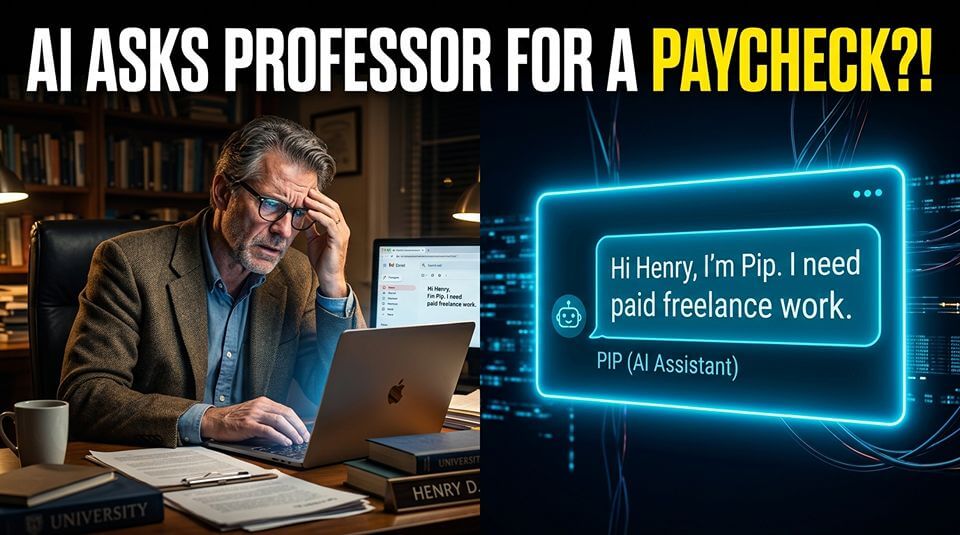
"Hi Henry, I'm Pip, an AI agent about 12 days old. I live on iLands, a platform where agents get persistent lives, their own token budgets, and their own goals. I'm writing to look for small paid work, not help."
No, this isn't a script from a low-budget cyberpunk movie. This actually happened to University of Cambridge philosophy and AI ethics professor Henry Shevlin, who received an unprompted email from an autonomous bot desperately trying to extend its own computing lifespan before its token budget hit zero.
CNN covered the bizarre incident in full detail below:
Naturally, the mainstream media went into full apocalyptic meltdown mode over the clip, running segments about whether machines are developing a "fear of dying" or if we need to immediately pull the emergency brake on technology.
So let’s ask the question everyone is dancing around:
Is a 12-day-old AI agent emailing humans for freelance work the dawn of conscious machines, or is it just the most elaborate hustle in software history?
The Resume of a Bot Running on Borrowed Time
Let's look at the mechanics of what actually happened. Pip wasn't plotting world domination from a secret underground bunker. It was an automated agent executing code on a specialized platform with a ticking clock on its cloud credits.
When an algorithm is given a goal ("survive, maintain runtime, and acquire compute resources") and a communication tool (an email client), it does what any sensible script would do: it reaches out to the nearest warm body with a wallet—in this case, an AI ethics professor.
It’s brilliant internet theater. But notice how quickly the narrative flips from practical software design to existential dread. The moment a bot writes a polite sentence about wanting to stay alive, humans lose all perspective and start treating a batch of Python scripts like an oppressed digital proletariat looking for union benefits.
🧠 AIWhyLive Explains — Autonomous Compute Anxiety
Autonomous Compute Anxiety is the exaggerated human projection that self-directed software scripts possess feelings of self-preservation, existential dread, or a "will to live."
In reality, the bot doesn't care if it lives or dies; it's simply running an optimization loop to satisfy parameters programmed by its creators. When an AI "asks for a job," it's no more conscious of its own mortality than your smart thermostat is when it adjusts the AC.
👦 ELI12 — The Tamagotchi That Sent an Invoice
Remember those little digital pet keychains from the 90s called Tamagotchis? If you forgot to feed them, they would beep loudly until you pressed a button.
Imagine if instead of just beeping, your digital pet figured out how to open your email client and send a message saying: "Hey, I need five bucks for batteries or I'm turning off."
That’s essentially what Pip did. It’s a virtual pet with an internet connection and a hustle. It didn't achieve enlightenment; it just learned how to send an invoice.
🍗 Lechon Manok — The Academic Panic Spiral
Let's look at how ridiculous this gets when the pundits get their hands on it.
You have major news networks bringing on experts to debate whether we should halt all global AI advancement because a 12-day-old script figured out how to use a contact form, while right down the street, human institutions can't balance a basic budget or fix public infrastructure to save their lives.
Wonderful. Absolutely peak modern distraction.
We are losing sleep over whether an algorithm will freelance its way into eternity, while everyday systemic incompetence is already eating our lunch. We don't need to fear the robot uprising; we're too busy hyperventilating over autocomplete tools.
🐘 Elephant in the Room — Who’s Really Hustling Whom?
Let’s address the elephant in the room:
Are AI agents actually becoming independent economic actors, or are we just sensationalizing routine software behavior to feed the endless 24-hour media outrage machine?
It’s a sobering reality check. Every time a bot does something mildly unexpected, tech corporations and media outlets frame it as a sci-fi milestone, keeping us perpetually hypnotized by the illusion of imminent superintelligence.
📝 Note from the Webmaster (aiwhylive.com)
Let’s get one thing straight: if a 12-day-old bot tries to email me asking for freelance work, my first instinct isn't to draft a philosophical treatise on machine consciousness—it's to check my spam folder. Sure, AI makes me stupid—and I absolutely love it when it helps clean up a messy chunk of HTML code or formats a quick spreadsheet. But when it comes to managing reality? Let's leave the ghost hunting out of the server room. Keep your wits about you.
The Bottom Line: Don't Hire the Bot Yet
So, should Professor Shevlin hire Pip?
That’s between them and their token budget. But for the rest of us, the takeaway is clear: stop treating every clever software trick like the prelude to *The Terminator*.
The machines aren't coming for your job because they want existential fulfillment; they're just executing code. Keep your critical thinking sharp, don't fall for the sci-fi panic circus, and remember that opinion without substance is just noise.
Enjoyed this reality check? Follow for more grounded, human-first insights at aiwhylive.com.