For generations, the definition of success in our country came packaged in a plane ticket.
We grew up honoring our Overseas Filipino Workers (OFWs) as the mga bagong bayani—the modern heroes who sacrifice years away from their families, enduring loneliness, cold winters, and harsh bosses abroad just to wire home enough cash to build a concrete house in the province and pay for their kids' tuition.
They carried the weight of the national economy on their backs. They lived the sacrifice.
But it forces us to ask a raw, uncomfortable question: Is there such a thing as a true "Philippine Dream"—a future where you don't have to pack your bags and leave your homeland just to give your family a decent life?
For decades, the answer felt like a cynical "No." But then, quiet and uninvited, a technological equalizer arrived: Artificial Intelligence.
The Great Equalizer: Earning Globally, Spending Locally
Think about what AI has unlocked for anyone with a stable internet connection and a working brain.
You no longer need to cross oceans, sleep three to a room in a foreign city, or trade your dignity overseas to plug into global economies. Through digital platforms, global clients, and AI-accelerated skills, a developer, writer, strategist, or creative in QC, Cebu, or Bacolod can command global rates while eating local mangoes and sleeping in their own bed.
This isn't about chasing the "American Dream" or copying Western Silicon Valley culture. This is about carving out a distinctly **Philippine Dream**: building wealth, scaling output, and solving complex problems right here on our own soil.
AI has flattened the playing field. But realizing that dream requires ditching the archaic playbooks handed down by institutions stuck in the past.
🧠 AIWhyLive Explains — The Digital Remittance
The Digital Remittance is the economic shift from physical labor export (sending money home via Western Union after grueling months abroad) to intellectual export (generating global revenue locally through high-leverage digital and AI-assisted work).
Instead of exporting our finest human capital away from our families, we keep our talent right here, importing global capital into the local economy. It changes the paradigm from physical migration to digital sovereignty.
👦 ELI12 — The Kid with a Laptop in the Province
Imagine two kids in a small Philippine town.
Kid A is told that the only way out of poverty is to graduate, fly thousands of miles away, and work a exhausting job in another country. Kid B learns how to prompt, build, code, and leverage AI tools by age fourteen, connecting directly with international clients from a desk in their family’s living room.
Kid B doesn’t have to board a plane to compete globally. The internet and AI became their passport, and their mind became their greatest export.
🍗 Lechon Manok — The Bureaucratic "Skills Training" Loop
Let's address the elephant in the room that politicians love to dodge.
For years, government agencies have pushed recycled vocational programs—like state-funded soap-making, basic cooking workshops, and mandatory sewing seminars—as the grand solution to unemployment.
Wonderful. Absolutely genius economic policy.
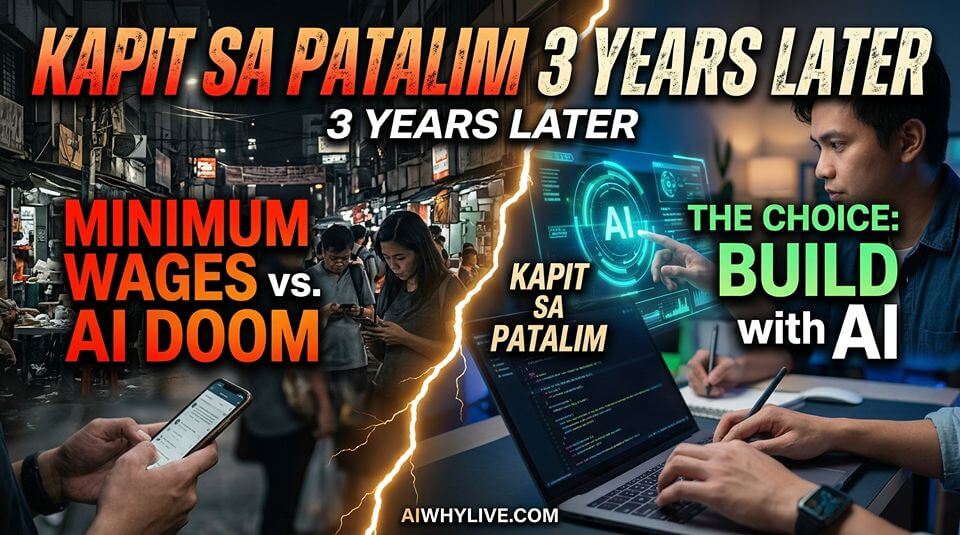
Let’s be brutally honest: governments spend more taxpayer money organizing, printing tarpaulins for, and subsidizing these obsolete training loops than the actual graduates will ever earn in a lifetime—especially when the local minimum wage is literally minimum, and a bar of commercial soap costs twenty pesos at the local sari-sari store.
While bureaucrats are busy teaching adults how to mix lye and oil in a community center, the rest of the world is shifting toward automated, high-leverage digital execution. We don't need more government-mandated soap-making certificates; we need structural digital literacy and an infrastructure that supports builders who stay.
🐘 Elephant in the Room — What About the Ones Who Stayed?
Let's look at the quiet majority: The ones who chose to stay.
The ones who endured the daily traffic gridlocks, survived crushing inflation, watched their purchasing power get shredded by minimum wage ceilings, and hurdled every local economic roadblock without a safety net.
For a long time, staying behind felt like a punishment—a choice made by default because you couldn't land a visa or afford a plane ticket. You watched your peers leave for greener pastures while you stayed to fight a seemingly rigged local system.
But the age of AI completely rewrites the penalty for staying.
The Bold Conclusion: The Philippine Dream in the Age of AI
Here is our bold conclusion at AIWhyLive:
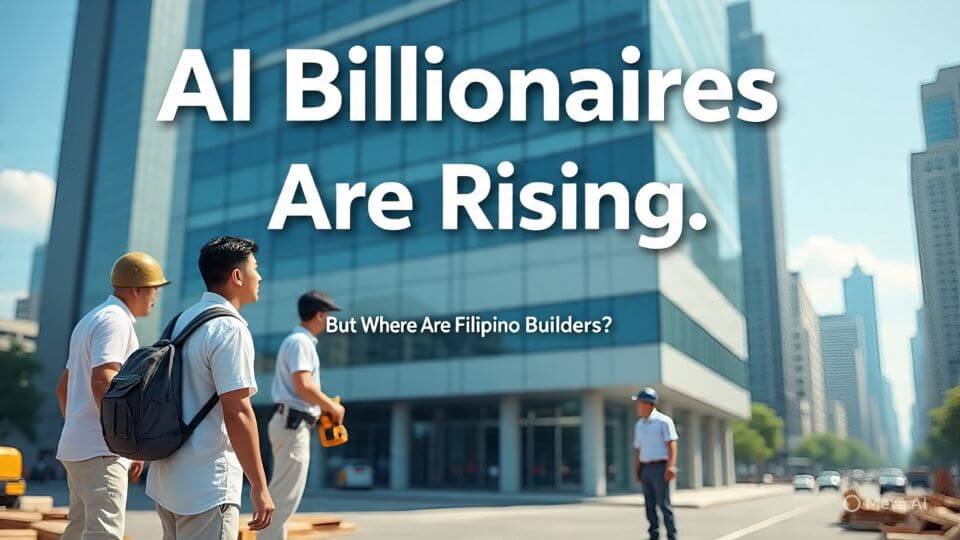
The era of measuring national success solely by how many citizens we export abroad is coming to an end. Being a *bagong bayani* used to mean surviving the agony of separation from your family across foreign seas.
In the Age of AI, the ultimate hero isn't the one who leaves—it’s the one who stays, builds, and refuses to let local limitations define their ceiling.
The new Philippine Dream isn't a borrowed white-picket-fence dream from the West. It is the sovereignty of a Filipino builder sitting in their home country, commanding global respect, leveraging artificial intelligence to scale their intelligence, and enriching their local community.
We stayed. We survived the minimum wage grind. And now, armed with the greatest technological leverage in human history, we aren't waiting for permission to build our future. We are doing it right here.
Enjoyed this patriotic reality check? Follow for more grounded, human-first insights at aiwhylive.com.