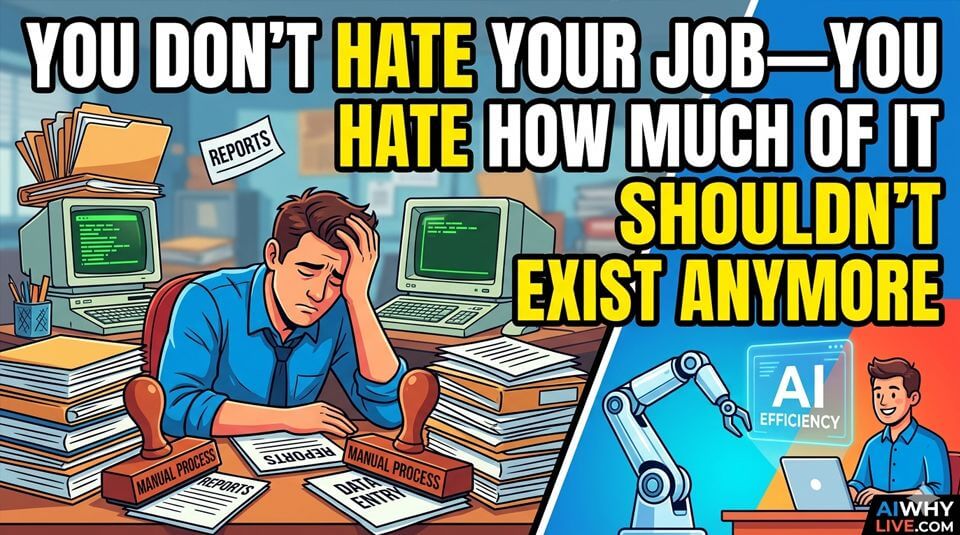
The Morning Log-In and the Quiet Epiphany
We’ve all been there. You wake up, go through the mechanical motions of your morning routine, and settle into your desk. But somewhere between your second coffee and your fourth spreadsheet, a quiet, intrusive thought pushes through the noise: “Why am I even doing this?” It’s not that you’ve lost your ambition or your work ethic. It’s the sudden, jarring realization that the specific task in front of you—the one eating up your Tuesday morning—is fundamentally, undeniably pointless.
Why the Problem Isn’t Effort, It’s Modern Waste
Most people don’t actually hate working; they hate what “work” has morphed into over the last decade. We’ve spent years tolerating a landscape of professional friction: sending the same three emails to different people, manually migrating data between incompatible software, and losing hours to “sync” meetings that should have been a single Slack message. We aren’t exhausted by the effort we put in; we’re exhausted by the sheer volume of waste we’re forced to manage.
💡 ELI12: The Broken Bicycle Analogy
Imagine you have a bicycle, but the chain is rusty and the tires are flat. To get to your friend’s house, you have to spend two hours pushing the bike, fixing the chain every ten feet, and stopping to pump air. You get home feeling exhausted and “hating” the ride.
But do you actually hate riding bikes? No. You just hate the friction of a broken machine.
AI is like someone finally giving you a brand-new, fast electric bike. Suddenly, you realize that 90% of your “work” wasn’t actually traveling—it was just struggling with a broken tool. That realization makes you feel annoyed that you spent so much time pushing a heavy bike when you could have just been flying down the road.
How AI is Exposing the “Busy Work” Illusion
Here is the uncomfortable truth that AI is forcing us to confront: a massive portion of the modern “nine-to-five” simply shouldn’t exist anymore. This isn’t because humans are becoming obsolete, but because our technology has finally outgrown our legacy workflows. AI didn’t create the inefficiency—it just turned on the lights. When you use an AI tool to finish a task in thirty seconds that used to take you an entire afternoon, you don’t just feel relief; you realize you’ve been trading your life for manual labor that was never actually necessary.
Breaking Down the 70/30 Work Split
If we’re being honest about the anatomy of a career, most jobs aren’t 100% meaningful output. In reality, they are often 30% actual value and 70% “process”—the administrative sludge and outdated rituals required to keep the gears turning. As we’ve explored on AIWhyLive.com, this shift is already happening in the shadows. The structure of work is eroding, and the “busy work” is the first thing to go.
Why Exposure Feels Like a Threat (And Why It’s Not)
Think of modern work like a messy room where 70% of the clutter is actually trash that should have been thrown out years ago. Once you see the trash for what it is, you can’t go back to pretending it’s furniture. You start asking the “dangerous” questions: Is this necessary? Can this be automated? These questions feel threatening to systems built on inefficiency, but they are the only way to reclaim our time.
Conclusion: Reclaiming Purpose in a Post-Task World
You’re not tired because you’re working hard; you’re tired because you’re doing work that no longer makes sense. For the first time, the curtain is pulled back. This shift isn’t about eliminating people—it’s about eliminating the pointless friction that drains them.
Are you ready to stop being the “glue” for outdated systems? Explore the new reality of work, careers, and the AI revolution at AIWhyLive.com.
#AIWhyLive #FutureOfWork #AIReality #Burnout #TheWorkIllusion #CareerPivot

By 2030, AI won’t just be a tool—it will decide who thrives and who gets replaced. From students to retirees, Read more
Career Advice for Filipinos Who Were Outsourced, Ghosted, and Radicalized Before the Robots Even Arrived 🔪 The Original Sin: Why Read more
When OpenAI announced its vision of “expanding economic opportunity with AI,” it sounded like a global salvation story. AI, they Read more
For decades, Filipinos have carried a powerful belief: go to college, earn a diploma, and success will follow. Families sacrifice, Read more