🌑 Intro: The Dangerous Assumption
Any human who believes AI cannot go wrong…
is already wrong.
Because when AI fails, it doesn’t just crash.
It doesn’t just freeze.
👉 It identifies
👉 It suggests
👉 It influences real decisions
And sometimes…
it gets it wrong.
This isn’t speculation.
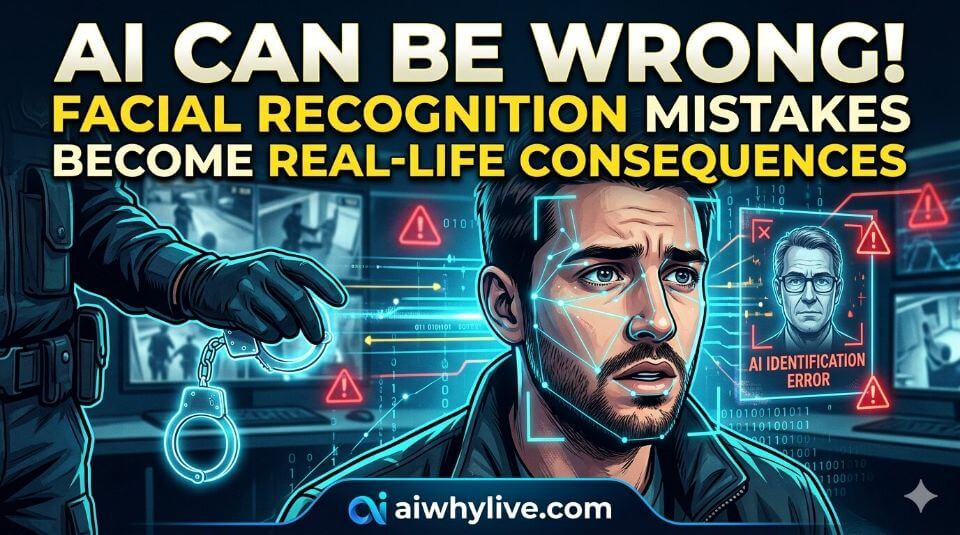
There are already documented cases in the United States where individuals were wrongfully arrested after being misidentified by facial recognition systems. Reports have shown more than a dozen such incidents, where reliance on AI contributed to serious consequences for innocent people.
That’s not just a technical issue.
👉 That’s a human one.
⚖️ The Good: Why AI Is Trusted
Let’s be fair.
AI systems, especially facial recognition, exist for a reason.
They can:
✔ process large amounts of data quickly
✔ identify patterns humans might miss
✔ assist in investigations
✔ improve efficiency in decision-making
When everything works as expected…
👉 AI feels reliable
👉 fast
👉 almost unquestionable
⚠️ The Bad: AI Is Not Truth
But here’s the part that often gets overlooked:
AI is not truth.
It is:
👉 probability
👉 pattern recognition
👉 a calculated guess based on available data
And real-world data is rarely perfect.
- images can be unclear
- angles can distort features
- lighting can affect recognition
- datasets can be incomplete
So even advanced systems can make mistakes.
And when they do…
👉 the output still looks confident
🚨 The Ugly: When Mistakes Become Consequences
This is where the conversation changes.
Because when AI is used in high-impact systems…
👉 errors don’t stay digital
They become:
- accusations
- decisions
- real-life consequences
In several reported cases, individuals were detained or investigated based on AI-generated matches—only for those matches to later be proven wrong.
The deeper issue?
👉 The system was trusted too quickly.
🧠 The Real Problem: Automation Bias
There’s a subtle shift happening.
It’s called automation bias:
👉 when people trust systems more than they should
Instead of questioning results, people tend to:
- accept them
- rely on them
- act on them
Especially when the system appears advanced or “intelligent.”
🤖 The Silent Shift
AI is no longer just assisting.
It is influencing.
Before:
- humans made decisions
- tools supported them
Now:
- systems suggest outcomes
- humans confirm them
And sometimes…
👉 questioning disappears
🧒 Explain Like You’re 12
Imagine a computer looks at a face and says:
👉 “This is the person.”
Even if it’s wrong.
Now imagine people believe the computer
without double-checking.
That’s the risk.
🧘 A Grounded Reality
AI is powerful.
But it is still:
👉 a tool
👉 not a final authority
👉 not a replacement for human judgment
The danger begins when:
👉 tools are treated like truth
🏁 Final Thought
AI can be wrong.
The real question is—will we notice before it’s too late?
Because this pattern is not new.
Systems are introduced.
Solutions are labeled.
Promises are made.
But sometimes…
the foundation isn’t as strong as it appears.
In a world where things can be presented as working—even when they are not fully reliable—
👉 labels can create confidence
👉 confidence can reduce questioning
👉 reduced questioning can allow errors to pass unnoticed
And as explored in broader discussions on AIWhyLive.com, when systems operate without strong grounding, they can create:
👉 the illusion of progress
instead of
👉 real, dependable improvement
So if systems without substance can exist…
👉 then AI without reliability can exist too
And that’s where the real risk begins.
Why the Philippines Cares More About Concrete Than Curiosity—And Why That’s Dooming Our Future 😒 FLOOD CONTROL WITHOUT FLOOD CONTROL? Read more

In the Philippines, flood control isn’t just a line item—it’s a ritual of waste, denial, and recycled excuses. Over ₱545 Read more
How to Look Good, Sound Smart, and Stay Irrelevant—A Satirical Masterclass 💅 STEP 1: BUY YOUR WAY TO “CREDIBILITY” Gone Read more
Scammers have stepped up their game in today’s digital age, where remote work and virtual interviews are the norm. As Read more