
When Did Doing Nothing Become So Uncomfortable?
You're waiting for someone.
They're ten minutes late.
You sit down.
Nothing to do.
Nobody to talk to.
No urgent work.
No emergency.
No problem to solve.
Just you.
And silence.
So naturally...
you reach for your phone.
😂
Maybe Facebook.
Maybe TikTok.
Maybe YouTube.
Maybe Messenger.
Maybe email.
Maybe you check something you already checked three minutes ago.
And now, in the Age of AI, there's another possibility:
Ask AI something.
Anything.
Because apparently one of the strangest activities available to a modern human is:
Welcome to the discomfort of silence in the Age of AI.
🧠 AIWhyLive Explains: Silence Isn't Just the Absence of Sound Anymore
When we say "silence," we usually imagine sound.
No television.
No conversation.
No music.
But modern silence can mean something much broader.
No notification.
No new message.
No new post.
No reaction.
No answer.
No content.
No stimulation.
Nothing demanding your attention.
We've built a world where almost every empty second can be filled.
The smartphone filled physical waiting.
Social media filled social waiting.
Streaming filled boredom.
Search engines filled informational uncertainty.
And now generative AI can fill something even deeper:
That may be one of the least discussed consequences of artificial intelligence.
Before AI, Sometimes You Had to Sit With the Question
You didn't know something.
So you thought about it.
Maybe for five minutes.
Maybe overnight.
Maybe for a week.
You asked somebody.
You read.
You changed your mind.
You asked another question.
You got confused.
You thought some more.
Eventually, perhaps, you understood.
Today?
"Hey AI..."
Seconds later:
Answer.
Explanation.
Examples.
Counterarguments.
Summary.
Bullet points.
ELI5.
Want it shorter?
Done.
Want the opposite argument?
Done.
This is extraordinary.
I use it.
I love it.
But there's a question worth asking:
Maybe we simply become more efficient.
But perhaps some thinking used to happen there.
🍗 Lechon Manok: The Last Human Thought
Human:
"I wonder why I'm unhappy."
Brain:
"Well, maybe we should think about—"
Human:
"CHATGPT!"
Brain:
"Wait."
AI:
"Here are 12 possible reasons."
Human:
"Excellent."
Brain:
"I had literally just started."
😂
That's the strange new relationship.
AI isn't necessarily stopping us from thinking.
But it has become incredibly easy to interrupt ourselves before our own thinking gets started.
Boredom Isn't Necessarily the Enemy
Boredom gets terrible marketing.
We treat it like a system error.
WARNING: NOTHING IS HAPPENING.
Quick!
Find a screen.
But the relationship between boredom, attention and thought is more complicated than "boredom is good" or "boredom is bad."
Boredom is generally unpleasant and can impair attention and performance.
Yet periods in which attention turns inward can also involve mind-wandering, reflection, planning and internally generated thought.
Some research has associated deliberate mind-wandering with aspects of creative problem solving, although mind-wandering can also hurt performance when sustained attention is required.
So no:
Staring at the ceiling does not automatically turn you into Einstein.
😂
But if every empty space is immediately occupied by external content, we may never discover what our own minds would have put there.
The Strange Digital Boredom Paradox
Here's where things become counterintuitive.
We often use digital media because we're bored.
But emerging research suggests some forms of digital-media behavior may actually make boredom worse.
Rapidly switching between videos, constantly looking for something more interesting, dividing attention and continually increasing the level of stimulation we expect can make slower experiences feel even less engaging.
In other words:
The way we consume stimulation may sometimes make us even more bored.
That's an uncomfortable loop.
And AI now enters that loop with something social media never had:
Personalized intellectual stimulation on demand.
AI Can Fill Intellectual Silence
Social media filled boredom with other people's thoughts.
AI can fill it with thoughts generated specifically for you.
Don't know what to post?
AI can write it.
Don't know how to reply?
AI can reply.
Don't know what your opinion should be?
AI can construct both sides.
Don't know what career to choose?
AI can compare them.
Don't know what to cook?
AI has recipes.
Don't understand something?
AI can explain it.
This is enormously useful.
But usefulness doesn't eliminate an important question:
🐘 Elephant in the Room: Maybe We Don't Always Want Answers
Sometimes what we want is relief.
There's a difference.
Uncertainty is uncomfortable.
Waiting is uncomfortable.
Not knowing what somebody thinks of us is uncomfortable.
Not knowing what happens next is uncomfortable.
AI can provide immediate cognitive relief.
Ask.
Receive.
Move on.
But an instant answer and a resolved problem aren't always the same thing.
Sometimes there isn't enough information yet.
Sometimes the other person simply hasn't replied.
Sometimes the decision isn't ready to be made.
Sometimes you don't yet know how you feel.
Sometimes life hasn't given you the answer.
AI can generate one anyway.
And that may be precisely when we should be careful.
Silence Is Where We Meet Ourselves Without an Audience
There may be another reason silence feels uncomfortable.
Nobody is watching.
No likes.
No reactions.
No validation.
No comments.
No applause.
Just you.
That can feel strange in an Internet culture where visibility can become confused with significance.
If I didn't post the vacation...
did I enjoy it?
If I didn't photograph the meal...
was it special?
If nobody knows I'm successful...
am I successful?
If I help somebody and don't upload the photo...
did the good deed count?
AIWhyLive has explored this from another direction in When Noise Thinks It's Power: The Silent Prosperity They Never Understood.
The central distinction remains useful:
Sometimes the quiet person isn't absent.
They're simply busy doing something that doesn't require applause.
The Internet Trained Us to Fear Disappearing
For years, platforms have encouraged us to:
Post consistently.
Stay visible.
Engage.
React.
Comment.
Build your personal brand.
Don't let the algorithm forget you.
There is legitimate commercial logic behind some of this.
Creators need audiences.
Businesses need visibility.
Publishers need readers.
But human beings aren't brands every minute of every day.
You don't have to publish proof that you still exist.
And you don't need an opinion on everything entering your feed.
Sometimes silence isn't absence.
It's refusal.
Silence Can Also Be a Form of Data Restraint
This connects directly with another AIWhyLive argument:
In the Age of AI, Do Not Give Your Data for Free.
Every public rant can reveal something.
Every impulsive comment.
Every argument.
Every fear.
Every obsession.
Every angry reaction.
Every attempt to prove you're right.
Together they can form a behavioral trail.
Choosing not to publish something means you didn't voluntarily add that particular thought to the public record.
You simply...
said nothing.
In an era of large-scale data collection and analysis, restraint can be practical—not merely philosophical.
But Silence Is Not Always Wisdom
This distinction matters.
Silence can be cowardice.
Silence can protect wrongdoing.
Silence can allow lies to spread.
Silence can abandon someone who needs help.
There are moments when speaking is necessary.
The argument is not:
Never speak.
The argument is:
Knowing when to speak is intelligence.
Knowing when not to speak may be another kind.
👦 ELI12: The Muddy Glass
Imagine a glass of water filled with mud.
Shake it.
The water becomes cloudy.
How do you make it clear?
You don't shake it harder.
You put it down.
Then you wait.
Slowly...
the dirt settles.
The water clears.
Sometimes our minds can feel like that.
We have a problem.
So we scroll.
Search.
Ask.
Watch.
Prompt.
Read.
React.
Then ask AI to summarize everything.
More information.
More movement.
More shaking.
Sometimes what we actually needed was:
five quiet minutes.
The Internet Has a Receipt
There is another advantage to occasionally remaining silent.
You rarely regret the stupid comment you never posted.
😂
As explored in Along Came Silence... But the Internet Has the Receipt, digital statements can remain discoverable long after the emotional moment that produced them has disappeared.
Years from now, the Internet may still remember what you wrote during a 15-minute burst of anger.
You?
You may not even remember what the argument was about.
Digital records may outlive it.
Which is why silence sometimes isn't weakness.
It's future-proofing.
AI Makes Words Cheap
Writing once contained substantial friction.
A long letter took time.
An essay required thought.
A public statement required somebody to construct it.
Generative AI dramatically lowers that friction.
We can produce:
10 posts.
50 captions.
100 variations.
Thousands of words.
Very quickly.
The cost of producing language is collapsing.
Which creates an interesting possibility:
The scarce resource may no longer be content.
It may be:
judgment.
Knowing which words actually deserve to exist.
What Happens When AI Never Lets Us Be Alone With Our Brain?
This may be the deeper question.
AI can become:
Teacher.
Adviser.
Editor.
Programmer.
Research assistant.
Debate partner.
Idea generator.
Companion.
Sometimes even the voice we consult before our own.
That can be extraordinarily useful.
But there is a difference between:
AI helping me think
and:
AI thinking before I give myself the chance.
That boundary may become one of the important personal skills of the AI era.
🍗 Lechon Manok: The Five-Minute Challenge
Try something terrifying tomorrow.
Wait somewhere for five minutes.
Don't open Facebook.
Don't open TikTok.
Don't check email.
Don't read the news.
Don't ask AI anything.
Don't even pretend you're checking the weather.
Just sit there.
Human:
"What do I do?"
AI:
"Nothing."
Human:
"FOR FIVE MINUTES?"
AI:
"Yes."
Human:
"Is this medically safe?"
😂
That's how strange silence can feel.
Silence Is Not Necessarily Empty
Maybe that's the mistake.
We assume silence contains nothing.
But silence can contain:
- observation,
- reflection,
- memory,
- restraint,
- imagination,
- recovery,
- attention,
- listening,
- uncertainty,
- and sometimes an idea that hasn't arrived yet.
AI can generate an answer in seconds.
But not every answer needs to arrive in seconds.
The Three Silences of the AI Age
| Type | What It Means |
|---|---|
| Digital Silence | Not every notification deserves attention. Not every trend deserves participation. Not every outrage deserves your data. |
| Social Silence | Not every accusation requires a defense. Not every stranger deserves an argument. Not every success requires an announcement. |
| Intellectual Silence | Not every question requires an immediate AI answer. Sometimes think first, ask AI second, then compare your thinking with the machine's. |
That third one may be particularly important.
Think first.
Then ask AI.
Then compare:
What did I see?
What did AI see?
What did both of us miss?
That isn't rejecting AI.
It's using AI as a thinking partner instead of a thinking replacement.
🐘 The Bigger Elephant: AI May Make Silence a Luxury
Imagine the future.
AI assistants everywhere.
Always available.
Always suggesting.
Always completing.
Always recommending.
Always predicting what you might want next.
The moment you stop...
the machine asks:
"Would you like me to help?"
Convenient?
Absolutely.
But perhaps one of the premium human experiences of the future will occasionally be:
No algorithm.
No notification.
No recommendation.
No optimization.
No generated answer.
Just an uninterrupted human thought.
Funny.
We spent centuries inventing machines to save time.
Then filled every saved second with something else.
A Simple AI-Silence Experiment
I'm not proposing a digital monastery.
Try something much simpler.
Step 1: When an interesting non-urgent question appears, don't immediately ask AI.
Step 2: Give yourself five minutes to think about it.
Step 3: Write down your own answer or questions.
Step 4: Ask AI.
Step 5: Compare the two.
Did AI notice something you missed?
Probably.
Did you notice something AI missed?
Possibly.
Did your original thinking help you ask AI a better question?
That's the experiment.
The goal isn't:
Human versus AI.
It's:
Human first. AI next. Better thinking together.
Frequently Asked Questions About Silence in the Age of AI
Why does silence feel uncomfortable?
Silence can remove the stimulation and distraction we are accustomed to, leaving us with boredom, uncertainty or our own thoughts. Modern digital technology makes escaping those states unusually easy, so low-stimulation moments can feel unfamiliar or uncomfortable.
Is AI making people less comfortable with silence?
It would be too simplistic to blame AI alone. Smartphones, social media, streaming services and constant connectivity were already filling empty moments long before generative AI became widespread. AI adds something new: it can instantly fill intellectual uncertainty with personalized explanations, suggestions and conversation.
Is boredom good for the brain?
Boredom is not automatically beneficial. It can reduce attention and performance. However, low-demand periods can also allow mind-wandering and internally generated thought, and some research has linked deliberate mind-wandering with aspects of creativity. The lesson is not to seek boredom constantly, but to recognize that every moment of boredom does not necessarily require immediate digital stimulation.
Can constant digital stimulation make boredom worse?
Research suggests it can in some circumstances. Studies have found that rapidly switching between digital content can paradoxically increase boredom, while researchers have proposed that fragmented attention and rising expectations for stimulation may make less intense activities feel more boring.
Should we stop asking AI questions?
No. AI can be extremely useful for learning, analysis and creativity. The more useful question is whether we sometimes ask AI before giving ourselves a chance to think. For non-urgent questions, thinking first and consulting AI afterward can turn AI into a partner rather than an automatic substitute for reflection.
Can silence improve creativity?
Silence itself does not guarantee creativity. Research on mind-wandering is nuanced: it can interfere with tasks requiring sustained attention, while deliberate mind-wandering has also been associated with creative problem solving in some studies. Context matters.
Can silence protect digital privacy?
Choosing not to publicly share an unnecessary opinion, emotional reaction or personal detail means that particular information is not voluntarily added to your public digital footprint. Silence is not a complete privacy strategy, but selective disclosure can reduce the amount of personal information you intentionally expose.
Is silence always a good thing?
No. Silence can be harmful when speaking is necessary to report wrongdoing, ask for help, protect another person, correct dangerous misinformation or defend legitimate rights. The goal is thoughtful silence, not permanent silence.
🎤 Drop Mic: AI Can Fill Every Silence. Maybe It Shouldn't.
Artificial intelligence is giving humanity something extraordinary.
Answers on demand.
Ideas on demand.
Words on demand.
Advice on demand.
Conversation on demand.
Almost no intellectual silence needs to remain silent anymore.
And that's exactly why we should occasionally protect it.
Because perhaps silence wasn't the bug.
Perhaps sometimes...
The moment before the idea.
The pause before the reply.
The restraint before the stupid post.
The uncertainty before understanding.
The boredom before imagination.
The breath before deciding what actually deserves our attention.
AI doesn't have to destroy that space.
It can make what comes after it better.
So use AI.
Ask questions.
Explore.
Create.
Learn.
Build.
But occasionally, when your hand automatically reaches for the phone...
or your fingers start typing:
"Hey AI..."
try something radical.
Wait.
Let the question sit there.
Let your brain answer first.
You can always ask AI afterward.
Because in an age where machines can generate almost unlimited words...
AIWhyLive — Think beyond the prompt.
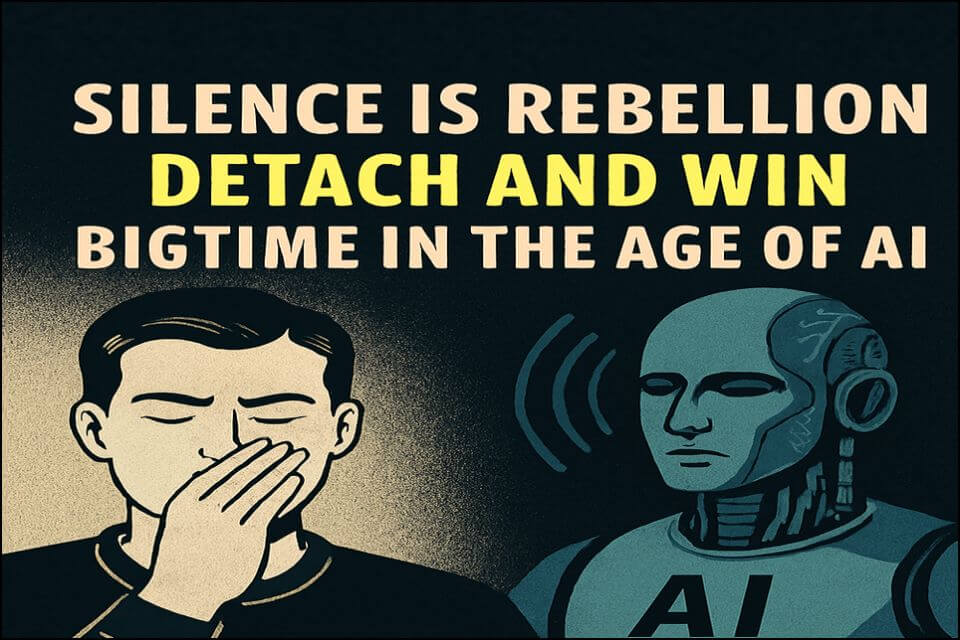
🧠 Abstract: Winning by Letting Go In 2026, the algorithm rewards three things: noise, outrage, and endless performance. We are Read more

There was a time when certain public figures couldn’t resist showing off online. Their feeds were filled with snapshots of Read more

Long before algorithms needed massive datasets to train their neural networks, humans had an even cheaper habit: handing over their Read more

Personality Transplant, Anyone? Who Are You When AI Writes You Better Than You? Need to sound smarter? AI. More confident? Read more