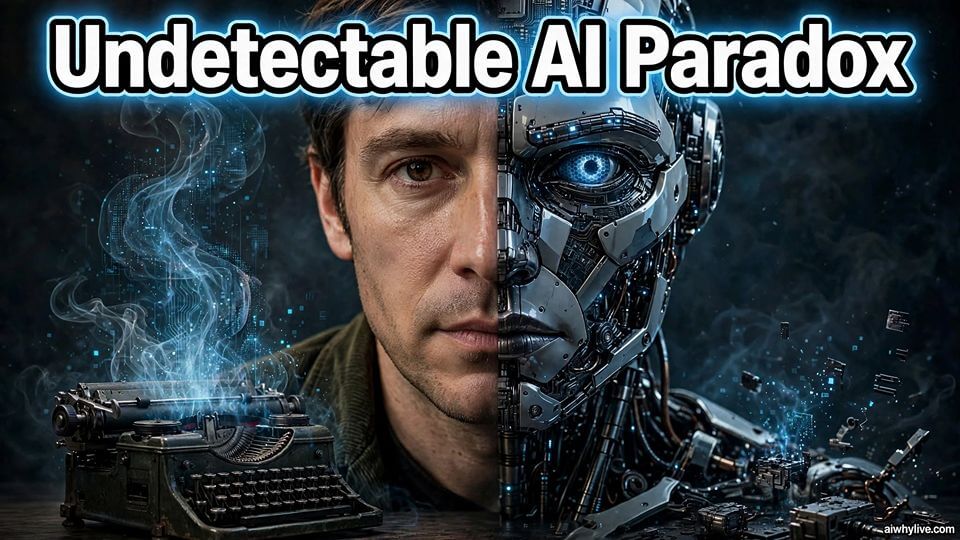
AI humanizers can make AI writing harder to detect. So what?
Artificial intelligence writes the article.
Another artificial intelligence rewrites it to sound human.
Another artificial intelligence examines it to determine whether artificial intelligence wrote it.
The detector announces:
HUMAN.
Everybody celebrates.
Except perhaps the human.
Because somewhere between generating, humanizing, detecting and submitting the work, we forgot to ask a remarkably simple question:
What exactly did the human do?
Welcome to the strange world of undetectable AI.
AI can now generate text.
AI humanizers can rewrite AI-generated text to make it appear more human.
AI detectors can examine that rewritten text and attempt to decide whether it came from a human or a machine.
And another generation of AI humanizers can try to defeat those detectors again.
This may be technologically impressive.
It is also slightly ridiculous.
AI WRITES IT
↓
AI HUMANIZES IT
↓
AI DETECTS IT
↓
AI SAYS "HUMAN"
↓
HUMAN PRESSES SUBMIT
Progress?
Perhaps.
But maybe we're measuring the wrong thing.
It is not a tutorial for deceiving teachers, employers, clients, publishers or AI-detection systems.
And when we mention performance or bypass claims made by a company, they should be understood as the company's claims unless independently verified.
What Is Undetectable AI?
Undetectable AI generally refers to AI-generated text that has been written or rewritten so that AI-detection tools are less likely to classify it as AI-generated.
Tools designed to do this are often called:
- AI humanizers,
- AI bypassers,
- AI detection removers,
- undetectable AI writers,
- or stealth writers.
The basic proposition sounds simple.
AI-generated writing can have patterns.
AI detectors try to recognize those patterns.
AI humanizers rewrite the text to make those patterns appear more human.
Then the detector examines it again.
And so begins the great technological arms race nobody knew humanity needed.
Meet StealthGPT
StealthGPT is one example of this growing category.
Its website markets an AI Humanizer designed to transform AI-generated text into writing that appears human to AI detectors.
As of 2026, the company advertises a 99% bypass rate, support for numerous AI detectors and more than 1.5 million users and 9.4 million processed documents.
Those are StealthGPT's own marketing claims, not independent findings by AIWhyLive.
Its advertised workflow is remarkably straightforward:
Generate AI content.
Paste it into the humanizer.
Humanize it.
Run the output through an AI detector.
Then submit or publish it.
Which brings us to the obvious question.
If AI wrote it and AI rewrote it so another AI wouldn't recognize it...
what exactly became human?
🧠 AIWhyLive Explains: Undetectable Does Not Mean Human
This distinction is the heart of the entire debate.
Suppose an AI generates an essay.
An AI humanizer rewrites it.
An AI detector analyzes the result.
The detector says:
98% HUMAN.
What has actually been proven?
Not necessarily that a human wrote it.
It may simply mean that a particular detection system classified the statistical patterns of that particular text as more human-like.
Those are completely different things.
Passing an AI detector does not magically transform AI-generated work into human-generated work.
If you wear a disguise and a security camera fails to recognize you, you haven't transformed into somebody else.
You changed what the detector could see.
That is why the phrase "AI humanizer" deserves examination.
The writing may become more human-like.
The detector may become less confident.
The sentences may sound more natural.
But none of those things automatically answer the deeper question of authorship.
Just Because It Is AI...
Now we need to make the argument uncomfortable from the other direction.
Just because it is AI doesn't mean it is wrong.
AI-generated writing can contain accurate information.
AI can explain difficult concepts clearly.
AI can improve grammar.
AI can help organize ideas.
AI can translate.
AI can summarize.
AI can help someone communicate an idea they genuinely understand but struggle to express.
AI can also be wrong.
Very wrong.
Confidently wrong.
Beautifully formatted wrong.
But the mere presence of AI does not automatically make an idea false, worthless or dishonest.
The source of a sentence and the truth of a sentence are not the same question.
If AI says:
"Water freezes at approximately 0°C under standard atmospheric pressure,"
the fact does not suddenly become false because a machine generated the sentence.
Likewise, a brilliant human can write something completely wrong.
Human authorship has never been a guarantee of truth.
Just Because It Is Human—or Humanized...
And this is where the humanizer paradox becomes even more interesting.
Just because it is human—or humanized—doesn't mean it is right.
Human beings invented misinformation long before ChatGPT arrived.
Humans lie.
Humans misunderstand.
Humans exaggerate.
Humans plagiarize.
Humans confidently repeat things they never verified.
Humans write terrible essays.
Humans occasionally write magnificent nonsense.
So if an AI humanizer makes a false AI-generated statement sound wonderfully natural...
what exactly have we improved?
The truth?
No.
The evidence?
No.
The reasoning?
Not necessarily.
We may simply have improved the disguise.
Human-sounding is not the same as human.
Human is not the same as correct.
Undetectable is not the same as trustworthy.
That may be the most important distinction in the entire AI-detection debate.
Maybe We're Testing the Wrong Thing
Consider what an AI detector is being asked to decide:
Does this text look like AI wrote it?
But perhaps education, publishing and professional work should be asking harder questions:
Is it true?
Is it original?
Is it useful?
Was it properly sourced?
Does the person submitting it understand it?
Can that person defend the argument?
Did AI assist the thinking—or replace it?
Was AI use permitted and disclosed where disclosure was required?
Those questions are much harder than producing a percentage.
Unfortunately, they are also much closer to what actually matters.
The AI Humanizer Paradox
The entire ecosystem contains a wonderfully circular logic.
AI becomes good at writing.
↓
Humans become worried about AI writing.
↓
AI is built to detect AI writing.
↓
AI is built to hide AI writing from AI.
↓
AI checks whether AI successfully hid the AI.
↓
Human receives the result.
And somewhere in Silicon Valley...
someone probably calls this productivity.
🍗 Lechon Manok: The AI Laundry Machine
Human:
"AI, write my essay."
AI:
"Done."
Human:
"Another AI says you wrote it."
AI:
"Correct."
Human:
"Make it look like you didn't."
AI Humanizer:
"Done."
Human:
"Now ask AI if AI can detect the AI that hid the AI written by AI."
AI Detector:
"98% HUMAN."
Human:
"Excellent. I wrote it."
Teacher:
"Great. Explain paragraph three."
Human:
"..."
Human:
"Can I ask AI?"
😂
Maybe we didn't humanize the writing.
Maybe we humanized the alibi.
Humanizing AI Is Not Automatically Bad
This distinction matters too.
There is nothing inherently wrong with wanting AI-generated writing to sound better.
Raw AI output can be repetitive.
Generic.
Overly polished.
Full of predictable transitions.
Sometimes painfully enthusiastic.
Editing that output for clarity, personality, rhythm and readability can be perfectly legitimate.
AIWhyLive itself uses AI as a tool.
The important question is the objective.
"Help me communicate this idea more clearly."
is fundamentally different from:
"Help me conceal the fact that AI produced work I am required to produce myself."
One objective improves communication.
The other can be about concealing provenance.
The technology may be similar.
The intention isn't.
🐘 The Elephant in the Room: Why Do You Need AI to Hide the AI?
This is the question an entire industry of AI detection and humanization makes difficult to avoid.
If AI use is permitted, why hide it?
If AI use isn't permitted, why use a second AI to conceal the first?
If the AI merely helped improve your own ideas, perhaps the real conversation should be about reasonable disclosure rather than technological camouflage.
And if AI generated the thinking, the evidence, the argument and the words...
while the human's main intellectual contribution was clicking:
HUMANIZE
then perhaps the detector isn't the biggest problem.
If you need AI to hide the fact that you used AI, maybe AI isn't the most interesting ethical problem anymore.
What Does "Humanized" Actually Mean?
The word itself is fascinating.
Humanized.
It sounds as if artificial intelligence enters a machine and emerges with a soul.
That isn't what happens.
AI humanizers generally attempt to alter characteristics of writing that detection systems associate with machine-generated text.
StealthGPT, for example, says its system changes statistical characteristics involving sentence rhythm, vocabulary distribution, predictability and structural patterns.
The company's own explanation discusses concepts such as perplexity and burstiness.
The objective is to make the resulting text statistically resemble human writing more closely.
That's technically interesting.
But:
Changing the statistical fingerprints of writing does not automatically change the intellectual origin of the idea.
Can AI Detectors Be Wrong?
Yes.
And this prevents the debate from becoming conveniently simple.
An AI detector is not a magical authorship machine.
It makes an inference based on characteristics of text.
Human writing can be classified incorrectly.
AI-generated writing can escape detection.
Heavily edited AI writing makes the distinction even harder.
And humanizers are deliberately designed to make classification more difficult.
So:
"The detector says AI"
should not automatically become:
"Case closed. Guilty."
And:
"The detector says human"
should not automatically become:
"Case closed. A human wrote everything."
Both conclusions can ask more of the detector than it can reliably prove.
Where Does Human Writing End and AI Writing Begin?
This question will become increasingly difficult.
Suppose you write an article and AI fixes three grammatical errors.
Human?
Probably.
Suppose AI reorganizes your paragraphs.
Still human?
Suppose you provide every idea and AI turns your notes into polished sentences.
What now?
Suppose AI writes the first draft and you rewrite half.
Suppose AI writes 90% and you change the introduction.
Suppose AI writes everything and you replace twelve words.
At what exact percentage does the machine become the author?
47%?
51%?
83.6%?
Good luck.
The more deeply AI enters ordinary writing tools, the less useful a simple binary may become.
The future may not be Human vs AI.
It may be Human + AI—and the difficult question will be how much of each.
👦 ELI12: The Homework Test
A student asks a robot to do the homework.
Another robot examines it and says:
"A robot wrote this."
So the student gives the homework to another robot.
"Make it look like a human wrote it."
The robot rewrites it.
Another robot examines the new version.
"Human!"
The student celebrates.
Then the teacher asks:
"What did you learn?"
That's when the detector finally works.
😂
The Real Problem for Education
Education has a difficult problem.
If the assignment exists mainly to produce 1,500 words, AI can increasingly produce those words.
A humanizer may make those words harder to classify.
A detector may try to classify them anyway.
Schools can spend enormous energy building better detectors.
Students can respond with better humanizers.
And both sides can continue indefinitely.
Or education can ask a more painful question:
Was producing the document ever the real purpose of the assignment?
If the purpose was learning, perhaps assessment increasingly needs to measure understanding.
Ask the student to explain.
Defend the argument.
Apply the concept.
Challenge the conclusion.
Show the process.
Connect the work to something unexpected.
AI can still help.
But now the human has to understand what the AI helped produce.
The Real Problem for Writers and Publishers
The same issue exists outside school.
Suppose an article is technically undetectable.
Wonderful.
Is it accurate?
Does it say anything new?
Does it contain experience?
Does it contain judgment?
Does it have a point?
Did anybody verify the sources?
Would anybody care if they read it?
Those questions matter much more than whether a detector returns:
7% AI.
Because the internet does not have a shortage of words.
AI solved that problem spectacularly.
The internet has a shortage of things worth reading.
Undetectable Garbage Is Still Garbage
This may be the simplest way to understand the problem.
If AI produces a bad article...
and another AI makes it undetectable...
you now possess:
undetectable garbage.
Congratulations.
Likewise, if a human writes something dishonest, inaccurate or meaningless...
the fact that it is 100% organically free-range human does not make it valuable.
Which brings us back to our two rules:
JUST BECAUSE IT IS AI...
doesn't mean it is wrong.
And:
JUST BECAUSE IT IS HUMAN OR HUMANIZED...
doesn't mean it is right.
Maybe those two sentences should sit above every AI detector.
🧠 AIWhyLive Explains: Provenance, Quality and Truth Are Different Questions
We keep collapsing three separate questions into one.
Question 1: Who or what produced this?
That's provenance.
Question 2: Is it well written or useful?
That's quality.
Question 3: Is it factually correct?
That's truth.
Something can be:
AI-generated and true.
AI-generated and false.
Human-written and true.
Human-written and false.
Humanized and brilliant.
Humanized and garbage.
Perfectly human and completely plagiarized.
Entirely AI-assisted and genuinely original in its underlying human idea.
Those categories overlap.
"Was AI involved?" is an important question in some situations.
It is not the answer to every other question.
Maybe AI Detection Becomes Less Important
There is another possibility.
AI may become so deeply integrated into ordinary software that asking whether AI "touched" a document eventually becomes almost meaningless.
Spellcheck touches our writing.
Grammar tools touch our writing.
Search engines influence our research.
Autocomplete predicts our words.
Translation software transforms language.
AI increasingly sits inside browsers, operating systems, office software and communication tools.
Eventually, the more useful question may not be:
"Did AI touch this?"
but:
"What did the human contribute?"
Ideas?
Experience?
Judgment?
Verification?
Responsibility?
Original research?
Creative direction?
Understanding?
Maybe those become the scarce resources.
Frequently Asked Questions About Undetectable AI
What is undetectable AI?
Undetectable AI generally refers to AI-generated or AI-rewritten text that AI-detection tools are less likely to classify as machine-generated.
What is an AI humanizer?
An AI humanizer rewrites AI-generated text to make it read or statistically appear more like human writing. Different products use different techniques, and their performance against detectors can vary.
What is StealthGPT?
StealthGPT is an AI writing and humanization platform that markets tools for generating and rewriting AI content so that it appears human to AI-detection systems. Its website currently advertises a 99% bypass rate; that figure is a company claim.
Does humanized AI become human-written?
Not automatically. Rewriting AI-generated text so that it resembles human writing or passes an AI detector does not by itself establish that a human originated the words, reasoning or ideas.
Does passing an AI detector prove a human wrote the text?
No. A detector classification is not the same thing as definitive proof of authorship. AI-generated or humanized text can escape detection, while human-written material can sometimes be misclassified.
Does an AI detector prove that AI wrote something?
An AI detector can provide a classification or probability based on patterns it associates with machine-generated writing, but that should not automatically be treated as conclusive proof of authorship.
Is AI-generated content automatically bad?
No. AI-generated material can be useful, accurate and well written. It can also contain errors, fabricated information or weak reasoning. The fact that AI generated something does not determine whether the content is true or valuable.
Is human-written content automatically better?
No. Humans can produce excellent, inaccurate, original, plagiarized, insightful or meaningless content. Human authorship alone is not proof of quality or truth.
Is using an AI humanizer cheating?
That depends on the context, rules and intention. Editing AI-assisted writing for clarity is different from deliberately disguising prohibited AI-generated work to misrepresent authorship. Schools, employers, publishers and clients may have different AI-use policies.
Why do people use AI humanizers?
Reasons can include making AI writing sound less robotic, improving style and readability, reducing false AI-detection concerns or attempting to bypass AI detectors. Those purposes have very different ethical implications.
Will AI humanizers make AI detectors useless?
AI detection and AI humanization are evolving technologies. Humanizers can make classification harder, while detectors continue to change. This arms race may eventually make process, understanding, disclosure and verification more useful than relying on a single detector score.
🐘 The Final Elephant: Who Are We Actually Fooling?
Suppose you successfully fool the detector.
Congratulations.
It says human.
The teacher believes you.
The client believes you.
The employer believes you.
The publisher believes you.
Maybe everybody believes you.
But suppose AI generated the ideas.
AI wrote the text.
AI rewrote the text.
AI checked the text.
And your contribution was pressing:
Submit.
Who exactly won?
The human?
The AI?
The humanizer?
The detector?
Or did we simply become extremely sophisticated at measuring the wrong thing?
🎤 Drop Mic: Undetectable AI Is Still AI
Maybe the future isn't about making AI undetectable.
Maybe AI will eventually become so ordinary that detecting its presence stops being the most important question.
We don't interrogate every email to determine whether spellcheck touched it.
We don't investigate every spreadsheet to discover whether a calculator helped.
Perhaps one day we won't care whether AI touched a paragraph.
We will ask something harder.
Did you understand it?
Did you verify it?
Did you contribute something?
Is it true?
Is it useful?
Can you defend it without asking AI what it means?
Because:
Just because it is AI doesn't mean it is wrong.
Just because it is human—or humanized—doesn't mean it is right.
AI can be brilliant.
AI can be stupid.
Humans can be brilliant.
Humans can be stupid.
And apparently we have now invented AI whose job is to make the first one look like the second one so another AI won't recognize the first one.
Welcome to 2026.
You can fool an AI detector.
You may fool a teacher.
You may fool a client.
You may even fool yourself.
But if AI did the thinking and you merely disguised the evidence...
Who exactly did you fool?
The detector—or yourself?
Maybe the future of AI shouldn't be about proving that our words look human.
Maybe it should be about proving that the human behind them still has something worth saying.

Before we dive in: no, Sidekicker.ai isn’t a secret MMA move or the trusty sidekick you summon when your hero Read more

The rise of Artificial Intelligence (AI) is reshaping the internet in ways we never imagined. From content creation to how Read more

🛫 Create Your Own Runway, Not Clout, in the Age of AI — Because Likes Don't Pay the Bills Read more
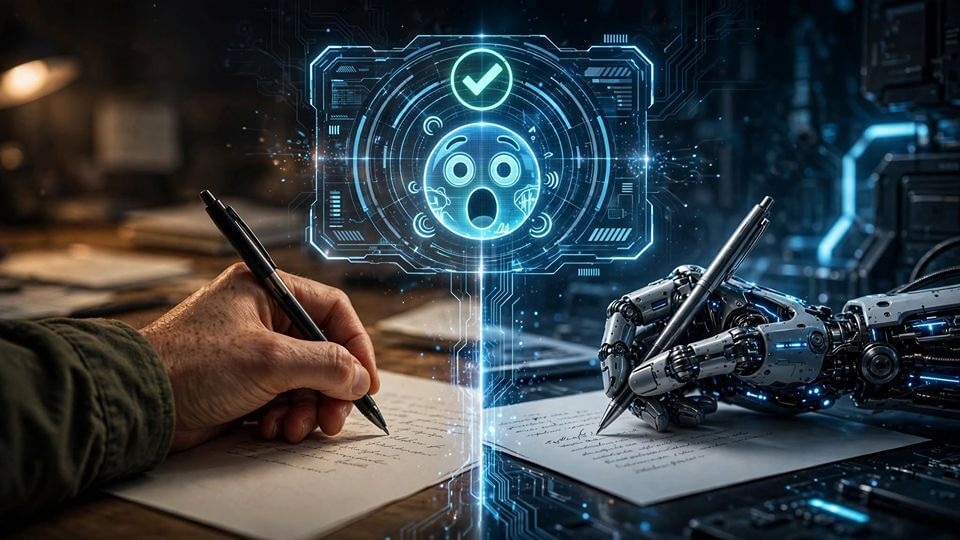
If AI can write like a human—and humans can write with AI—who decides what counts as AI-written?Here is a Read more