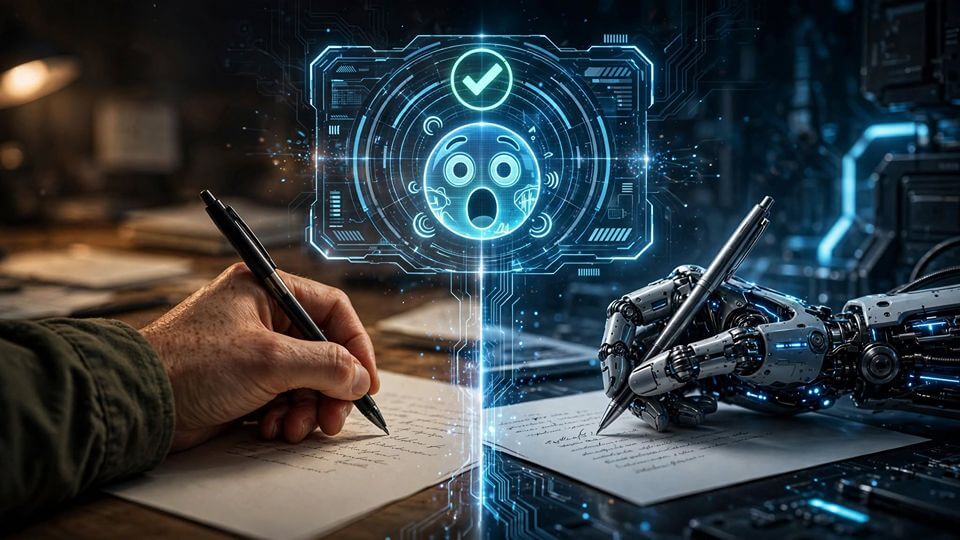
If AI can write like a human—and humans can write with AI—who decides what counts as AI-written?
Here is a strange question for the age of artificial intelligence:
Can AI write an article that an AI detector thinks was written by a human?
And there is an even stranger question:
If a human writes an article with AI, is that article still human-written?
Welcome to one of the weirdest arguments in modern content creation.
We now have AI systems that can write essays, blog posts, advertisements, reports, emails and social media posts.
Then we have another class of AI systems trying to determine whether those words were written by AI.
So we have something almost comical happening:
AI writes.
AI checks.
Humans argue about the result.
🧠 AIWhyLive Explains: How Does AI Actually Write?
Large language models do not write exactly the way humans do.
At a simplified level, an AI language model generates text by predicting what token or piece of language should come next based on patterns learned during training and the context provided in the conversation.
Think of the process like this:
Prompt → probability → token → probability → token → sentence → paragraph
It happens incredibly quickly.
This is why AI can produce a polished paragraph almost instantly.
It isn't necessarily sitting there experiencing the subject the way a human writer does.
It is generating language based on learned patterns and the instructions it receives.
And those patterns are exactly what AI detectors try to analyze.
How Does an AI Detector Work?
An AI detector does not look inside ChatGPT and discover a secret label saying:
“Yes. I wrote this.”
Instead, detection systems analyze characteristics of the text.
Depending on the detector, those characteristics can include things such as:
- word predictability
- sentence structure
- vocabulary patterns
- variation between sentences
- linguistic patterns
- statistical characteristics associated with generated text
One concept often discussed in AI-text detection is perplexity.
Very simply, perplexity relates to how predictable or surprising the next word is within a sequence.
Another concept is burstiness, which can describe variation in sentence structure and complexity.
Humans can be inconsistent.
We write one very short sentence.
Then another sentence becomes ridiculously long because we suddenly remembered three other things we wanted to say.
Then we use a fragment.
Then we change our mind.
Then we say something that sounds completely unlike the previous paragraph.
Humans are messy.
AI can be remarkably consistent.
That difference can become one signal used by detection systems.
But Here Is the Problem With AI Detection
A detector is also making a prediction.
It is not watching the writer's hands.
It is not watching the writer's brain.
It does not know whether the author was sitting in Manila, Cebu, Bacolod or somewhere else at 2:00 in the morning drinking coffee.
It sees the text.
Then it estimates what kind of writing the text resembles.
That distinction matters.
Turnitin currently states that its AI writing detection may misidentify human-written, AI-generated and AI-paraphrased writing. It also says its AI report should not be used as the sole basis for adverse action against a student.
Even OpenAI's own experimental AI text classifier was discontinued in 2023 because of its low accuracy. OpenAI reported that its classifier correctly identified only a portion of AI-written text in its evaluation and sometimes incorrectly labeled human writing as AI-generated.
That does not mean AI detectors are useless.
It means their results need to be interpreted carefully.
🍗 Lechon Manok: Congratulations, Your Article Passed!
Imagine this:
AI Detector: 0% AI detected.
Congratulations!
Your article is officially...
boring.
Nobody read it.
Nobody shared it.
Nobody learned anything.
But hey...
0% AI!
That is the trap.
We can become so obsessed with whether an article looks human to a machine that we forget to ask whether the article is actually useful to humans.
Can AI Write Content That Passes an AI Detector?
Sometimes, a piece of AI-generated or AI-assisted writing may not be identified as AI by a particular detector.
But there is no universal “AI detector pass.”
Different detection systems use different models and thresholds.
AI writing systems also change.
Detection systems change.
Editing changes the text.
Length changes the evidence available to the detector.
Even the same document can potentially produce different results under different systems or model versions.
Turnitin's current documentation illustrates this moving target: its AI detection models have been updated repeatedly, including updates in 2026 intended to improve detection of newer AI-generated content.
So the honest answer is:
There is no permanent recipe for “passing” every AI detector.
🐘 Elephant in the Room: Does Humanizing AI Content Make It Human?
This is where things get much more interesting.
Imagine three writers.
Writer A: Pure AI
The writer gives AI a topic.
AI produces the article.
The writer publishes it almost unchanged.
Writer B: Humanized AI
The writer asks AI for a draft.
Then the writer rewrites it.
They add personal stories, local examples, opinions, humor, corrections and original observations.
Writer C: Human + AI Collaboration
The human develops the idea.
The human decides the argument.
The human supplies the experiences and examples.
AI helps with brainstorming, organization, alternative explanations, editing or research questions.
The human challenges the AI.
The human fact-checks it.
The human decides what survives.
These are three very different creative processes.
And yet all three may contain words generated by an AI system.
🧠 The Real Question: Who Did the Thinking?
Perhaps the future of authorship will not be determined simply by asking:
“Who typed the words?”
Instead, we may need to ask:
“Who supplied the thinking?”
Who created the original idea?
Who decided what mattered?
Who rejected the bad suggestions?
Who added the real-world experience?
Who checked the facts?
Who accepted responsibility for the final article?
Those questions can tell us far more about authorship than a single detector percentage.
👦 ELI12: Think About a Calculator
Imagine you ask a calculator:
438 × 72 = ?
The calculator gives you the answer.
Did the calculator become a mathematician?
No.
But there is a difference between using a calculator to help solve a problem and submitting an answer without understanding anything.
AI writing can work the same way.
Using AI is not automatically the same thing as outsourcing your thinking.
The important question is what the human actually contributed.
So How Do You Create Writing That Sounds Like You?
Forget the obsession with finding a magic trick that fools a detector.
A better goal is to create writing that genuinely contains your contribution.
- Start with your own idea.
- Give AI your actual experiences and examples.
- Challenge the AI's assumptions.
- Rewrite sections in your natural voice.
- Add details that reflect your real knowledge.
- Remove generic filler.
- Fact-check important claims.
- Add original analysis instead of simply repeating the AI's answer.
- Keep drafts and source material when authorship matters.
- Follow the disclosure or AI-use rules that apply to your school, employer, client or publication.
The objective is not:
“How do I fool the detector?”
The better question is:
“How do I make this genuinely mine?”
What Happens When Humans and AI Co-Author?
This may become one of the most difficult problems for AI detection.
A 2025 research study specifically examined detection under human-AI coauthoring and found that fine-grained detection of mixed human and AI contributions remains far from solved.
That makes sense.
Consider a paragraph where:
AI writes 60%.
The human rewrites 30%.
The human adds a personal story worth 10%.
What is that?
AI-written?
Human-written?
Co-written?
Edited AI?
Humanized AI?
There may not be a simple binary answer.
Let's Actually Test It
Instead of arguing endlessly about AI detectors, AIWhyLive can do something more useful:
Run an experiment.
Take the same topic and create four versions:
- Pure AI: generate the article and publish the draft.
- AI + editing: substantially rewrite the generated article.
- Human + AI collaboration: human supplies the ideas and judgment while AI assists.
- Human-written: write the article without AI assistance.
Then test all four with multiple AI detectors.
Record the results.
Compare them.
And most importantly:
Do not assume which version will “win.”
Let the experiment tell us.
What Would a “Pass” Actually Prove?
Suppose our article receives:
0% AI detected.
What does that prove?
It does not necessarily prove that no AI was used.
It means that the particular detection system did not identify qualifying text as likely AI-generated under its current model and rules.
Turnitin itself describes its result as the percentage of qualifying text that its model identifies as likely AI-generated; it also explicitly warns that the system is not always accurate.
So:
Detector score ≠ authorship certificate.
🎤 Drop Mic: Maybe We Are Asking the Wrong Question
For years, we have asked:
“Was this written by AI?”
Maybe we eventually need to ask better questions.
Was the information accurate?
Was the idea original?
Was the writer responsible for the final result?
Was AI used honestly where disclosure was required?
Did the human contribute meaningful thought?
Did the article actually help somebody?
Because AI can produce 2,000 words in seconds.
It can make mediocre writing sound polished.
It can make an inexperienced writer sound experienced.
It can also produce writing that some detectors identify as AI—and writing that some detectors may not.
But none of those things answer the most important question.
Did anybody actually have something worth saying?
🔥 The Bold AIWhyLive Conclusion
Can AI write content that passes an AI detector?
Yes, it may pass some detectors under some circumstances.
But that is not the same as proving the content was human-written.
And a detector flag is not automatically proof that AI wrote the content either.
The technology is an arms race between generation and detection.
Tomorrow's AI will not necessarily write like today's AI.
Tomorrow's detector will not necessarily detect like today's detector.
And tomorrow's writers may not even fit neatly into the categories of “human” and “AI.”
We may become something else:
Human-AI collaborators.
So perhaps the ultimate test isn't:
“Can I fool the AI detector?”
Perhaps it is:
“Can I create something worth reading, thinking about and remembering—with AI or without it?”
That is a much harder test.
And maybe it is the only one that really matters.
Frequently Asked Questions
Can AI write content that passes an AI detector?
Sometimes. A particular AI detector may fail to identify AI-generated or AI-assisted writing. However, different detectors use different methods, and results can change as AI and detection systems evolve.
How do AI detectors identify AI writing?
AI detectors analyze statistical and linguistic characteristics of text. Depending on the system, these can include predictability, sentence patterns, vocabulary and variation.
Does humanizing AI content make it human-written?
Not automatically. Human editing can significantly transform AI-generated text, but authorship is broader than wording. The human's original ideas, judgment, experience and responsibility for the final work also matter.
Can an AI detector prove that ChatGPT wrote an article?
No detector should automatically be treated as definitive proof of authorship. Detection systems estimate whether text resembles AI-generated writing, and their own documentation acknowledges limitations and possible errors.
Is human-AI collaboration the same as AI-generated content?
Not necessarily. A human can use AI for brainstorming, organization, editing or research assistance while providing the central ideas, judgment, experience and final decisions.

The Prompt Engineer Resume Scam | AIWhyLive The Great Rebranding Panic Remember 2023 and 2024? Overnight, LinkedIn flooded with self-proclaimed Read more

Type a prompt into an advanced AI model, switch on its highest reasoning toggle, and cross your fingers for the Read more

Rethinking credentials, creativity, and integrity when AI does the repeating Once, self-teaching meant endless copy/paste from textbooks, YouTube tutorials, or Read more

We used to fear plagiarism. Now we fear irrelevance. In the age of AI, anyone can sound like an expert. Read more