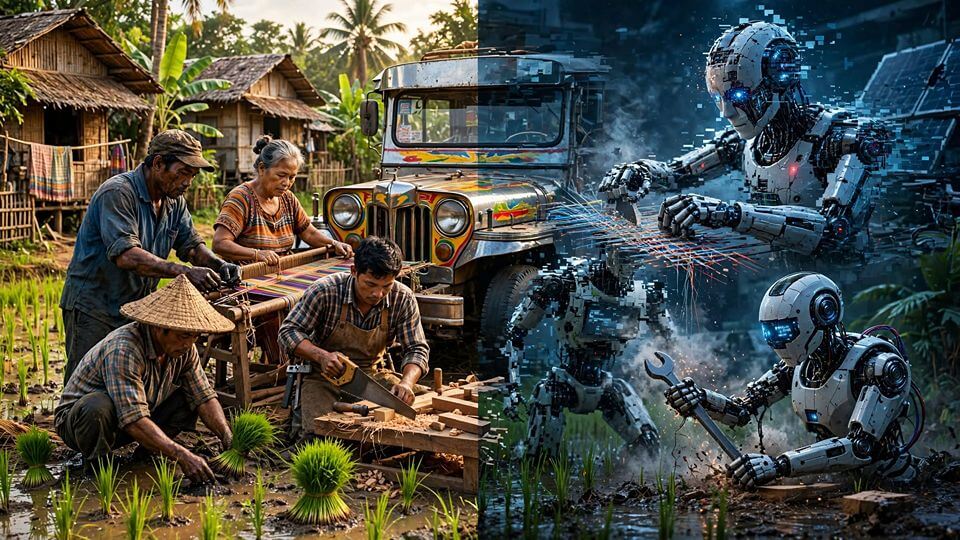
What happens when the skills that got us hired are the same skills AI can now perform?
The Career Ladder Is Changing
Every year, thousands of Filipino graduates leave school carrying something more valuable than a diploma:
Hope.
Hope that their first job will lead to a better job.
Hope that experience will lead to promotion.
Hope that hard work will eventually lead to stability.
For decades, that ladder has worked reasonably well for many people.
Learn the process.
Follow the instructions.
Be reliable.
Type faster.
Speak good English.
Answer the customer.
Prepare the report.
Update the spreadsheet.
Do the same thing tomorrow.
And again on Monday.
Those skills helped build careers and households across the Philippines.
But something has changed.
The machine can now do many of those things too.
And unlike a human employee, software can work 24 hours a day without asking for a coffee break.
That doesn't mean every job disappears tomorrow.
It means the value of certain tasks is changing.
And that distinction matters.
🧠 AIWhyLive Explains: What Is Skill Devaluation?
Skill devaluation happens when a skill becomes less valuable in the labor market because technology, automation, or other changes make that skill easier or cheaper to perform.
It doesn't necessarily mean the person who has the skill is worthless.
It means the economic value of performing that particular task can change.
Think about typing.
Typing is still useful.
But being the fastest typist in the office is not the career advantage it once was.
Why?
Because computers became better at handling text.
Now AI is doing something similar with a much larger collection of knowledge-work tasks.
The skill isn't necessarily disappearing. Its scarcity may be disappearing.
The Philippines Has a Very Interesting Problem
The Philippines built a major part of its modern service economy around something the world needed:
People who could reliably do knowledge and service work for global clients.
English communication became a major advantage.
Customer service became an industry.
Business-process outsourcing became an industry.
IT services grew.
Back-office operations grew.
Thousands of Filipinos built careers around these opportunities.
And this is important:
AI doesn't erase the achievements of those workers.
The technology simply changes the environment in which those skills are valued.
A skill that was extremely valuable ten years ago can still be useful today while becoming less valuable tomorrow.
That isn't an insult.
It's how technology changes economies.
The Old Career Formula
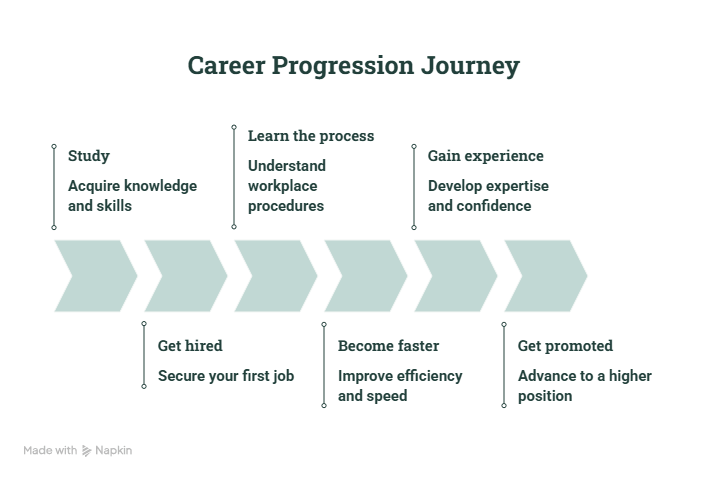
For a long time, the formula looked something like this:
Study → Get hired → Learn the process → Become faster → Gain experience → Get promoted.
There is nothing wrong with that formula.
But AI introduces a strange new question:
What happens when becoming faster at the process is exactly what the machine is designed to do?
If a computer can process thousands of records in seconds, being able to process hundreds manually may no longer be enough.
If AI can generate a first-draft customer response instantly, typing that response faster may no longer be the main advantage.
If software can summarize a long document in seconds, reading speed alone becomes less important than knowing whether the summary is correct and what it means.
Which Old-School Skills Are Under Pressure?
This is where we need to be careful.
Calling a skill "AI-proof" is risky because technology changes quickly.
So instead of asking, "Which jobs are guaranteed to survive?", a better question is:
"Which tasks are becoming easier for machines to perform?"
Examples include work that is highly repetitive, predictable, rules-based, and digital.
- Routine data entry — especially when information already exists in digital form.
- Basic transcription — particularly where the work is repetitive and standardized.
- Template-based writing — such as repetitive descriptions, routine messages, and standard summaries.
- Basic information retrieval — especially when the answer is straightforward and already available digitally.
- Routine document formatting — where software can recognize the desired structure.
- Simple customer-service interactions — particularly repetitive questions with predictable answers.
- Basic administrative processing — where the workflow follows clear rules.
Notice something important.
These are tasks.
Not necessarily entire careers.
That distinction is one of the most important things to understand about AI and employment.
🧠 AIWhyLive Explains: Task Displacement
Task displacement means technology takes over some tasks that people previously performed.
That does not automatically mean an entire occupation disappears.
A nurse may use AI without becoming an "AI nurse."
A lawyer may use AI without becoming a software engineer.
A customer-service worker may use an AI assistant while still handling difficult customers.
A programmer may use AI to generate code while spending more time reviewing architecture and solving problems.
In other words:
AI can replace parts of a job without replacing the whole person.
That is a much more useful way to think about the future of work.
🍗 Lechon Manok — The Automated Helpdesk Dilemma
Imagine this.
A customer sends an email.
The old process:
Open email.
Read the complaint.
Search the knowledge base.
Find the correct response.
Rewrite it politely.
Send it.
Repeat.
For eight hours.
Then AI arrives.
AI reads the email.
AI identifies the issue.
AI searches the knowledge base.
AI drafts the response.
And suddenly the human employee isn't spending all day writing the same answer.
Great!
Except now comes the awkward meeting.
"If the AI can handle the easy cases, what should the human do?"
Maybe the answer isn't nothing.
Maybe the answer is:
Handle the cases that weren't easy in the first place.
The angry customer.
The unusual situation.
The account with conflicting information.
The problem nobody has seen before.
The situation where following the script makes everything worse.
And yes, somewhere in the middle of all this, there is probably still a freshly roasted lechon manok waiting for lunch.
Technology changes.
Lunch remains important.
🐘 Elephant in the Room: What Happens When Pure Execution Is Worth Less?
Let's ask the uncomfortable question.
If a machine can execute your instructions faster, cheaper, and continuously, what exactly are you being paid for?
This question sounds brutal.
But perhaps it is the question workers should be asking before technology forces them to.
If your entire value is:
"Give me instructions and I will follow them perfectly."
AI creates a problem.
But if your value is:
"Give me a messy problem and I will figure out what to do."
That is a different proposition.
The future may reward people who can move from:
execution → judgment
instructions → problem-solving
answers → questions
following the process → improving the process
That is the real career shift.
The Skills That May Become More Valuable
There is no magical list of permanently "AI-proof" skills.
But some capabilities are harder to reduce to a simple script because they involve context, responsibility, uncertainty, relationships, or physical reality.
1. Judgment
Knowing what to do when the instructions don't cover the situation.
2. Problem-solving
Finding the real problem instead of merely completing the assigned task.
3. Communication
Not just speaking English or writing grammatically correct sentences, but understanding people.
4. Emotional intelligence
Recognizing when a customer, patient, employee, colleague, or client needs something different from the standard response.
5. Critical thinking
Knowing when information looks convincing but doesn't make sense.
6. Verification
Checking whether an AI-generated answer is actually correct before acting on it.
7. Creativity
Not merely generating content, but deciding what is worth creating and why.
8. Leadership
Getting people to move together when there is uncertainty, conflict, or change.
9. Local and cultural context
Understanding the subtle things that may not appear in a database or instruction manual.
10. Physical-world skills
Many jobs still require people to physically inspect, repair, operate, care for, build, transport, or manage things in the real world.
But Here's the Twist: AI Can Also Make Humans Better
This article isn't an argument that humans should fight AI.
That would be like telling people to fight calculators because calculators are better at arithmetic.
The smarter question is:
How do we use the machine to become better at the things that matter?
A Filipino employee who learns how to use AI effectively may be able to handle more customers.
A small business owner may be able to create marketing material without hiring an agency for every small task.
A programmer may be able to prototype an idea much faster.
A teacher may be able to create different learning materials for different students.
A doctor may use software to reduce administrative work.
A freelancer may compete internationally with a much smaller team.
AI can therefore be a threat.
It can also be leverage.
The difference may be how we use it.
🧠 AIWhyLive Explains: AI Leverage
AI leverage means using AI to increase what one person or a small team can accomplish.
Instead of asking:
"Can AI do my job?"
try asking:
"What could I accomplish if AI handled the repetitive parts of my job?"
That question changes the conversation.
You stop thinking only about replacement.
You start thinking about capability.
The New Filipino Advantage May Not Be English Alone
For years, strong English communication helped Filipinos compete globally.
That advantage remains important.
But AI can now generate, translate, rewrite, summarize, and polish language.
So perhaps the next advantage is not simply:
"I can communicate in English."
It becomes:
"I understand the problem, I understand the customer, and I know how to use AI to solve it."
That is a much harder skill to commoditize.
👦 ELI12 — The Calculator and the Mathematician
Imagine you are famous in your neighborhood because you can calculate numbers very quickly.
You can add.
Subtract.
Multiply.
Divide.
You are incredibly fast.
Then somebody gives everyone a calculator.
Suddenly, your speed isn't so special anymore.
But the calculator still needs someone who knows:
What should we calculate?
Why are we calculating it?
Does the answer make sense?
What should we do with the answer?
That's the lesson.
Don't try to beat the calculator at being a calculator.
Learn how to solve the problem.
The Biggest Mistake Is Learning Yesterday's Skill Forever
There is nothing wrong with mastering an old skill.
The danger comes when you assume that mastery means you never need to evolve again.
Technology doesn't care how comfortable your old workflow was.
The customer doesn't care how many years your spreadsheet process has existed.
The market doesn't promise to preserve yesterday's advantage.
And AI certainly doesn't care.
That sounds harsh.
But there is another way to look at it.
You don't have to throw away what you know.
You can build on it.
The experienced customer-service worker can learn AI.
The accountant can learn AI-assisted analysis.
The programmer can learn AI-assisted development.
The writer can learn AI-assisted research.
The teacher can learn AI-assisted lesson creation.
The secretary can learn AI-assisted administration.
Your old skill can become the foundation for your new skill.
What Should Filipino Workers Learn Next?
If you are worried about AI, don't begin with:
"Which job should I run away from?"
Begin with:
"Which parts of my work can AI already do, and which parts still require me?"
Then learn the technology.
Not because you want to become a programmer.
Not because you need to become an AI expert.
Because understanding the tool gives you more options.
Learn how to:
- write useful prompts
- check AI answers
- protect confidential information
- automate repetitive tasks
- organize information
- evaluate AI output
- combine AI with your existing expertise
- identify problems worth solving
You don't need to become AI.
You need to become the person who knows what to do with AI.
The New Career Ladder
Maybe the old career ladder was:
Learn → Execute → Repeat → Improve → Manage.
The emerging ladder may look more like:
Learn → Use AI → Verify → Solve → Improve → Orchestrate → Lead.
Notice the word:
Orchestrate.
You don't necessarily need to perform every task yourself.
You need to understand the whole process well enough to direct people and machines toward the right result.
🧠 AIWhyLive Explains: Orchestration
Orchestration means coordinating different people, tools, systems, and processes so they work together toward a desired outcome.
In the AI era, an effective worker may not be the person who manually performs every step.
It may be the person who knows:
- what needs to be done
- which tool should do it
- what information the tool needs
- what could go wrong
- how to verify the result
- when a human must intervene
That is a different kind of expertise.
Don't Become Anti-AI. Become AI-Literate.
There is a temptation to divide the world into two groups:
People who love AI.
People who fear AI.
Reality is more complicated.
You can be excited about AI and still worry about jobs.
You can use AI and still question its answers.
You can embrace automation and still defend human judgment.
You can believe technology creates opportunities while recognizing that transitions can hurt real people.
AI literacy means understanding both the opportunity and the risk.
📝 Note from the Webmaster
📝 A Note from the Webmaster — AIWhyLive
Let me keep it real. I love digital tools. I use AI. A lot. And yes, AI makes me stupid—and I absolutely love it when it takes away boring work that I don't need to do manually anymore. But I don't want AI to take away the part of my brain that still asks: "Wait. Does this actually make sense?" That question is becoming more important, not less. I don't want to compete with AI by trying to type faster than AI. I want to use AI to create things I couldn't create as easily before. That, for me, is the opportunity.
The Uncomfortable Truth About "AI-Proof"
There is probably no such thing as a permanently AI-proof skill.
That is why I intentionally put the phrase in the title.
"AI-proof" sounds comforting.
But the future doesn't offer guarantees.
A skill that seems difficult to automate today may become easier to automate tomorrow.
So perhaps the better goal isn't to find an AI-proof job.
Perhaps it is to become an AI-adaptive person.
Someone who can learn.
Someone who can question.
Someone who can solve unfamiliar problems.
Someone who can work with new tools.
Someone who can recognize when technology is helping—and when it is making things worse.
That is harder to replace because adaptability itself becomes the skill.
🎤 Drop Mic — Don't Race the Machine
The future of work isn't necessarily about humans versus AI.
That makes a great movie.
Real life is messier.
The bigger story is probably humans with AI.
The Filipino worker who learns to use AI may compete differently from the worker who ignores it.
The company that uses AI responsibly may operate differently from the company that refuses to adapt.
The freelancer who learns to combine expertise with AI may offer something different from someone selling hours of repetitive work.
The student who learns to use AI without surrendering critical thinking may enter the workplace with a very different toolkit.
So don't obsess over finding a job that AI can never touch.
Build skills that become more useful when AI enters the room.
Learn the machine.
Question the machine.
Use the machine.
Check the machine.
And when necessary, tell the machine:
"No. That's not what we're trying to solve."
Because the future may not belong to the person who works hardest.
And it may not belong to the person who knows the most.
It may increasingly belong to the person who can learn, adapt, judge, and use powerful tools without becoming dependent on them.
Don't try to become AI-proof.
Become harder to replace because you know how to make AI useful.
AIWhyLive Takeaway
The old career ladder is not necessarily dead.
But some of its steps are changing.
Routine execution is increasingly exposed to automation.
Human judgment, context, problem-solving, communication, responsibility, and adaptability remain important.
And the biggest career mistake may not be learning an old skill.
It may be refusing to learn the next one.
Stop Doom Scrolling and Start Building With AI | AIWhyLive Last time I checked, you're not a zombie. So why Read more
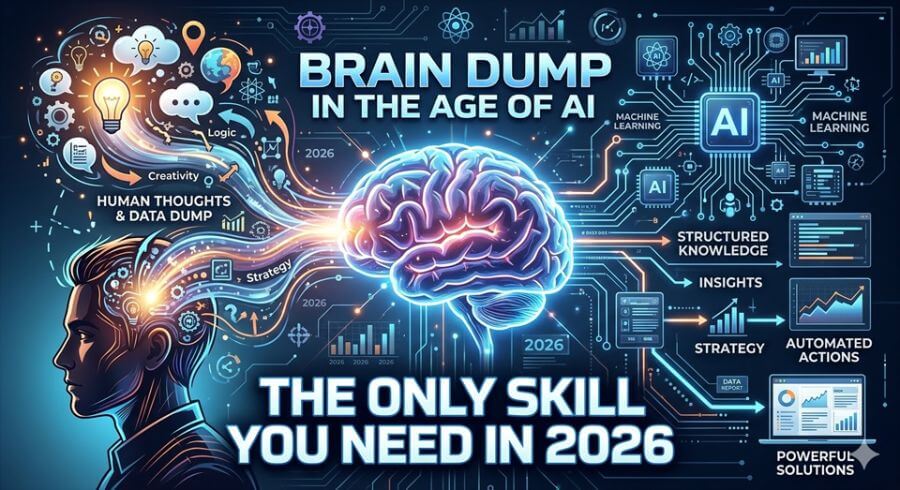
🌪️ Forget Prompt Engineering We’ve been told that to survive the AI revolution, we need to master “Prompt Engineering.” Wrong. Read more

🚨 WAKE UP CALL: YOUR DIPLOMA WON’T SAVE YOU You spent 4+ years in college.Your family sacrificed—maybe even sold land—for Read more
The world is changing faster than ever, and staying ahead means continuously learning new skills. For Filipinos, 2025 presents countless Read more