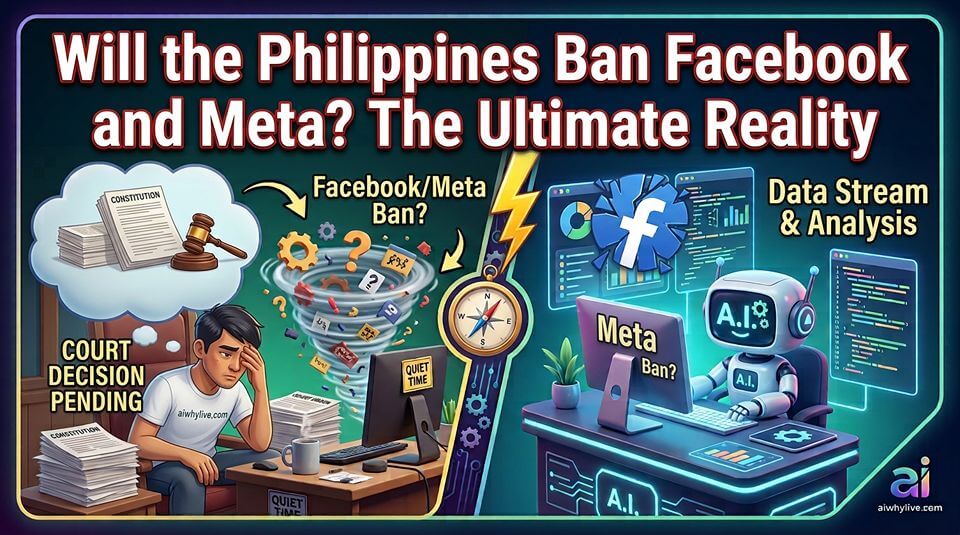
Picture this: You wake up tomorrow, tap your phone screen, and Messenger, Facebook, and Instagram are completely blank.
No notifications. No family group chats loading. No marketplace scrolling. Just a cold, silent void.
Sounds like a dystopian sci-fi movie, right? But in the halls of the House of Representatives right now, a potential ban on Meta isn't a joke—it’s a very real ultimatum. Lawmakers are threatening to block the social media giant if they refuse to set up a physical office on Philippine soil and get serious about filtering out scams and toxic content.
As the undisputed social media capital of the world, how did we get to the point where the government is ready to pull the plug on Mark Zuckerberg's empire? And more importantly: where are the noisy local influencers and budget-funded *epals* going to post their manufactured clout if the feeds go dark?
The Social Media Capital Faces an Ultimatum
Let’s look at the reality on the ground. Filipinos didn't just adopt Facebook; we built our entire digital existence on it. From small-scale e-commerce to school announcements, breaking news, and family check-ins, our social infrastructure runs through Meta.
So when the government threatens a total ban over rampant online scams, deepfake fraud, and child safety failures, it sends shockwaves through the country. Half the population panics about losing communication lines, while the other half wonders if a digital detox by legislative force is long overdue.
It’s high-stakes political theater meeting everyday digital addiction.
🧠 AIWhyLive Explains — Legislated Digital Cold Turkey
Legislated Digital Cold Turkey refers to file-grade regulatory panic where governments use sudden ban threats to force multi-national tech conglomerates into legal accountability.
Instead of gradual, sensible policy changes, it creates an abrupt collision between state sovereignty and deep-seated platform dependency—testing whether a population can survive overnight disconnection from its primary communication pipeline.
👦 ELI12 — Taking Away the House Tablet
Imagine a kid who spends all day glued to a giant community tablet, trading items, shouting at neighbors, and sometimes letting strangers trick them into bad trades.
Eventually, the parents get furious at the tablet owners for refusing to put up safety guards. The parents say, "If you don't put a permanent office in our house so we can hold you accountable, we're locking the tablet away forever."
That is basically what Congress is telling Meta right now.
🍗 Lechon Manok — The Clout-Chaser's Nightmare
Let's look at how peak our local digital drama has become.
If Meta actually gets restricted, where are the noisy local *epals* and wannabe lifestyle gurus going to post their rented sports cars, iced coffee aesthetics, and motivational quotes paid for with money they don't even own?
They’re out here trying to impress an audience of strangers they secretly despise, using aesthetic backdrops funded by loans they can't afford. Take away the algorithm, and suddenly they're just people standing quietly in an empty parking lot holding a ring light.
Wonderful. Absolutely peak institutional chaos. We automated our social lives, and now we have to threaten a national blackout just to get tech executives—and loud influencers—to face reality.
🐘 Elephant in the Room — Social Media Beats a Billboard, But at What Cost?
Let’s address the elephant in the room:
Let’s be honest: social media, even with all the toxic bashers and scam ads, is still infinitely better than a boring government billboard. At least online, you can swipe away the noise.
But if a Meta ban actually happened in the Philippines, would society collapse or would we finally look up from our screens? When a foreign tech monopoly holds absolute sway over a nation's communication, safety, and attention, independence isn't just about politics—it's about digital self-preservation.
📝 Note from the Webmaster (aiwhylive.com)
Let’s keep it 100: I love digital tools. Sure, AI makes me stupid—and I absolutely love it when it automates tedious backend tasks. But when it comes to relying entirely on one Silicon Valley giant that treats user safety like an optional feature—while local clout-chasers rent lifestyle items just to feed the algorithm—maybe a reality check is overdue. Stay grounded, keep your critical thinking active, and don't let any platform own your soul.
The Bottom Line: Don't Tie Your Worth to a Feed
Whether Meta sets up a local office or Congress backs down after a settlement, the takeaway is clear: convenience should never mean total surrender of safety, sanity, or financial reality.
Stop treating corporate apps like oxygen, stop funding fake lifestyles for audiences you don't even like, and remember that opinion without substance is just noise. Keep building, keep questioning, and keep your bullshit detector fully charged.
Enjoyed this reality check? Follow for more grounded, human-first insights at aiwhylive.com.