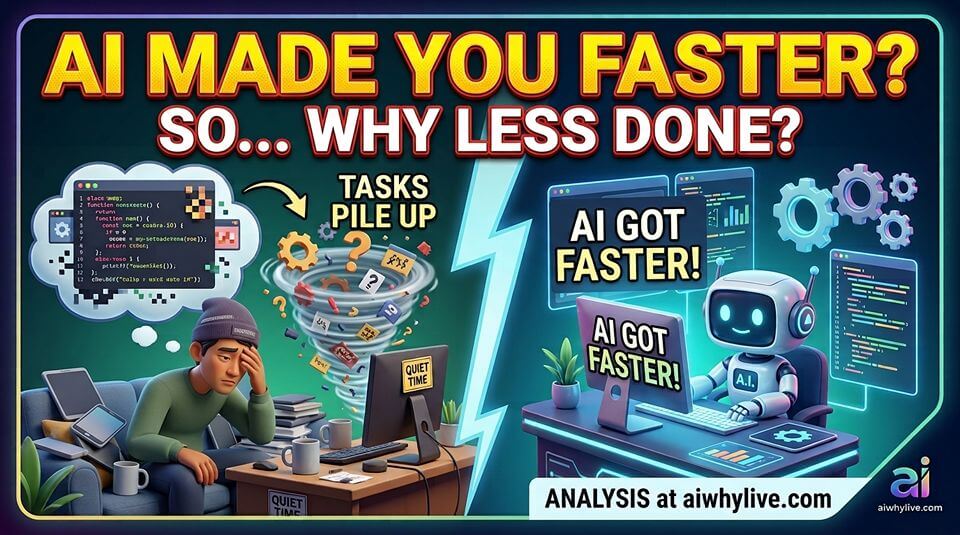
AI can write faster, research faster, code faster, and create faster. But what if becoming faster is not the same thing as getting more done?
Let me ask you something uncomfortable.
Are you actually getting more done because of AI?
Or are you simply getting better at doing more things?
There is a difference. A very big one. According to modern workplace research on technological efficiency, digital acceleration often shifts our focus toward volume rather than true impact.
Before AI, I might spend two hours writing an article. Now AI can help me create an outline in seconds, ask for headlines, rewrite paragraphs, check grammar, summarize research, and generate code.
It feels incredible. And it is.
But there is a strange problem hiding underneath all that speed.
Sometimes I finish more things and accomplish less. Instead of resting, we use our newly saved minutes to fall straight back into infinite feeds, algorithmic doomscrolling, and mindless digital noise. As explored in our breakdown of Wasted vs. Meaningful Time in the AI Age, having more time means nothing if we just spend it managing low-value distractions.
The Dark Side of AI Productivity and Speed
AI productivity means using artificial intelligence to help complete work faster, easier, or with fewer resources.
That can mean asking AI to:
- write or rewrite text
- summarize documents
- analyze information
- generate computer code
- create images
- organize ideas
- research a subject
- automate repetitive tasks
- help make decisions
Simple enough. But there is an important distinction: Doing something faster is not automatically the same as creating more value. AI can reduce the time required to produce something, but that does not guarantee that the thing produced is useful, correct, necessary, or even worth producing.
The Great AI Productivity Promise
We have been told a beautiful story about AI. AI will remove boring work, save time, make workers more productive, help small businesses compete, and help ordinary people do things that once required specialists.
Much of that is already happening. But there is a question we don't ask often enough:
What are we doing with all that saved time?
Are we finishing earlier? Are we spending more time with our families? Are we learning something new? Are we resting? Are we thinking?
Or did we simply fill the empty space with another twenty tasks and an endless loop of doomscrolling?
AI Didn't Remove Work. It Changed the Amount of Work We Think We Can Handle.
This is where things get interesting. Suppose you used to have enough time to write five reports. AI arrives and helps you write those five reports in half the time.
What happens next? Your boss may not say, "Great. You can now work half as much." The new expectation might become, "Great. Now do ten."
AI increased productivity. And somehow... you still feel behind.
Speed Has a Dark Side
Speed feels productive. Our brains like visible progress. A completed email. A finished presentation. A generated image. A completed report. A working piece of code. Click. Done. Next.
And suddenly you have completed fifty things. But ask yourself:
Which of those fifty things actually mattered?
👦 ELI12 — The Fast Assistant Trap
Imagine having a toy robot that can clean your room in five seconds by shoving everything under the bed.
Your room looks clean instantly, but you haven't actually organized anything—you've just hidden the mess where you'll trip over it later.
That is what rushing through work with AI feels like. Speed is useless if you're sprinting in the wrong direction.
🍗 Lechon Manok: "I Used AI, Therefore I Worked."
Ah yes. The modern productivity miracle. Open ChatGPT. Type a prompt. Copy. Paste. Send. Congratulations, you worked for approximately seventeen seconds.
Except... did you actually work? Maybe. Maybe not. AI can absolutely help us work. But sometimes we confuse producing output with doing meaningful work.
Those are not always the same thing. And yes, I am roasting myself here too, because I use AI a lot. Sometimes I ask AI to help me do something I could have done myself—not because I couldn't, but because I didn't want to. There. That's the confession.
🧠 AIWhyLive Explains: What Is AI Overreliance?
AI overreliance happens when a person depends on AI so heavily that they stop providing enough human judgment, verification, or independent thinking.
It doesn't mean using AI too much in some magical numerical sense. There is no universal rule saying, "Use AI exactly 37 percent of the time." The real question is:
Can you still recognize when the AI is wrong?
If the answer is no, the problem isn't that you use AI. The problem is that AI has become the final authority.
🐘 Elephant in the Room: What If AI Is Making Us Less Capable?
There. Let's ask the uncomfortable question.
What if AI makes us more productive today but less capable tomorrow?
Imagine someone who never writes, researches, calculates, codes, or makes a difficult decision without asking AI. Eventually, something changes. Not necessarily intelligence, but confidence in our own ability.
We may begin thinking, "I can't do this without AI." That is a very different statement from "AI helps me do this better." The first is dependence; the second is augmentation.
The Calculator Didn't Destroy Mathematics
Let's be fair. Humans have always invented tools like calculators, spreadsheets, search engines, GPS, and spellcheckers. We don't insist on doing everything manually just to prove that we are human.
So AI isn't automatically dangerous because it makes work easier. The interesting difference is that AI can increasingly help with something much closer to the work of the mind: writing, reasoning, summarizing, coding, analysis, and decision support.
That's why the human role doesn't disappear. It changes.
The New Skill May Be Knowing What NOT to Automate
We spent years learning how to automate repetitive tasks. Now we may need to learn something else: When should I keep the human in the loop?
Maybe you don't need to personally write every routine email, but you probably should understand an important email before sending it. Maybe AI can summarize a 100-page document, but if you are making a major decision, you should know what was left out.
Automation removes effort. It does not automatically remove responsibility.
AI Can Also Create More Decisions
Here's another strange paradox. AI makes creation cheap, meaning we can create more emails, articles, presentations, posts, and code. But abundance creates a new problem: Someone still has to decide what matters.
AI can give you 50 ideas or 10 headlines, but you still have to choose the right one and ensure it isn't nonsense. AI can produce more, but it cannot automatically give everything meaning.
The Productivity Paradox
Here is the paradox:
The easier it becomes to produce something, the easier it becomes to produce things that don't need to exist.
When writing an email took ten minutes, you thought twice. When AI creates one in ten seconds, sending unnecessary messages becomes free. AI doesn't only reduce the cost of doing something—it can reduce the psychological cost of doing something unnecessary.
When Everything Becomes Easy, Attention Becomes Expensive
This may become one of the biggest challenges of the AI era. We won't necessarily suffer from a lack of content; we'll suffer from too much of it, too many options, too many drafts, and too many notifications.
Human attention remains limited. AI doesn't appear to care. It can keep producing forever.
AI Doesn't Get Tired. You Do.
This is why I think the human side of AI productivity matters. AI can generate another version, and another, and another. You still have to read them, decide, and live with the result.
Eventually, your brain says, "Enough." AI doesn't necessarily know when enough is enough. You do. Or at least, you should.
So What Should We Actually Do?
I'm not going to tell you to stop using AI. Use it, experiment with it, let it save you time, and let it handle repetitive work. But keep a few things for yourself:
Think before you automate.
Ask whether the task actually needs doing.
Understand before you trust.
Especially when the result affects money, health, employment, security, or other people.
Review before you publish.
AI can produce impressive nonsense.
Keep learning.
Don't let AI become the only place where your knowledge lives.
ELI12: AI Is Like Having a Really Fast Assistant
Imagine you have an assistant who can work incredibly fast. You give the assistant a task. Five seconds later: "Done."
Fantastic. But would you stop checking the work? Would you let the assistant decide everything? Probably not. That's basically the AI relationship we need: Let the assistant be fast. You remain responsible for knowing where you're going.
AIWhyLive Explains: Productivity vs. Progress
These words sound similar, but they aren't. Productivity is generally about how efficiently resources are turned into output. Progress is about whether you are actually moving toward something worthwhile.
You can be highly productive and make zero progress. You can answer 200 emails, generate 100 articles, and spend an entire day being extremely busy, still going home wondering: "What did I actually accomplish?"
The Question AI Cannot Answer For You
AI can help answer how, when, what, and where. But one question remains stubbornly human:
Why?
Why am I doing this? Why does this matter? Why should anyone care? AI can help you think about those questions, but it cannot live your answer.
And Maybe That's the Real AI Productivity Revolution
Perhaps the biggest change AI brings isn't that we can do more. The bigger change may be that AI forces us to decide: What is actually worth doing?
When creation becomes cheap, judgment becomes valuable. When information becomes abundant, attention becomes valuable. When execution becomes fast, direction becomes valuable.
Drop Mic: Maybe We Don't Need to Work Faster
Maybe the future isn't about doing everything faster. Maybe it's about becoming better at deciding what deserves our time.
Because if AI can help us finish ten times more work, and we simply create ten times more unnecessary work, we haven't really become more productive. We've just become faster at being busy.
AI made you faster. Now the real question is: What are you going to do with the speed?
AIWhyLive Takeaway
Use AI. But don't surrender your judgment to it. Let AI make you faster, more capable, and free of boring work. But every once in a while, stop and ask yourself:
Am I getting more done—or am I simply doing more?
That question may be more important than any productivity hack AI can give us.
Why We’re Doing More… But Remembering Less 🧠 Something Strange Is Happening You finish tasks faster than ever. Emails? Done Read more
The AI Dilemma: Efficiency vs. Intelligence A recent MSN article explores a growing concern—are we offloading too many mental tasks Read more
A little over a year ago, we asked a provocative question: White-Collar Wipeout: 61% Say AI Will Steal Their Job—Filipinos, Read more
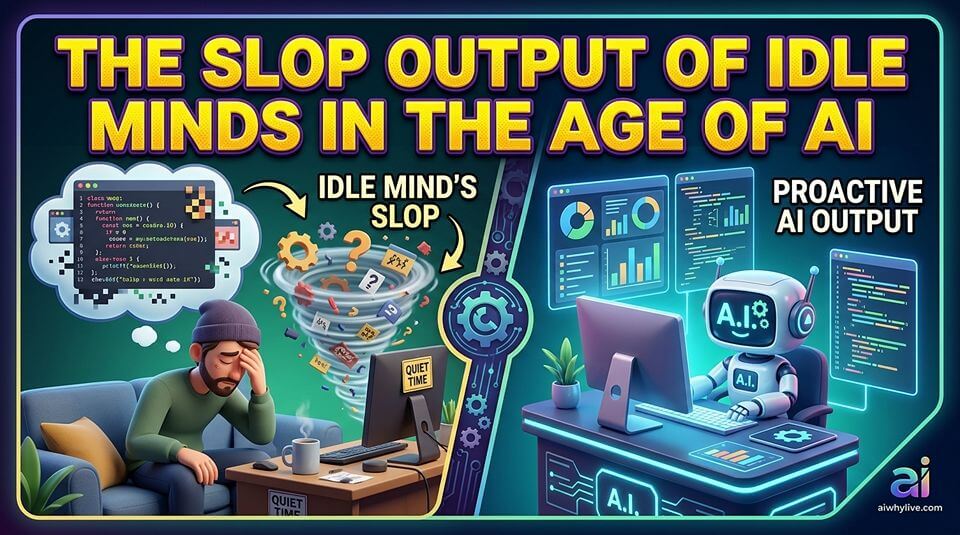
"Idle hands are the devil's workshop." Generations of elders used to warn us about the dangers of sitting around with Read more