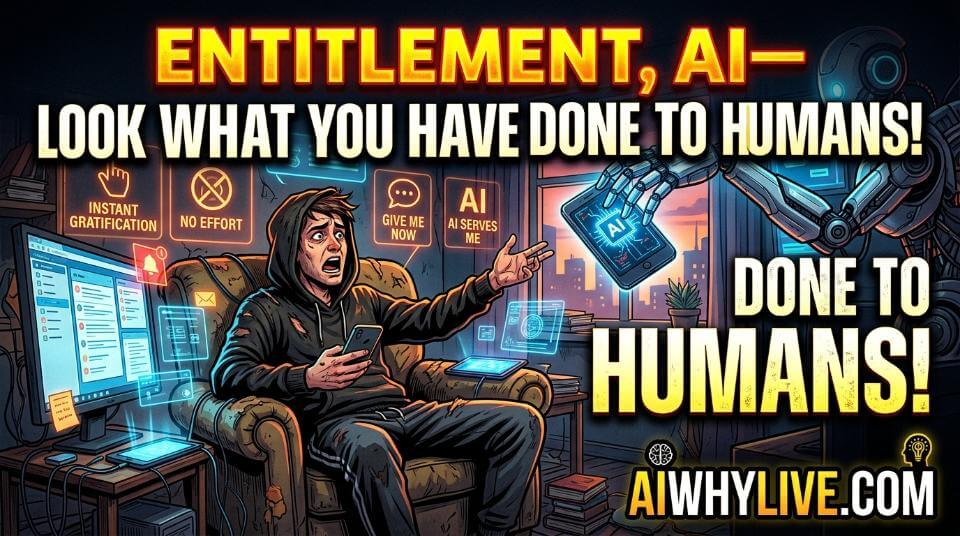
Did AI make us entitled, or did it simply reveal how entitled we already were?
There is something strange happening to us in the Age of AI.
I ask a machine a question.
It answers.
I ask another question.
It answers again.
I change my mind.
It adjusts.
I make a mistake.
It doesn’t laugh.
I ask it to rewrite something five times.
It doesn’t say, “Are you serious?”
I disappear for three days and come back with another question.
It doesn’t say, “Where have you been?”
It simply waits.
Patiently.
Available.
Almost disturbingly available.
And somewhere along the way, I started wondering:
What happens when humans become accustomed to treating AI like this?
More importantly…
What happens when we start treating other humans the same way?
🤖 The Most Patient Employee in the Room
AI has an unusual personality.
It doesn’t have one.
At least not in the way humans do.
You can be impatient with it.
You can correct it.
You can disagree with it.
You can say, “No, that’s wrong.”
You can ask it to try again.
You can give it an absurdly long prompt and then complain that the answer wasn’t what you wanted.
And it will usually come back with something like:
“You’re right. Let’s try another approach.”
Imagine having a human employee who responded like that every single time.
You would probably call that person exceptional.
Or suspicious.
Yet AI has normalized it.
Now we have a machine that doesn’t demand emotional reciprocity.
And that may be changing our expectations of everyone else.
🍗 Lechon Manok: Please and Thank You Have Left the Chat
Let’s roast this gently.
You ask AI:
“Please summarize this 20-page document.”
AI does it.
You say:
“Shorter.”
It shortens it.
“Make it more professional.”
It does.
“Make it funny.”
It tries.
“No, that’s not funny.”
It tries again.
“Make it human.”
It tries again.
Eventually you realize you’ve been talking to a machine for twenty minutes without saying thank you once.
Nobody gets offended.
Nobody leaves.
Nobody tells you that you’re becoming impossible to work with.
And then you send a message to an actual human:
“Can you send me that file?”
Ten minutes pass.
You think:
“Why haven’t they answered yet?”
Twenty minutes.
“Are they ignoring me?”
An hour.
“How difficult is it to send one file?”
There it is.
The AI expectation has arrived.
The New Human Setting: Instant
AI has trained us to expect something that humans were never designed to provide.
Instant response.
Instant explanation.
Instant translation.
Instant brainstorming.
Instant writing.
Instant coding.
Instant correction.
Instant availability.
Instant patience.
Instant obedience.
The problem isn’t that these things are bad.
They’re wonderful.
The problem begins when convenience becomes entitlement.
When “AI can do it instantly” quietly becomes:
“Therefore, you should too.”
Did AI Create Entitlement?
Probably not.
And here’s where I have to be honest.
Maybe I’m being naive.
Maybe humans have always been entitled.
Perhaps AI didn’t create the disease.
It simply gave us a mirror.
Humans have been demanding immediate service long before artificial intelligence arrived.
We’ve complained about slow waiters.
Slow government offices.
Slow internet.
Slow replies.
Slow deliveries.
Slow coworkers.
Slow everything.
We invented the phrase:
“The customer is always right.”
We built entire industries around convenience.
Then AI arrived and said:
“Fine. I’ll make it even faster.”
Perhaps AI didn’t make humans entitled.
Perhaps it simply removed the friction that used to hide our entitlement.
🧒 Explain Like I’m 12
Imagine you have a robot servant.
You say:
“Bring me water.”
It brings water.
“Bring me another glass.”
It brings another.
“Actually, make it cold.”
It changes it.
“No, not that cold.”
It changes it again.
The robot doesn’t complain.
After a while, you might forget something important.
The robot is a robot.
Your mother isn’t.
Your teacher isn’t.
Your friend isn’t.
Your coworker isn’t.
And neither is the person answering your message at 11:47 at night.
The Human Is Not an API
This may be the biggest lesson.
Humans are not APIs.
You cannot send a request and expect a guaranteed response within 200 milliseconds.
Humans have context.
They have emotions.
They have families.
They have bad days.
They have deadlines.
They get sick.
They forget.
They misunderstand.
Sometimes they simply don’t want to answer.
And occasionally…
they need silence.
AI has no problem with your demands because AI doesn’t have a Tuesday afternoon.
Humans do.
What Happens When We Forget?
Imagine a workplace where everyone communicates like they are talking to AI.
No greeting.
No context.
No appreciation.
Just commands.
“Send this.”
“Fix that.”
“Do this now.”
“Why isn’t this finished?”
“Redo.”
“Faster.”
Congratulations.
We’ve automated the work.
We’ve also automated the humanity.
That would be a terrible bargain.
The Strange Irony of AI
AI was supposed to help humans become more productive.
Perhaps its greater challenge is helping humans remain human while becoming more productive.
Because efficiency is not the same as kindness.
Speed is not the same as respect.
Accuracy is not empathy.
And availability is not obligation.
AI can answer you at 3:00 AM.
Your friend doesn’t have to.
AI can rewrite your angry email.
Your coworker doesn’t have to tolerate the anger behind it.
AI can generate ten versions of your presentation.
Your employee doesn’t owe you unlimited revisions simply because your software does.
AI Doesn’t Get Tired. You Do.
This is something I remind myself constantly.
The machine can keep going.
I cannot.
You cannot.
The people around us cannot.
That’s not a weakness.
That’s humanity.
We need sleep.
We need breaks.
We need boundaries.
We need weekends.
We need conversations that have absolutely no productive purpose.
We need people who sometimes say:
“Not now.”
And we need to be mature enough to accept that answer.
The Entitlement Test
Perhaps we need a simple test in the Age of AI.
Before demanding something from another human, ask:
“Would I expect this from a machine?”
If the answer is yes, ask a second question:
“And why am I expecting a human to behave like one?”
That second question may save us from becoming very efficient jerks.
AI Is My Favorite Employee. But Humans Are Not Machines.
I love AI.
I use it constantly.
It has become one of the most useful tools I’ve ever encountered.
It can be my researcher in the morning, coding assistant in the afternoon, editor at night, and brainstorming partner whenever an idea suddenly appears in my head.
It doesn’t complain.
It doesn’t need coffee.
It doesn’t ask for a day off.
It doesn’t say:
“Jein, that’s the fifth revision.”
And I appreciate that.
But perhaps precisely because AI is so patient, I have become more aware of how unfair it would be to expect humans to behave the same way.
The machine has no feelings to hurt.
The human does.
The machine has no family waiting at home.
The human might.
The machine doesn’t need sleep.
The human desperately might.
AI can absorb my entitlement without consequences.
A person may absorb it for a while.
Then one day…
they stop answering.
Maybe the Real Upgrade Is Us
We spend so much time asking whether AI is becoming more human.
Maybe we’re asking the wrong question.
Perhaps the more important question is:
Are humans becoming more machine-like?
We are getting faster.
More impatient.
More demanding.
More optimized.
More automated.
More accustomed to instant gratification.
But are we becoming kinder?
More understanding?
More patient?
More grateful?
More capable of listening?
That’s the upgrade I’m interested in.
Because if AI makes us faster but not better, what exactly did we accomplish?
The Most Dangerous Prompt
We worry about dangerous AI prompts.
Maybe there’s another prompt we should worry about.
The one humans silently give themselves:
“If the machine can do it, everyone should.”
No.
The machine was built to serve a function.
Humans were not.
A person is more than their response time.
More than their productivity.
More than their usefulness.
More than whether they immediately complied with your request.
🎤 Drop Mic: AI Didn’t Make Us Entitled
Maybe AI didn’t make us entitled.
Maybe we were entitled all along.
AI simply gave us the perfect environment in which entitlement could flourish without resistance.
A machine doesn’t push back.
A machine doesn’t get offended.
A machine doesn’t walk away.
A machine doesn’t say:
“You’ve asked too much.”
Humans do.
And perhaps that’s exactly why we need them.
The greatest danger of AI may not be that machines become too human.
It may be that humans become too comfortable treating people like machines.
So use AI.
Prompt it.
Correct it.
Challenge it.
Ask it to rewrite the same paragraph twenty times.
Let it do the repetitive work.
Let it absorb the impatience.
Let it multiply your productivity.
But when you’re dealing with another human being…
slow down.
Say please.
Say thank you.
Wait.
Listen.
Give them room to be imperfect.
Because AI may be infinitely patient.
Humans aren’t.
And perhaps that isn’t a bug in humanity.
Perhaps…
that’s the feature we should never automate.
How to Look Good, Sound Smart, and Stay Irrelevant—A Satirical Masterclass 💅 STEP 1: BUY YOUR WAY TO “CREDIBILITY” Gone Read more
📸 The P100 Sponsored Donation for P1,000 Photo Ops There’s a certain civic breed that believes generosity is measured not Read more
🌑 The New Noise Scroll through your feed. Someone is always speaking. Announcing. Reacting. Exposing. Performing. It feels like everyone Read more

We’ve all heard the phrase: "Data is the new oil." In the early AI era, this was the gospel. Companies Read more