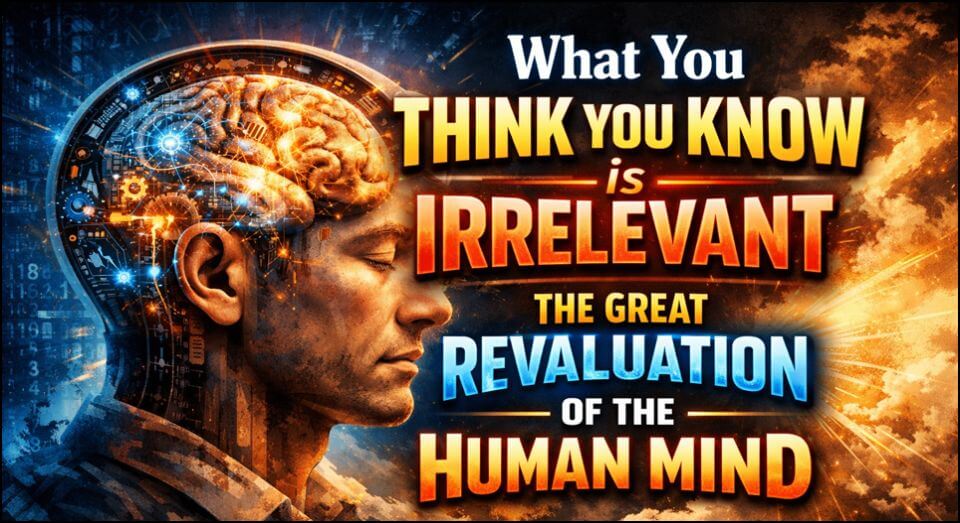
For the last century, our society was built on a simple, comforting lie: Knowledge is Power.
We spent 20 years in school “downloading” facts. We built resumes based on “years of experience.” We paid consultants for their “subject matter expertise.” Our entire economic identity was a bucket of things we knew.
That bucket just sprang a leak.
In the Age of AI, “knowing things” has become a low-margin commodity. If a 175-billion parameter model can “know” it faster, more accurately, and for the cost of a few API tokens, your knowledge isn’t an asset. It’s overhead.
1. The Death of the “Expert” 📉
We are witnessing the Hyper-Inflation of Expertise. In 2010, knowing how to write complex SQL queries or synthesize a 50-page legal brief made you a high-earner. In 2025, those are “entry-level” prompts for a machine.
When knowledge is “on-tap” like electricity, the person who merely possesses information is as useful as a person who claims they are valuable because they own a flashlight. Everyone has a flashlight now. The sun is out.
2. From “Search” to “Synthesis” 🔄
The “Old Internet” was a library. You succeeded if you were the best at finding the book. The “AI Internet” is an engine. It doesn’t want you to find the book; it wants you to build the bridge.
What you know is static. What you can synthesize—taking disparate nodes of data and forcing them into a new, functional reality—is the only remaining human moat.
3. The “Information Gain” Test 🧪
At AIWhyLive, we use a simple metric to determine if a human is still relevant in their field: The Information Gain Test.
If you speak, and an LLM could have predicted 95% of what you were going to say based on its training data, your contribution to the world is zero. You are a biological repeater.
To be relevant, you must provide the 5% that isn’t in the training data:
- Contextual Friction: The “messy” reality of how things actually work on the ground.
- Counter-Intuitive Leaps: Logic that defies the “average” (which is all AI is—a sophisticated average).
- Skin in the Game: The ability to be wrong and suffer for it. AI cannot feel the weight of a bad decision; you can.
4. The New Hierarchy of Value 🏆
If “Knowing” is dead, what replaces it?
- Curation: Filtering the infinite noise.
- Architecture: Knowing how to stack AI “bricks” to build a cathedral.
- Taste: The final, un-automatable frontier. AI can create “perfection,” but only humans can define “cool,” “moving,” or “meaningful.”
The Bottom Line
Stop trying to be a database. You will lose. Stop trying to be a calculator. You already lost.
The Age of AI isn’t asking you what you know. It’s asking you what you can do with what it knows.
If you don’t adapt, you risk becoming part of the most tragic demographic of the new economy: The Ghost Graduates. Across the globe, from the BPO hubs of the Philippines to the tech corridors of Silicon Valley, millions are graduating with degrees for jobs that no longer exist, possessing knowledge that a machine learned three years ago. They are specters in a market that has moved on.
Don’t be a ghost in the machine. Be the architect of its output.
Follow AIWhyLive for more dispatches from the front lines of the Human-AI transition.

Stephen Hawking once said, "The greatest enemy of knowledge is not ignorance; it is the illusion of knowledge." In 2026, Read more
🧠 Abstract: False Knowledge Reborn False knowledge is not new. From gossip in the plaza to myths in textbooks, Filipinos Read more
🌑 Abstract: Wealth You Can’t See In 2026, the richest people aren’t the ones flexing cars, mansions, or noisy “success Read more
🧠 What is Proof of Human Significance? Proof of Human Significance (PoHS) is the digital fingerprint of an actual carbon-based Read more