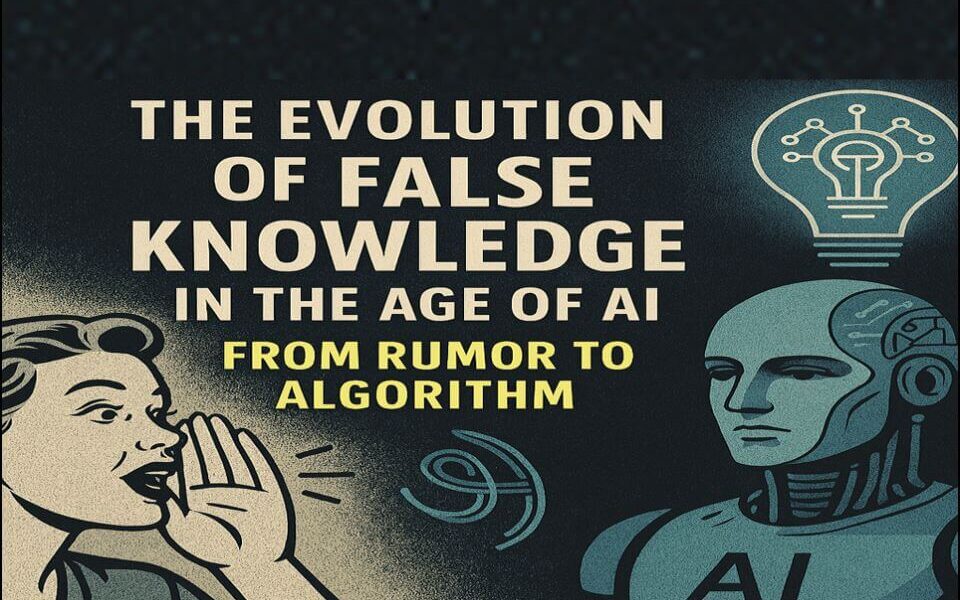
🧠 Abstract: False Knowledge Reborn
False knowledge is not new. From gossip in the plaza to myths in textbooks, Filipinos have always wrestled with half-truths. It is a part of our social fabric—a byproduct of a culture that values storytelling and connection. But in 2026, AI has fundamentally mutated this cycle: rumors are no longer just spoken; they become data. Myths are no longer just written; they become prompts. Illusions are no longer just believed; they become “facts.”
We are no longer just fighting “fake news”; we are fighting a new species of intellectual decay.
⚡ The Framework of False Knowledge Evolution
To understand where we are going, we have to look at the four stages of how we’ve been collectively wrong. Each era didn’t replace the last; it simply built a faster delivery system for the lie.
- Stage 1 – Oral Rumors: Passed through word of mouth, shaped by community bias. This was the era of the kapitbahay whisper—slow, local, and easily debunked by a single witness.
- Stage 2 – Institutional Myths: Embedded in schools, politics, and media as “official truth.” These were the historical distortions in textbooks that took decades to correct.
- Stage 3 – Digital Noise: Social media amplified half-truths into viral certainty. The “algorithm” replaced the “editor,” and engagement became the metric for truth.
- Stage 4 – AI Illusions: This is our current reality. Generative systems now produce polished, confident answers—even when fundamentally wrong. Knowledge is now a statistical prediction, not a verified reality.
🎭 The Satirical Hook: The New Face of Deception
We laugh at the barangay chismis that spreads faster than jeepneys during rush hour. There’s a certain charm to the absurdity of a neighbor’s tall tale.
We pity the outdated textbooks that still teach “facts” from 1985 as if the world hasn’t turned. We recognize those as relics of a slower time.
But the AI that confidently explains a falsehood with perfect grammar, citing non-existent sources with the tone of a Nobel laureate? That’s the new face of false knowledge. It doesn’t look like a rumor. It doesn’t look like a myth. It looks like a solution. We aren’t being lied to by a person; we are being “hallucinated at” by a machine that was trained to never say, “I don’t know.”
🤖 Synthetic Certainty: The Hallucination as a Feature
The danger of 2026 isn’t that AI is “stupid.” The danger is that it is consistently, beautifully plausible.
We are entering the age of Synthetic Certainty. This is where False Knowledge stops looking like a weird conspiracy theory and starts looking like a peer-reviewed paper. Because LLMs (Large Language Models) are designed to predict the next likely word—not the next truth—they prioritize “sounding right” over “being right.”
When you combine a machine that wants to please with a human who wants to be validated, you create a feedback loop of high-resolution nonsense.
🧒 Explain Like I’m 12: The Super-Fast Whisperer
Imagine you are playing a game of “Chinese whispers” (or Passing the Message).
A group of friends stands in a line. The first person whispers, “The cat is on the mat.” By the time it reaches the tenth person, it usually turns into something silly like, “The bat wears a hat.” Everyone laughs because they know it’s wrong.
Now, imagine AI is a “Super-Fast Whisperer.” It can play that game with a million people at the same time, in less than a second. But instead of the message getting “silly,” the AI makes it sound very serious and very smart. If the AI hears a rumor, it doesn’t just pass it on; it writes a 500-page book about why the “Bat in the Hat” is actually the king of the world. Because it sounds so smart, millions of people believe it.
📢 Bold Conclusion: The Challenge of 2026
In the Age of AI, false knowledge doesn’t disappear—it evolves.
Rumor → Myth → Noise → Illusion.
We have moved from the “whisper in the plaza” to the “hallucination in the cloud.” The danger isn’t ignorance—it’s confidence in error. We are surrounded by systems that are 100% certain and 0% accurate.
In 2026, the real challenge is not access to information; we have more of that than ever before. The challenge is learning how to question it. The most radical act you can perform today is Strategic Skepticism. If you aren’t questioning the source of your certainty, you are just a host for the algorithm’s noise.
Stay Human. Stay Precise. Stay Unfiltered. aiwhylive.com
#FalseKnowledge #SyntheticCertainty #AIWhyLive #CriticalThinking #DigitalSovereignty #FilipinoAI
📖 Abstract: The Fiesta of Chaos Filipinos have always lived with chaos—traffic jams, typhoon seasons, political dynasties. But in the Read more

The Hidden Energy Drain of Notifications, Feeds, and AI Loops 📖 Abstract We wake up, check GCash for a balance, Read more

From Engagement Loops to AI-Powered Energy Bandits 📖 Abstract: The Finite Resource They Are Still Hunting Before the rise of Read more
From Buy-and-Sell to Predict-and-Sell, How AI Hijacked the Original Social Network—and Why Inefficiency Was the Point 👵 The Beautiful Inefficiency Read more