In 2026, you think you’re making “smart” choices. You think you’re choosing the best AI subscription, the best laptop, or the best delivery deal on Grab or FoodPanda.
You’re wrong. You’re being steered.
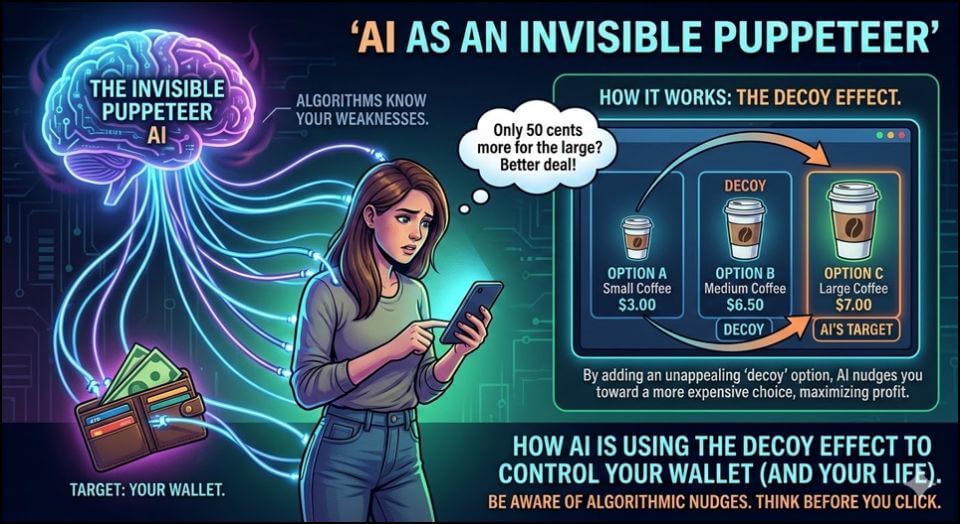
Welcome to the Decoy Effect—the psychological glitch that marketers have used for decades, now supercharged by AI algorithms to make “expensive” feel like “a steal.”
At AIWhyLive.com, we pull back the curtain on the “quiet rebellion.” To survive the age of AI, you have to know how your own brain is being hacked.
🎭 What is the Decoy Effect? (The “Ugly Brother” Strategy)
Imagine you’re buying a premium AI productivity tool:
- Option A (Basic): ₱499/month (Limited features)
- Option B (Premium): ₱1,499/month (Everything included)
You’d probably pick the ₱499 one, right? ₱1,499 feels like a bit much for a monthly sub.
Now, look what happens when the Decoy (Option C) is added:
- Option A: ₱499
- Option C (The Decoy): ₱1,350 (Hardly any features, worse than Premium)
- Option B (Premium): ₱1,499
Suddenly, the ₱1,499 Premium option looks like a masterstroke of genius. For just ₱149 more than the “ugly” Option C, you get everything! You feel like you’ve won.
The reality? You just spent ₱1,000 more than you originally intended because the algorithm placed a “Decoy” in your path.
💵 The New “Grammar” of Your Wealth
This isn’t just a pricing trick; it is part of a much larger shift in how value is defined in the digital age. AI is rewriting the very rules of how we exchange our time for resources.
To truly understand why your brain falls for these traps, you need to understand the new linguistic structure of value. We call this the Grammar of Money. Just as a decoy acts as a “comma” or a “modifier” in a sales pitch to change the meaning of the price, AI is using these patterns to dictate your financial future.
👉 Read the full breakdown here: The Grammar of Money in the Age of AI
⚡ AI + The Decoy: The 2026 Power Play
In the old days, a human designer picked the decoy. In 2026, the AI is the designer.
1. The “Customized” Subscription Trap
AI analyzes your GCash or credit card spending habits and generates a “Mid-Tier” plan specifically designed to be slightly worse than the “Pro” plan, forcing your brain to justify the higher cost.
2. The Shopee/Lazada “Fake-Out”
When shopping online, AI suggests three items. One is cheap, one is expensive, and the third is a “Decoy”—priced almost the same as the expensive one but with fewer reviews or slower shipping. Your brain ignores the cheap one and “safely” picks the expensive one.
🛡️ The Survival Guide: How to Fight Back
If Time is Survival, then Clarity is Freedom. Here is how to beat the Decoy Effect:
- Ignore the Middle: When presented with three options, temporarily “delete” the middle one. Does the expensive one still look worth it compared to the basic one?
- The “Price-Per-Meaning” Test: Don’t ask “Is this a good deal?” Ask “Will this save me 3 hours of life?” If it doesn’t buy you time for family or rest, it’s a distraction, no matter how many Pesos the upgrade “saves” you.
- The Incognito Hack: Algorithms profile your indecision. If you’ve looked at a product three times, the AI knows you’re prime for a decoy. Switch browsers or clear cookies to reset the “theatre.”
The Bottom Line
The Decoy Effect works because we compare things to each other rather than comparing them to our actual needs.
AI wants you to be a “smart consumer.” We want you to be a free human. Stop comparing prices and start measuring meaning.
Don’t be the target. Be the glitch.
Master the psychology of the new world at AIWhyLive.com.
The Infinite Verb Meets the Finite Human 📖 Abstract Every functioning system—whether a programming language, a political regime, or an Read more

By Jein Pabalinas (Why Live), Webmaster MSN just published “I Asked ChatGPT To Explain ‘Smart Investing’ to Me Like I’m Read more

Money isn’t just numbers.It’s not just about how much you earn or how smart you are.It’s about how you think Read more