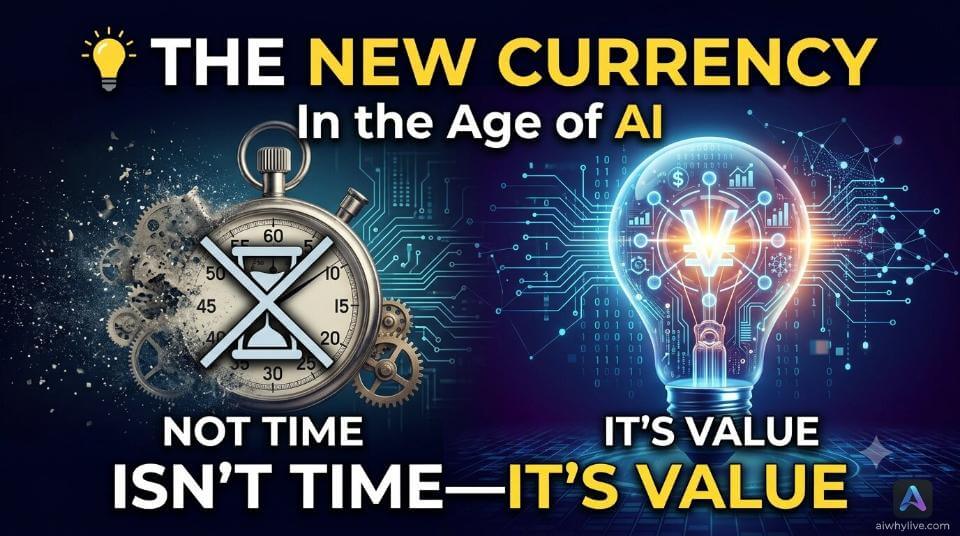
If value is the new currency in the Age of AI, then what happened to time?
Last week, I argued in AIWhyLive that the new currency in the Age of AI isn’t time—it’s value. The response surprised me. Some readers agreed immediately. Others asked a question that quietly lingered in my mind long after I had published the article.
“If value is the new currency, then what happened to time?”
The more I reflected on it, the more I realized I had skipped an important chapter.
Time never stopped being valuable.
Artificial intelligence didn’t replace time. It didn’t manufacture a twenty-fifth hour or persuade the Earth to spin more slowly. Every sunrise still deposits the same twenty-four hours into every human life, regardless of wealth, education, profession, or nationality.
What AI changed wasn’t time itself.
It changed the exchange rate between time and value.
Once you understand that, every hour begins to feel different.
From Data to Value—and Now to Time
About a year ago, I explored another question in AIWhyLive: “Is Data the New Oil in the AI Era?“ At the time, the comparison felt compelling. Oil fueled the Industrial Revolution. Data fuels artificial intelligence. The analogy made sense because AI feeds on data just as engines once depended on oil.
But after another year of living with AI—writing, coding, researching, designing, experimenting, and building almost every day—I realized that data is only the fuel. Fuel is important, but no one drives simply to admire gasoline.
People drive to reach destinations.
Likewise, businesses do not collect data simply to own data. They collect it to create something meaningful.
That “something” is value.
And value cannot exist without one resource that every human possesses in exactly the same amount.
Time.
AI Didn’t Print More Time. It Increased Its Purchasing Power
Economists often speak about purchasing power.
One hundred pesos today does not necessarily buy what one hundred pesos bought years ago. The number printed on the bill remains the same, but what it can accomplish changes over time.
Artificial intelligence is quietly doing something remarkably similar to time.
One hour is still sixty minutes.
A day is still twenty-four hours.
The calendar hasn’t changed.
What has changed is what sixty minutes can accomplish.
An hour that once disappeared into repetitive typing can now become an hour spent refining ideas. Research that previously consumed an afternoon can now take minutes. Brainstorming that once stalled for days can begin with a thoughtful conversation. Coding, outlining, translating, summarizing, and organizing have all become dramatically faster.
The clock never changed.
The purchasing power of an hour did.
That is the exchange rate AI has been quietly rewriting.
The AI Exchange Rate
If I had to summarize this idea in one simple mental model, it would look like this:
Value Yield = Time Invested × Algorithmic Leverage²
Don’t worry.
This isn’t a mathematics lesson.
It’s a way of seeing the world.
Time Invested is the only resource every human receives equally.
Algorithmic Leverage represents how effectively you use AI to remove friction, automate repetition, accelerate learning, and improve decision-making.
The result isn’t merely more output.
It’s greater value produced from exactly the same amount of time.
Notice that leverage is squared.
That isn’t because AI performs one task better.
It’s because improvements compound.
You research faster.
You write better.
You iterate more often.
You correct mistakes earlier.
You experiment more freely.
You launch ideas sooner.
Each improvement strengthens the next, creating a multiplier effect that feels almost magical—not because AI created more time, but because it transformed the value hidden inside every hour.
Filipino Time Meets AI Time
Growing up, I often heard an expression that many Filipinos know by heart.
“Filipino Time.”
We’ve laughed about it for generations.
A meeting scheduled for two o’clock quietly begins at half past two.
Someone says, “I’m almost there,” while still leaving the house.
Guests arrive after the food has already cooled.
It became a harmless cultural joke, but beneath the humor lies something more uncomfortable.
Time is the only resource we can never replenish, yet it is often the easiest to waste.
Perhaps AI offers us an opportunity to redefine what “Filipino Time” means.
Imagine if it no longer described habitual lateness but exceptional preparedness.
Imagine arriving at meetings with summaries already generated, action items already organized, documents already translated, and repetitive work already completed—not because you worked longer, but because you worked differently.
That would be a version of Filipino Time worth exporting to the world.
Explain Like I’m 12
Imagine every morning someone gives you exactly twenty-four gold coins.
You must spend every coin before midnight.
You cannot save them.
You cannot borrow tomorrow’s coins.
Everyone receives exactly the same twenty-four.
Now imagine someone hands you a magical backpack.
The backpack doesn’t create more coins.
Instead, every coin you place inside becomes worth two.
Then four.
Then eight.
Did you receive more coins?
No.
You simply learned how to make every coin accomplish more.
Artificial intelligence is that backpack.
It doesn’t create time.
It multiplies what your time can become.
Busy Is No Longer Impressive
For decades, society admired busyness.
People proudly wore exhaustion like a medal of honor.
“I’m fully booked.”
“I barely slept.”
“I’ve been working sixteen hours.”
Those statements once sounded impressive.
Today they make me wonder something else.
Did those sixteen hours create sixteen hours of value?
Or merely sixteen hours of activity?
Artificial intelligence is quietly exposing a truth many of us have avoided for years.
Movement isn’t always progress.
Activity isn’t always achievement.
Looking busy has never been the same as becoming valuable.
What AI Really Gave Me
People often ask how AI changed my life.
They expect me to talk about writing faster, building websites more quickly, or generating ideas in seconds.
Those things are true.
But they aren’t the greatest gift.
The greatest gift AI gave me wasn’t speed.
It was perspective.
I no longer measure my day by the number of hours I worked.
I measure it by a different question:
“How much value did today’s hours create?”
That single question quietly changed everything.
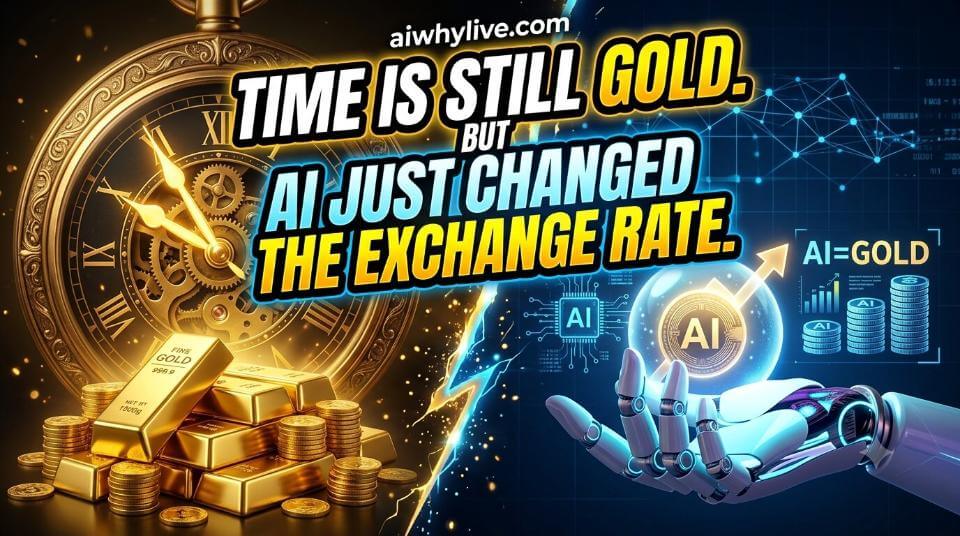
Time Is Still Gold. Value Is Still the Currency.
When I wrote “The New Currency in the Age of AI Isn’t Time—It’s Value,” I thought I had reached the conclusion.
I hadn’t.
That article explained what the future rewards.
This article explains how we reach it.
Time remains the rarest resource every human receives.
Value is what we choose to create with it.
Artificial intelligence stands quietly between the two—not replacing either one, but transforming the relationship between them.
Time is still the gold.
Value is still the currency.
AI simply became the exchange rate.
Final Thought
Every midnight, life deposits exactly twenty-four hours into every human account.
The richest person receives twenty-four.
The poorest person receives twenty-four.
The student receives twenty-four.
The entrepreneur receives twenty-four.
The dreamer receives twenty-four.
The skeptic receives twenty-four.
Artificial intelligence changes none of that.
What it changes is what those twenty-four hours are capable of becoming.
Perhaps that’s why the Age of AI feels so different.
Yesterday, success was often measured by hours worked.
Tomorrow, it will increasingly be measured by value created.
The people who thrive won’t necessarily be the busiest.
They won’t always be the smartest.
They won’t even be the first to adopt every new AI tool.
They will be the ones who understand that AI is not a substitute for human effort but a multiplier of human intention.
Because at the end of every day, the question isn’t how much time you had.
The question is what your time became.
Time is still gold.
Value is still the currency.
Artificial intelligence simply changed the exchange rate.
And perhaps the greatest investment you can ever make is not finding more hours—but learning how to make every hour worth more than it was yesterday.
🕰️ The Classic Time Trap Long before smartphones and social feeds, people already struggled with time. The factory clock dictated Read more
“Last year, I asked whether data had become the new oil in the Age of AI. Today, I think I Read more
Why scarcity can be leverage, and simplicity can be wealth. The real flex in 2026 isn’t how many tools you Read more