By 2030, AI won’t just be a tool—it will decide who thrives and who gets replaced. From students to retirees, sari-sari store owners to OFWs, the question is no longer “Will AI affect me?” It’s “Which free AI tools and skills will protect my job, grow my business, and keep me unreplaceable?”
🧠 Why This Matters
The digital landscape in the Philippines is shifting from “manual labor” to “intellectual leverage.” If your daily tasks can be described in a three-step manual, a free AI model can already do it faster. Survival in the 2026 economy requires moving from being a worker to being an architect of AI systems.
Many daily tasks today can already be done faster by AI.
For example:
- Writing simple reports
- Answering customer questions
- Translating basic text
- Organizing spreadsheets
If your job mostly follows clear step-by-step instructions, AI can probably assist—or replace—part of it.
That’s why learning AI tools now is not optional. It’s becoming a basic digital survival skill.
📉 The Hit List: Jobs AI Will Replace First
If your career falls into these categories, the “grace period” is ending. These roles are being automated by localized, low-cost AI models:
- Routine Clerical & Admin: Basic filing, scheduling, and standard report generation.
- Generic Customer Support: Troubleshooting that doesn’t require deep emotional nuance or complex problem-solving.
- Repetitive Data Entry: Any job that involves moving information from one spreadsheet to another.
- Literal Translation: Basic language conversion that ignores Philippine cultural context and local dialects.
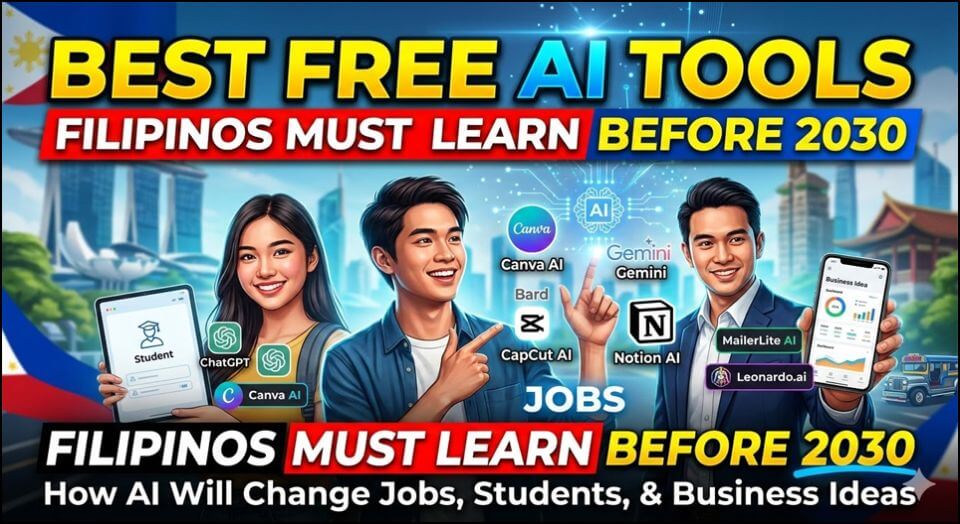
🛠️ The 2026 “Diskarte” Stack: Best Free AI Tools
The 2026 “Diskarte Stack”: Free AI Tools to Learn
The good news is that many powerful AI tools are free to start using. To stay unreplaceable, you must master the “Free Tiers” of these essential technologies:
AI Study Assistants (for students)
Tools like NotebookLM or specialized AI tutors can help explain difficult topics, summarize lessons, and act like a personal study partner.
Automation Tools (for micro-business owners)
Platforms like Zapier or Make allow small businesses to automate simple workflows.
Example:
A Facebook order can automatically update your inventory spreadsheet.
AI Chatbots (for customer service)
Small businesses can now use chatbots to answer common questions on Messenger or websites, reducing the need for 24/7 manual replies.
🚀 High-Growth AI Business Ideas for Filipinos
Stop looking for a job—start an “Invisible Engine.” These are 4 scalable business models with near-zero startup capital:
1. AI-Powered Sari-Sari Store Inventory
Build or set up simple camera-based AI tools that track stock levels via a smartphone. Offer this as a “Digital Upgrade” service to local neighborhood stores.
2. Localized Tutoring Bots
Global AI models don’t understand the K-12 curriculum in the Philippines perfectly. Create and “prompt-engineer” specialized bots that help Filipino students pass local board exams or entrance tests.
3. Barangay-Level Digital Assistants
Help local government units (LGUs) or community leaders automate permit inquiries, event schedules, and emergency broadcasts using free AI-driven messaging tools.
4. OFW-Focused Financial Planning
Develop AI-driven templates that help OFWs track remittances, calculate inflation-adjusted savings, and plan for their return to the Philippines using localized financial data.
🏁 The Unreplaceable Mindset: The Skill AI Cannot Replace
AI can generate answers, but it cannot replace:
- Local knowledge
- Community connections
- Cultural understanding
- Creative problem-solving
Those human strengths will remain valuable.
AI cannot replace your local network, your cultural intuition, and your ability to solve problems that don’t have a manual.
The smartest strategy is simple:
Learn to work with AI instead of competing against it.
Master the tools today, or be managed by someone who did.
For more deep dives into the tools that actually matter for the Philippine economy, visit AIWhyLive.com.
When OpenAI announced its vision of “expanding economic opportunity with AI,” it sounded like a global salvation story. AI, they Read more
For decades, Filipinos have carried a powerful belief: go to college, earn a diploma, and success will follow. Families sacrifice, Read more

Your Degree Won’t Save You. Your Skills Will. 🚨 WAKE-UP CALL: YOUR JOB IS ON THE CHOPPING BLOCK You spent Read more
Sam Altman’s Contradiction Explained (And How Filipinos Can Win Anyway) 🚨 The Great Career Paradox of 2024 OpenAI CEO Sam Read more