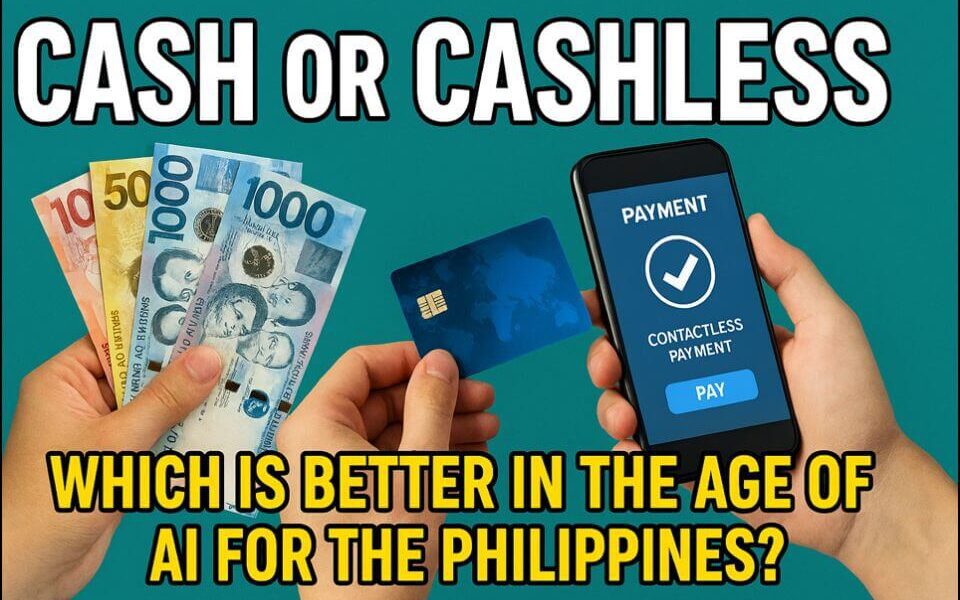
In the fast-evolving landscape of 2026, the Philippines stands at a unique financial crossroads. For decades, physical currency has been the lifeblood of the archipelago, but the integration of Artificial Intelligence and digital infrastructure is challenging the status quo. This report analyzes the data-driven reality of Filipino transactions in both private and public sectors.
🧠 Background
For generations, cash has been the undisputed backbone of Filipino daily life. From the clinking of coins for jeepney fares to the folded bills handed over at sari-sari store windows, “pera” was synonymous with physical paper. However, by 2026, a surge in digital wallets, standardized QR codes, and government-mandated e-payment systems has fundamentally reshaped the national economy. We are no longer moving toward a cashless society, but rather a “cash-lite” hybrid ecosystem.
⚡ Data Snapshot: The 2026 Landscape
| Aspect | Cash (Physical) | Cashless (Digital) |
|---|---|---|
| Usage Rate | Dominant in rural areas; 87% used cash in 2023 (down from 96% in 2022). | Surging in urban hubs; mobile wallets are now a primary financial tool for over 80M Filipinos. |
| Private Sector | Preferred in micro-businesses, wet markets, and areas with inconsistent signal. | Default for malls, e-commerce, and food delivery; AI-driven logistics favor digital settlement. |
| Gov. Transactions | Still required at many local desks for small fees and permits. | National agencies (SSS, Pag-IBIG, PhilHealth) now prioritize e-payment portals and mobile wallet integration. |
| Reliability | 100% offline uptime; no signal or battery required. | Dependent on internet/4G/5G; transactions may stall during high-traffic or connectivity drops. |
| Trust & Security | Tangible and familiar; immune to digital hacking but prone to physical theft. | Offers traceability and history; secured by AI biometrics but vulnerable to sophisticated phishing/scams. |
| Current Trend | Declining but highly resilient in the informal and rural economies. | Rising steadily among Gen Z, Millennials, and urban professionals. |
🎭 Everyday Realities: The Local Experience
The efficiency of a payment method in the Philippines is often determined by the environment of the transaction:
- Public Transport: Jeepney and tricycle rides remain overwhelmingly cash-based. While QR Ph pilot programs have been launched in Metro Manila, the speed of “abot-bayad” (passing fare) still outpaces digital scanning in crowded vehicles.
- The Sari-Sari Ecosystem: In urban neighborhoods, AI-assisted supply chain apps have encouraged shop owners to accept digital payments. However, in rural provinces, cash remains the only viable medium due to the “tingi” (fractional) nature of sales.
- Government Bureaucracy: National agencies have made massive strides; paying for a passport is now faster via digital portals. Conversely, many municipal offices still operate on a “cash na lang po” basis.
- Consumer Commerce: In major malls, cashless is the standard. Interestingly, “Cash on Delivery” (COD) is seeing a sharp decline as AI-backed buyer protection programs increase consumer trust.
🤖 The Role of AI in the Transition
AI is the silent engine driving the cashless side of the balance sheet. For those looking to master their digital finances, exploring AI Money Control in the Philippines provides essential insights into how algorithms are helping Filipinos manage their daily budgets.
- Smart Wealth Management: Modern Filipinos are moving beyond simple savings. By adopting Smart Investing Filipino Style, many are using AI-driven robo-advisors to navigate the local stock market and crypto-assets.
- Financial Inclusion: AI algorithms now calculate credit scores based on mobile load consumption, allowing the “unbanked” to access micro-loans without traditional bank accounts.
- The Emotional Quotient: As we move toward digital automation, the debate continues on whether digital ease leads to true satisfaction. Insights on Money vs. AI Happiness in 2026 suggest that while cashless systems offer efficiency, the psychological value of “tangible” money still plays a role in Filipino culture.
📢 Balanced Conclusion
In 2026, the question is not whether one is “better,” but which is more appropriate for the specific Filipino context.
- Cash remains the champion of reliability, inclusivity, and familiarity. It ensures that even the most remote citizen can participate in the economy.
- Cashless represents convenience, traceability, and modern efficiency. It is the gateway to the global digital economy and streamlined government services.
The Filipino reality is a robust hybrid. Cash and cashless co-exist, shaped by the practicalities of connectivity, the evolution of trust, and the accessibility of infrastructure.
Can Money Buy Happiness, or Just More Loneliness in the Age of AI? 📖 Abstract: The Currency of Illusion For Read more
Why Survival Requires Suspicion in the Age of Simulation 📖 Abstract: The Security of the Skeptic By 2026, paranoia is Read more
The Infinite Verb Meets the Finite Human 📖 Abstract Every functioning system—whether a programming language, a political regime, or an Read more

How to Survive (and Get Rich) When Algorithms Control Everything 🚨 WAKE UP CALL: YOUR FINANCIAL LIFE IS ALREADY BEING Read more