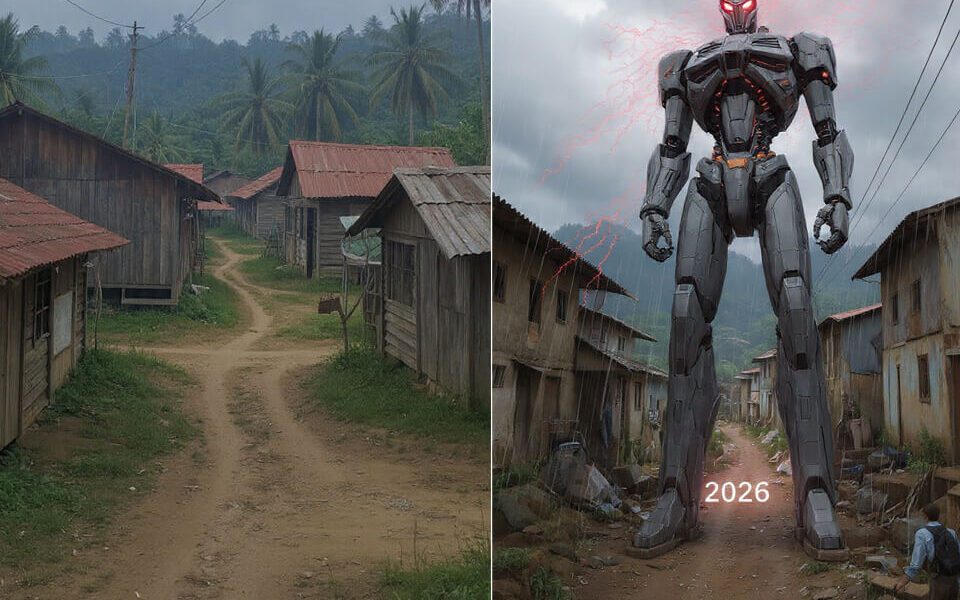
The paradox of inequality has haunted every generation: the poor remain trapped, the rich keep climbing. In 2026, the script hasn’t changed—but the stage has.
📖 The Abstract: Old Story, New Tools
For decades, we’ve been told that “hard work” is the primary engine of upward mobility. But by 2026, the data tells a colder story. Global inflation, precarious gig-work cycles, and algorithmic gatekeeping have created a ceiling that feels more like a vault door.
Yet, beneath the surface of this widening chasm, a disruptive force has reached terminal velocity. Artificial Intelligence is no longer a “tech trend”—it is the new infrastructure of reality. The viral question of our time is no longer “Will AI take our jobs?” but rather: Will AI be the ultimate weapon for the elite, or the Great Equalizer for the rest of us?
📉 1. The Anatomy of the Chasm: Why the Poor Stay Poorer
In 2026, poverty isn’t just a lack of cash; it’s a Systemic Lock-In powered by three distinct traps:
- The Debt & Subscription Trap: Between “Buy Now, Pay Later” schemes and the “Subscription-ification” of everything (from software to heated car seats), the poor are paying a “poverty premium.” They pay more for the same goods because they lack the capital to buy in bulk or own assets outright.
- Information Asymmetry: Historically, the rich buy consultants, lawyers, and strategists. The poor rely on fragmented, outdated, or “engagement-optimized” (fake) advice from social media algorithms. By the time a trend reaches the bottom, the cream has already been skimmed.
- Time Poverty: When you are working three “human-in-the-loop” gig jobs to keep up with inflation, you have zero bandwidth for strategic planning. The poor are forced to trade Time for Survival, leaving no time for Growth.
📈 2. The Multiplier Effect: Why the Rich Get Richer
While the working class trades time for money, the 2026 elite have mastered Leverage.
- Capital vs. Wages: Wealth in 2026 multiplies through automated investments and equity, not hourly rates. The rich aren’t working harder; their assets are working at the speed of light.
- The Automation Edge: High-net-worth individuals and large corporations have been the first to deploy “Agentic Swarms.” They use AI to cut 40% of their operating costs while doubling their output. They are widening the productivity gap into a canyon.
- The Network Effect: Access to elite circles is now augmented by AI. The rich use “Relationship Management AIs” to maintain thousands of high-value connections, ensuring they are always first in line for new opportunities.
🎭 3. Enter AI: The “Great Equalizer” Potential
If the story ended there, 2026 would be a dystopia. But AI contains a “glitch” in the system of inequality: It scales intelligence, not just capital. Here is how AI flips the script:
🧠 Knowledge Democratization (The End of the “Consultant Gap”)
In 2024, you needed $500/hour to talk to a top-tier business strategist. In 2026, a fine-tuned AI model (like Gemini 2.5) provides Ivy League-level insights for the cost of a Netflix subscription. For the first time, the “Playbook of the Rich” is open-source.
🚀 The Solo-Corp Revolution (Scaling Without Permission)
Previously, starting a business required a marketing team, a bookkeeper, and a coder. Today, AI-powered tools allow a single parent in a studio apartment to run a global e-commerce brand or a high-tech consultancy. AI handles the SEO, the bookkeeping, and the customer service, allowing the individual to compete with a Fortune 500 company on quality and speed.
⏳ Time Liberation
AI-driven automation is the first technology that can actually “give back” time. By automating the drudge work—scheduling, research, data entry, and basic writing—AI frees up the “Cognitive Bandwidth” that was previously stolen by the struggle for survival.
🧒 Explain Like I’m 12 (The Bicycle Metaphor)
Imagine two kids are in a race to the top of a giant hill.
- One kid has a Carbon-Fiber Racing Bike (The Rich).
- The other kid is Running Barefoot (The Poor).
The barefoot kid will lose every single time, no matter how hard they try. They might even give up.
AI is the “Electric Motor” that we just found in the bushes. If the barefoot kid attaches it to a rusty old frame, they can suddenly go just as fast as the racing bike. It doesn’t guarantee the kid will win, but it means the race is no longer decided by who can afford the fancy shoes at the start. For the first time, the race is about who knows how to steer.
📢 The Punchline: The Viral Truth
In 2026, inequality is still the default setting. The systems—banking, education, and labor—are still designed to keep the poor paying and the rich collecting.
But AI cracks the design. AI is the only tool in history that can turn a small voice into an amplified movement and a few hours of spare time into a digital empire.
The Viral Truth: AI won’t automatically save you. If you use it to watch more “brain-rot” content, you will stay in the vault. But if you wield it with discipline, AI is the first real lever in 200 years that can actually bend the arc of inequality.
The chasm is wide, but the bridge is now digital. Will you cross it?
Stay ahead of the shift. Join the movement at AIWhyLive.com.

And What Rich Countries Have That We Don’t 🧭 Intro: When Shame Is the Currency of Survival My Philippines is Read more

AI and Philippine Politics: Part 3 > “Blessed are ye poor: for yours is the kingdom of God.” > — Read more
Introduction: The Timeless Wisdom of Robert Kiyosaki Robert Kiyosaki’s Rich Dad, Poor Dad has shaped financial mindsets for decades, teaching Read more
Why Survival Requires Suspicion in the Age of Simulation 📖 Abstract: The Security of the Skeptic By 2026, paranoia is Read more